
 Syeda Yasmeen
Health & Wellness Writer Syeda Yasmeen creates clear and
reader-focused content covering health,
nutrition, wellness, women’s health,
men’s health and babies’ health.
Read Full Bio of Author →
Syeda Yasmeen
Health & Wellness Writer Syeda Yasmeen creates clear and
reader-focused content covering health,
nutrition, wellness, women’s health,
men’s health and babies’ health.
Read Full Bio of Author →
 Sameena Begum
Health, Technology & Digital Content Reviewer Sameena Begum reviews selected content
for clarity, factual presentation,
consistency and reader usefulness.
Read Full Bio of Reviewer →
Sameena Begum
Health, Technology & Digital Content Reviewer Sameena Begum reviews selected content
for clarity, factual presentation,
consistency and reader usefulness.
Read Full Bio of Reviewer →
For women who have had a cesarean and are now pregnant again, the question of how to give birth this time rarely has a simple answer. There are risks to understand, eligibility criteria to work through, and strong opinions coming from every direction. But once the initial research is done, most women arrive at the same practical question: does it actually matter where I give birth?
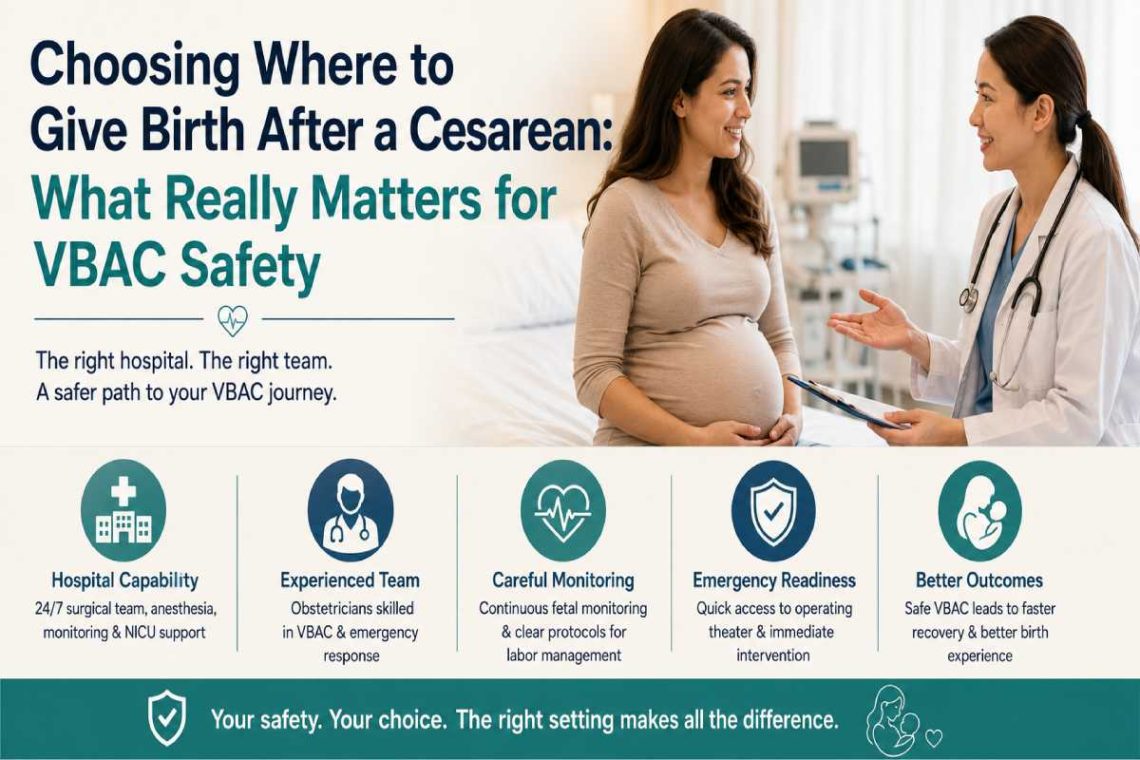
The answer is yes, significantly. For vaginal birth after cesarean (VBAC), the hospital you choose and the team caring for you can influence your outcome just as much as your individual medical profile. That aspect of the decision often gets less attention than it deserves.
What VBAC Actually Involves
VBAC refers to delivering vaginally following a previous birth by cesarean section. For a long time, the default medical position was that a cesarean in one pregnancy meant a cesarean in every subsequent pregnancy. That thinking has changed considerably. Research now supports VBAC as a medically reasonable option for many women, and in the right circumstances it can carry fewer risks than a repeat surgical delivery.
That said, VBAC is not simply a preference. It is a closely monitored medical process that requires specific conditions, a properly equipped facility, and a care team with the experience to manage it well. This is why two women with identical medical histories might receive very different recommendations depending on where they seek care.
Who Is a Candidate?
Eligibility for VBAC is assessed individually, but some general factors apply. Women who tend to be suitable candidates include those who had a low transverse uterine incision in their previous cesarean, which is the most common type and carries the lowest risk in a subsequent labor. Having only one prior cesarean, no current pregnancy complications, and spontaneous onset of labor also tend to support candidacy.
Factors that may make VBAC less appropriate include a previous uterine rupture, a vertical or classical incision from the prior surgery, or certain structural concerns with the pelvis or uterus. The reason for the original cesarean also matters. Your provider will look at the full picture, including your current pregnancy, before making a recommendation.
The Risk That Shapes Every VBAC Conversation
The central concern in VBAC planning is uterine rupture, which occurs when the scar from a previous cesarean tears during labor. It is uncommon, with most studies placing the risk at around 0.5% to 1% for women with a single low transverse incision. But when it does happen, the response needs to be immediate. The outcome depends almost entirely on how quickly the care team can act.
This is not intended to discourage VBAC. The majority of appropriate candidates attempt it successfully. But it is the reason why hospital capability is so central to any honest discussion of VBAC safety. A facility that cannot respond to this emergency swiftly is one where VBAC carries considerably more risk.
Why Hospital Capability Changes Everything
For a hospital to support VBAC safely, certain things need to be in place: continuous fetal monitoring throughout labor, experienced obstetricians available at all times, 24-hour access to a surgical team and operating theater, anesthesia on standby, and a neonatal unit equipped to receive the baby if needed.
Not every hospital can offer all of this consistently. Smaller facilities, rural hospitals, or those with limited staffing may simply not be able to guarantee the level of readiness that VBAC requires. In those settings, a recommendation for repeat cesarean is not arbitrary. It reflects the honest limits of what the facility can safely support.
When a hospital does have these capabilities in place, and a team with genuine VBAC experience, the picture looks quite different. The same patient who is told VBAC is not available at one facility may find it actively supported at another.
Questions Worth Asking Before You Decide
If you are considering VBAC, the most useful step you can take is asking specific questions of the hospital where you plan to give birth. General statistics matter less than the specifics of your situation and the reality of that facility’s capabilities.
Ask whether the hospital actively supports VBAC or handles it only on an ad hoc basis. Ask how quickly the surgical team can mobilize in an emergency and whether there is a defined protocol. Ask how labor is monitored in VBAC cases and what thresholds trigger a recommendation for cesarean. Ask how experienced the team is with VBAC specifically, not just with deliveries in general.
A hospital that welcomes these questions and answers them clearly is one worth taking seriously. One that deflects or gives only vague reassurances is worth examining more closely.
When Local Options Feel Limited
Some women discover that VBAC is unavailable or actively discouraged at the hospital nearest to them, even when they are clinically suitable candidates. This can be due to hospital policy, liability concerns, staffing constraints, or simply a lack of experience with VBAC cases in that setting.
For women in this position, looking beyond their immediate area is a reasonable response. This might mean traveling to a larger center or, for those in parts of Southeast Asia, seeking care at an internationally accredited hospital with a dedicated maternal health program. The goal is not to avoid safety. It is to find a setting where safety and choice can genuinely coexist.
How Labor Management Affects Outcomes
One of the most common misconceptions about VBAC is that success depends mainly on the body being ready. In reality, how labor is managed plays a significant role.
For example, certain labor-inducing medications carry a higher rupture risk in VBAC cases and require careful management. The timing of interventions matters too. A team that moves too quickly to cesarean at the first sign of slow progress may reduce VBAC success rates without meaningfully improving safety. A team that waits too long when genuine warning signs appear creates a different problem. Getting that balance right requires experience and good clinical judgment.
Clear communication throughout labor also makes a real difference. Women who are kept informed and feel supported during VBAC labor tend to have better experiences and, in many studies, better outcomes.
Asking a Better Question
Most of the conversation around VBAC gets framed as a binary choice: vaginal birth or repeat cesarean. But for many women, the more useful question is a different one: where can this be done safely, given my specific history and the capabilities of the facilities available to me?
That shift in framing changes what you look for. Instead of reading general statistics, you start evaluating specific hospitals, teams, and protocols. The goal is to identify the setting where your chances of a good outcome are genuinely highest, not just the one that is most convenient or most familiar.
If you are researching your options seriously, it is worth going beyond general reading and speaking directly with an obstetrician experienced in VBAC cases. For a thorough clinical overview of how eligibility is assessed, what labor management looks like, and how risks are evaluated, the VBAC guide published by Samitivej Hospitals is a detailed and reliable starting point. The decision deserves specific, honest, and well-informed guidance from a team that has the experience to back it up.
Sameena Begum
Sameena Begum reviews content for clarity, accuracy and reader usefulness. Her review process helps ensure that published information is clearly presented, relevant and easy for readers to understand.
Syeda Yasmeen
Syeda Yasmeen is a Health & Wellness Writer at InHumanBeing.com. She creates clear and reader-focused content across health, nutrition, wellness, women’s health, men’s health and babies’ health.