

 Syeda Yasmeen
Health & Wellness Writer Syeda Yasmeen creates clear and
reader-focused content covering health,
nutrition, wellness, women’s health,
men’s health and babies’ health.
Read Full Bio of Author →
Syeda Yasmeen
Health & Wellness Writer Syeda Yasmeen creates clear and
reader-focused content covering health,
nutrition, wellness, women’s health,
men’s health and babies’ health.
Read Full Bio of Author →
 Sameena Begum
Health, Technology & Digital Content Reviewer Sameena Begum reviews selected content
for clarity, factual presentation,
consistency and reader usefulness.
Read Full Bio of Reviewer →
Sameena Begum
Health, Technology & Digital Content Reviewer Sameena Begum reviews selected content
for clarity, factual presentation,
consistency and reader usefulness.
Read Full Bio of Reviewer →
When aiming to build muscle, gain strength, or recover from injuries quickly, you might consider the question of Best Time to Take Muscle Building Supplements. If protein is consumed right after a workout, is it too good to be true? Does creatine work better before or after your workout? How many minutes before exercising should you do a pre-workout?
The bright spot here is that, generally, supplement timing is not as complicated as it seems on social media. Consistency is more important than hitting a perfect minute on the clock, as are your overall diet, overall protein intake per day, progressive resistance training, sleep, and everything else.
However, supplements can be even easier to take, and, in certain cases, allow you to reap greater rewards from your workout, when used at the right time. It will tell you when to use protein powder, creatine powder, pre-workout and post workout supplements, and give you a basic schedule you could follow every day.
❝
This article is part of
Men’s Muscle Building Hub
Does Supplement Timing Matter?

Yes but not the same for every supplement.
Some supplements will serve to keep nutrients in the body for a long time, while others are to produce some kind of acute effect around exercising.
Creatine, for instance, increases and sustains muscle creatine stores and slowly builds up over time. It’s not a big deal if you take it at 7 a.m., rather than 7 p.m.
Caffeine is different. It is a good idea to take it prior to training as it impacts on alertness and exercise performance acutely.
For a complete overview of supplement options, explore our men’s muscle-building supplements guide to see how different supplements can fit into a structured training routine.
Timing Priority
| Factor | Importance for Muscle Growth |
| Total daily protein | Very high |
| Progressive resistance training | Very high |
| Total calorie intake | Very high |
| Sleep and recovery | Very high |
| Creatine consistency | High |
| Protein distribution | Moderate to high |
| Pre-workout timing | Moderate |
| Exact post-workout timing | Lower |
So you’ll want to avoid taking a supplement at the “optimal” time if it means you aren’t eating a good meal or getting a good restful night’s sleep.
The Simple Rule
Consider supplementation in three categories:
- Take daily supplements: Practice is practice.
- Pre workout supplements: Prioritize timing of exercise.
- Recovery supplements: Focus on meeting your nutritional needs after training.
Protein Timing
Timing protein has garnered much interest due to a rise in muscle protein synthesis following resistance training.
But the most important is the total amount of protein you eat for the day.
The typical recommended protein goal of 1.4-2.0 g/kg per day seems to apply to active men, who may require more in some situations depending on their aims and activity levels.
The best time to take protein is after a workout.
Protein is a key part of many muscle-building nutrition plans, so learn more about protein powder for muscle building and how it can complement your daily protein intake.
When Should You Take Protein?
Useful times include:
- Breakfast
- Between meals
- Before training
- After training
- Before bed
It’s not always necessary to eat all of your protein at once; you can spread it throughout the day.
Protein Before a Workout
Before working out, a high-protein snack or meal can give you protein during and after exercise.
Examples include:
- Greek yogurt topped with fruit
- Eggs on whole-grain toast
- Chicken and rice
- Protein smoothie
- Cottage cheese with berries
It might not be necessary to have a protein shake right before training if you’ve consumed a meal that contains protein several hours before.
If you’re considering creatine as part of your training routine, explore this guide to creatine for muscle building to understand its role alongside resistance training.
Protein After a Workout
It’s easy to use post workout protein, especially when the next meal is a few hours away.
For most men, eating a serving with about 20–40 grams of good protein is a good amount, though the right amount depends on how much protein they eat each day and their body size.
Protein Before Bed
If you require extra protein or a long period between dinner and breakfast, you may find it helpful to eat casein or another protein-based food before going to bed.
Examples:
- Cottage cheese
- Greek yogurt
- Casein protein shake
- Milk
Therefore, the best time to take muscle building supplements is partly related to your daily routine. Protein can be consumed at multiple different points throughout the day if you are getting enough protein.
For supplements commonly used before exercise, explore these pre-workout supplements and learn how they may fit into your workout schedule.
Creatine Timing
Creatine does not have to have an immediate effect, unlike caffeine.
It is mainly used to boost and maintain muscle creatine stores in the long-term.
When Should You Take Creatine?
For most people, the easiest approach is:
3–5 grams every day.
You can take it:
- Before training
- After training
- With breakfast
- With lunch
- With your protein shake
The secret is “consistency”.
Pre-Workout Creatine
Creatine is a type of amino acid that is found in some pre-workout supplements.
OK, but don’t expect creatine to have the same effect as caffeine. It doesn’t have to be used before exercise in order to see long-term benefits.
Recovery is just as important as training, so explore these post-workout supplements to learn about options used after exercise.
Post-Workout Creatine
It is also quite convenient to take creatine after a workout in a protein shake.
For example:
Post-workout shake:
- Whey protein
- 3–5 g creatine monohydrate
- Banana
- Milk or plant-based milk
This can help you remember to take creatine.
Rest-Day Creatine
Continue taking creatine on rest days.
It can just be consumed as usual with any meal.
Loading Phase
Others take a brief loading period of around 20 g a day in several small doses over 5-7 days then 3-5 g a day.
However, loading isn’t required.
The muscle will also begin to store creatine at the rate of 3-5 g per day, but this will occur more slowly.
If you’re comparing amino acid supplements, explore BCAAs vs EAAs to understand the differences and how they may fit into your overall supplement routine.
Pre-Workout Timing
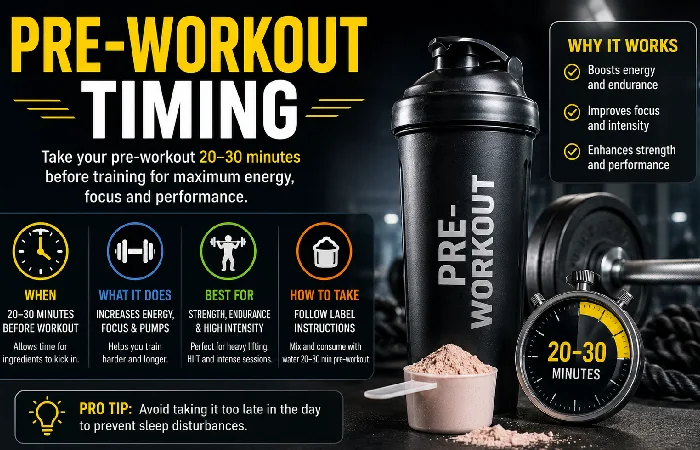
Pre-workout supplements are taken before exercises, but the best time to take them depends on the ingredients of the supplement.
The most critical factor that you need to take into account is typically caffeine.
Caffeine Timing
- Caffeine is generally taken 30-60 minutes prior to exercise.
- This will allow it to work for you before your training session.
- But some people are more sensitive to caffeine than others.
Common Pre-Workout Ingredients
| Ingredient | Typical Timing Consideration |
| Caffeine | About 30–60 minutes before |
| Citrulline | Usually before exercise |
| Beta-alanine | Consistency matters more than exact timing |
| Creatine | Daily consistency |
| Electrolytes | Before/during exercise when needed |
Morning Training
For those who train in the morning, a pre-workout with caffeine may come in handy.
If less caffeine is enough, you don’t have to go with a high-stimulant formula, though.
Evening Training
Limit caffeine in the later part of the day.
Caffeine disrupts sleep, which can have a detrimental impact on performance, recovery and health.
If you’re training late, then think about:
- A caffeine-free pre-workout
- A lower-caffeine formula
Training without the use of a stimulant.
Don’t Stack Stimulants
Take precautions with combinations:
- Pre-workout
- Coffee
- Energy drinks
- Caffeine tablets
- Other stimulant-containing supplements
Don’t just focus on the caffeine in your pre-workout; remember it’s all the caffeine you consume throughout the day.
Post-Workout Timing
There is an exaggerated notion of an “anabolic window”.
There is no need to take a protein shake within 5-10 minutes of your final set for muscle build.
Rather, concentrate on general nutrition and what you eat in relation to training.
What to Prioritize After Training
A good post-workout routine may include:
Protein + carbohydrates + fluids
For example:
Option 1: Chicken + rice + vegetables
Option 2: Whey protein + banana + oats
Option 3: Greek yogurt + berries + granola
Option 4: Eggs + potatoes + vegetables
When Post-Workout Nutrition Matters More
The more relevant timing occurs when:
- You trained fasted
- Your next meal is several hours away
You train several times a day!
You finished an endurance exercise.You finished a long endurance exercise.
You’re on a difficult training regimen
If you have taken a balanced meal with the protein content before training then you don’t need to be too concerned about having a post workout shake.
Hydration
Don’t forget fluids.
After a physical exertion, replace fluids according to the amount you have lost through your exercise.
Electrolytes may be useful following:
- Long workouts
- Heavy sweating
- Hot-weather training
- Endurance sessions
Regular exercise classes or meals should be enough for many normal sessions.
Sample Daily Schedule
An example of a man’s supplement routine for an evening strength workout is provided.
| Time | Meal/Supplement | Purpose |
| 7:30 AM | Eggs + oatmeal + fruit | Protein + energy |
| 10:30 AM | Greek yogurt + berries | Protein snack |
| 1:00 PM | Chicken + rice + vegetables | Balanced lunch |
| 4:30 PM | Banana + yogurt | Pre-workout fuel |
| 5:30 PM | Pre-workout, if needed | Energy/focus |
| 6:00 PM | Strength workout | Resistance training |
| 7:15 PM | Protein + creatine | Convenient recovery nutrition |
| 8:00 PM | Salmon + potatoes + vegetables | Complete meal |
| 10:00 PM | Greek yogurt/cottage cheese | Optional protein |
Simple Supplement Schedule
If you like a simple exercise regime:
Morning:
If necessary, add them to the supplement.
Before workout:
Pre-workout/caffeine if appropriate.
After workout:
Protein if needed.
Any time daily:
3–5 g creatine.
Throughout the day:
- Appropriate hydration and nutritious foods.
- This is a simpler supplement regimen to follow than a complex one.
Rest Day Example
The supplement regimen doesn’t need to be carried out on a rest day either.
Focus on:
- Adequate protein
- Balanced meals
- Hydration
- Sleep
If using, take creatine every day
Pre-workouts are not required when you’re not working out.
Frequently Asked Questions
When is the optimum time for muscle building supplements?
No “one universal time. Protein should be spread out over the day, creatine should be taken on a regular basis, and pre-workout supplements with stimulants are usually consumed before workouts.
When and how much protein should I eat before or after exercise?
Either can work. If you have consumed protein before exercise, you might not require the protein shake immediately following you exercise. Protein after exercise can be helpful if the next meal is a long time in the future.
When should you take creatine: before or after exercise?
Either is fine. It’s the consistency of daily intake that is important, rather than the exact timing.
When should I take pre-workout before a workout?
With products that contain caffeine, about 30 to 60 minutes prior to physical activity. Be sure to follow the product label and take into account your caffeine sensitivity.
Are there any supplements to take on rest days?
If you are using creatine it is best to take it every day. Protein supplements are not a must, and may be used as needed to meet your 20+20 target for protein each day.
In reality, is the post-workout anabolic window a thing of the past?
Muscle is still responsive for several hours after training for protein, compared to just a few minutes after working out. Focus on getting enough protein per day and eating smart meals that surround your workouts, instead of getting caught up in a small window.
Conclusion
You don’t need to have a complex timetable for taking muscle building supplements to find the best time for them. Progressive resistance training, proteins, calories, quality sleep, and consistent recovery, are still the most effective factors for building muscle.
As for protein, it is important to mainly get enough of it on a daily basis and spaced throughout the day. You can take creatine any time of the day, as long as you’re consistent. Caffeine-based pre-workout supplements are generally best consumed before workouts, and protein and carbs can be utilized for recovery if the next meal is not readily available.
The optimal supplement regimen is the one that you can stick with. Rather than fretting over the optimum time to eat and exercise, establish a schedule that incorporates the food and exercise segments into a simple routine, select supplements that serve a specific purpose, and allow your food and training plan to do the rest.
Sameena Begum
Sameena Begum reviews content for clarity, accuracy and reader usefulness. Her review process helps ensure that published information is clearly presented, relevant and easy for readers to understand.
Syeda Yasmeen
Syeda Yasmeen is a Health & Wellness Writer at InHumanBeing.com. She creates clear and reader-focused content across health, nutrition, wellness, women’s health, men’s health and babies’ health.