
 Syeda Yasmeen
Health & Wellness Writer Syeda Yasmeen creates clear and
reader-focused content covering health,
nutrition, wellness, women’s health,
men’s health and babies’ health.
Read Full Bio of Author →
Syeda Yasmeen
Health & Wellness Writer Syeda Yasmeen creates clear and
reader-focused content covering health,
nutrition, wellness, women’s health,
men’s health and babies’ health.
Read Full Bio of Author →
 Sameena Begum
Health, Technology & Digital Content Reviewer Sameena Begum reviews selected content
for clarity, factual presentation,
consistency and reader usefulness.
Read Full Bio of Reviewer →
Sameena Begum
Health, Technology & Digital Content Reviewer Sameena Begum reviews selected content
for clarity, factual presentation,
consistency and reader usefulness.
Read Full Bio of Reviewer →
 Dr. Khizrana Begum
General Physician and Dermatologist Dr. Khizrana Begum is a qualified medical
professional with MBBS and MD qualifications
and 5+ years of experience. She reviews health
and wellness content for medical accuracy,
clarity and responsible presentation.
Read Full Bio of Medical Reviewer →
Dr. Khizrana Begum
General Physician and Dermatologist Dr. Khizrana Begum is a qualified medical
professional with MBBS and MD qualifications
and 5+ years of experience. She reviews health
and wellness content for medical accuracy,
clarity and responsible presentation.
Read Full Bio of Medical Reviewer →
Creatine is the most studied and widespread sports supplement in the world. If you are new to the gym or a veteran, you have no doubt heard how it can benefit build strength, boost muscle mass and enhance exercise performance. However, on the Internet, there is so much info available that it is easy to get confused about the effects of creatine, the amount of creatine to take, and whether it is safe.
In this post you can discover, guide to Benefits, dosage and safety will cover all you essential to know in a simple way. What is creatine, how it benefits muscles grow, the optional dosage, the creatine loading phase, some common myths about creatine, and significant safety considerations. At the end of the day, you will know if creatine is a suitable supplement for your fitness goals.
Remember, creatine is not a cure-all solution. Strength training, a well-balanced diet, hydration, and adequate sleep continue to be the basis of muscle growth and athletic performance. Creatine just assists the efforts.
❝
This article is part of
Men’s Muscle Building Hub
What Is Creatine?
Creatine is a natural substance that is bent from three amino-acids: Arginine, Glycine and Methionine. It is synthesized in your liver, kidneys and pancreas, and is stored in your muscles.
Creatine can also be found in foods like:
- Beef
- Chicken
- Pork
- Fish
- Seafood
The amount that can be obtained through foods, however, is a small amount in comparison to what many athletes are taking as supplements.
How Creatine Works
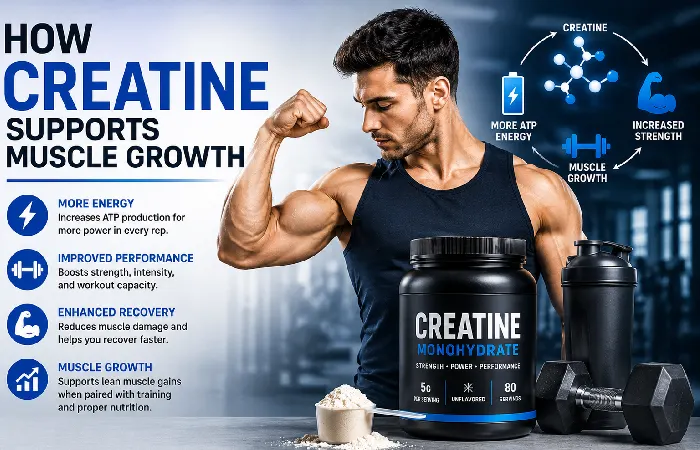
Creatine assists your muscle cells to produce energy during quick, intense exercises.
It raises phosphocreatine levels, thereby replenishing adenosine triphosphate (ATP) that is the primary energy source of the cells.
With more ATP available you might be able to:
- Lift heavier weights
- Perform more repetitions
- Sprint faster
- Understand how to recover from sets.
- Train with greater intensity
Types of Creatine
| Type | Description | Best For |
| Creatine Monohydrate | Most researched and affordable | Most people |
| Creatine HCl | More soluble in water | Those with digestive sensitivity |
| Buffered Creatine | Higher pH formulation | Alternative option |
| Creatine Magnesium Chelate | Bound with magnesium | Specific preferences |
| Creatine Ethyl Ester | Modified form | Less evidence than monohydrate |
Of these, creatine monohydrate is the best choice, as it is well supported by scientific research, effective and inexpensive.
Looking for a complete overview? Explore our men’s muscle-building supplements guide to learn about different options that can complement your training routine.
Benefits Beyond Muscle
Research indicates that creatine can also help with:
- Exercise performance
- Recovery after training
- Muscle endurance
- Healthy aging
- Physical function (ongoing research)
How Creatine Supports Muscle Growth
Men use creatine primarily for muscle growth and to help them with resistance training.
Creatine is not directly involved in the construction of muscle. Rather, it aids with training performance so that you can train more intensely over time.
Benefits for Muscle Growth
| Benefit | How It Helps |
| Increased strength | Lift heavier weights |
| Better workout performance | More training volume |
| Faster recovery | Shorter recovery between sets |
| Greater muscle hydration | Supports muscle cell volume |
| Improved power | Better explosive performance |
Increased Training Volume
Creatine will allow you to do more work during your workouts.
For instance, rather than finish:
- 8 repetitions
can perform:
- 10–12 repetitions
over several sets.
The extra volume of training over time can result in an increase in muscle size over weeks and months.
Protein is another popular supplement for supporting muscle growth, so explore protein powder for muscle building to compare it with other supplement options.
Improved Recovery
Stressed muscles are typically associated with high-intensity exercise.
Creatine could assist in recovery by:
- Replenishing energy stores
- Reduce the fatigue between sets.
- Supporting consistent training
- Muscle Cell Hydration
Creatine attracts water into the cells of muscle.
This may:
- Increase muscle fullness
- Support protein synthesis
- Build a muscle environment.
The temporary water retention is not a sign of fat gain and is a very normal occurrence.
Who May Benefit Most?
Creatine is popular amongst:
- Strength athletes
- Bodybuilders
- Recreational gym-goers
- Sprinters
- Team sport athletes
Older adults who are involved in resistance training
Vegetarians or vegans might experience even more benefits since they tend to eat less creatine via food.
If you want to learn about supplements used before exercise, explore these pre-workout supplements and how they may fit into a structured training plan.
Recommended Dosage
The number of people who use Creatine for Men: Benefits, Dosage, and Safety have some common questions to ask. One of them is how much should you take?
Fortunately, it’s easy to take creatine.
Standard Daily Dose
Most research supports:
- 3–5 grams per day
This is enough to keep muscle creatine stores high for maintaining.
Daily Dosage Guide
| Goal | Recommended Intake |
| General fitness | 3 g daily |
| Muscle building | 3–5 g daily |
| Larger individuals | Up to 5 g daily |
| Maintenance after loading | 3–5 g daily |
When Should You Take Creatine?
Research indicates that it is more important to be consistent than to be precise when scheduling.
There are a lot of people who use creatine:
- After workouts
- Before workouts
- With breakfast
- At lunch
Set a time each day that you can commit to.
Recovery matters just as much as training, so learn more about post-workout supplements and their role in a recovery-focused routine.
Should You Take It With Food?
Creatine can be taken with a food that contains carbohydrates and protein, but it isn’t necessary.
Good combinations include:
The protein shake is mixed with some bananas.
- Chicken with rice
- Greek yoghurt and fruit
- Oatmeal with milk
Stay Hydrated
Creatine causes the body to retain water in the muscle cells, so it is crucial to increase water intake all day long!
Aim to:
- Drink water consistently
- Take in more fluids while exercising.
- In hot weather keep hydrated;
Creatine Loading Phase
The question that always comes up when it comes to Creatine for Men: Benefits, Dosage, and Safety is whether or not a loading phase is needed.
The answer is “no,” a loading phase is not necessary.
Loading just increases your muscles’ creatine level faster. Alternatively, you can skip the loading phase and begin with a normal daily dose. You’ll still achieve similar muscle creatine levels; it will just take a little longer.
If you’re considering amino acid supplements, compare BCAAs vs EAAs to understand the differences between these two options.
What Is a Loading Phase?
A loading dose is a period of time (typically 5–7 days) in which a high dose of creatine is taken before a maintenance dose is used.
Typical Loading Protocol
| Phase | Daily Amount | Duration |
| Loading | 20 g (split into 4 doses of 5 g) | 5–7 days |
| Maintenance | 3–5 g | Daily |
Benefits of Loading
The quicker muscle creatine is used up.
Slightly faster training improvements
May be better able to add muscle mass faster
Do You Need to Load?
Not necessarily.
Many people take for granted:
3–5 grams every day
Muscle creatine stores will be saturated after 3-4 weeks, without the need to load the muscle with creatine.
Loading vs. No Loading
| Feature | Loading | No Loading |
| Faster results | Yes | Slower |
| Higher initial intake | Yes | No |
| Long-term benefits | Same | Same |
| Easier routine | No | Yes |
Basically, for novices, skipping the loading phase might be the easiest and most useful way to go.
Common Myth
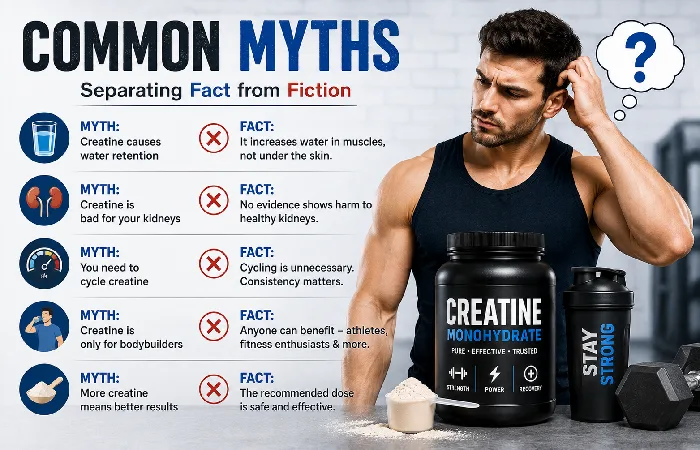
Though creatine has been studied for years, there are many misconceptions about it that continue to be passed along in the internet.
Let’s separate fact from fiction.
Myth 1: Creatine Is a Steroid
- False.
- Creatine is NOT an anabolic steroid.
- It’s a naturally occurring substance that is produced in your body and in meats and fish.
Myth #2 – Creatine harms healthy kidneys.
- This is incorrect for people who are healthy.
- Creatine supplementation in recommended doses has been found to be safe for healthy adults, consistently.
- People suffering from kidney disease or any other health condition should see a doctor before taking any supplements.
#3 Myth is that creatine causes dehydration.
- No evidence that creatine is a dehydrating agent if intake of fluids is sufficient.
- Indeed, creatine binds more water within the cells of their muscles.
- All that needs to be done is to keep adequate hydration — particularly when exercising.
Myth #4: Creatine leads to fat gain.Myth
- Creatine does not cause any body fat accumulation.
- A few people experience a slight weight gain in the first week due to the water that is held in the muscle.
- This is temporary water retention and not fat.
Myth 5: You Must Cycle Creatine
- No studies indicate that cyclists need to use creatine.
- Creatine is safe to continue use at 3-5 grams daily.
Safety Considerations
Creatine is one of the most extensively researched sports supplements on the market.
It is safe for healthy adults when used in recommended dosages.
To organize your supplement routine effectively, learn more about when to take muscle-building supplements and how timing can fit around your workouts.
General Safety Tips
| Recommendation | Why It Matters |
| Choose reputable brands | Ensures product quality |
| Follow recommended dosage | Avoid unnecessary intake |
| Drink enough water | Supports hydration |
| Store properly | Maintains product quality |
| Combine with balanced nutrition | Supports overall health |
Possible Side Effects
Creatine is well tolerated by most people.
The symptoms some people might have:
- Mild stomach discomfort
- Temporary bloating
Retention of water in the first 7 days, particularly after loads.
These effects are typically not severe and may be alleviated through:
- Taking smaller doses
- Splitting the daily amount
Taking creatine along with food.
Who Should Speak With a Healthcare Professional First?
Consult a healthcare provider before using creatine if you:
- Have kidney disease
- Use of drugs which affect kidney function
- Are under medical supervision for a chronic condition
- Creatine is well tolerated by healthy adults, when used responsibly.
Quick Comparison of Creatine Forms
| Type | Research Support | Best For |
| Creatine Monohydrate | 5 | Most users |
| Creatine HCl | 3 | Easier mixing |
| Buffered Creatine | 2 | Alternative option |
| Magnesium Creatine | 2 | Specific preferences |
| Ethyl Ester | 1 | Limited evidence |
Moreover, creatine monohydrate is the most effective, safe, and cost-effective supplement for most men.
Conclusion
Creatine for Men: Benefits, dosage, and safety is among the most backed up nutrition topics available. Research conducted over the past decades has demonstrated the efficacy of creatine monohydrate supplementation for improving strength, increasing training performance, promoting muscle growth and recovery with regular resistance training. It is inexpensive, simple to operate and have been extensively researched by scientists, so it is a popular option for novices and seasoned athletes.
For most healthy men, taking 3–5 grams of creatine monohydrate daily is all that’s needed. When it comes to building muscles, a loading phase can aid achieve muscle saturation in a faster span of time, but is not necessary for long-term muscle structure. To maximize the welfares of supplementation, select a quality product, maintain proper hydration, follow a nutritious diet and have a regular exercise program.
Always keep in mind that creatine is a tool and not a shortcut. Moreover, regular exercise, good nutrition, adequate rest and a healthy lifestyle are the best ways to gain the most strength, fitness and performance. Creatine, when combined with a balanced fitness regimen, can be a safe and effective supplement.
Dr. Khizrana Begum
Dr. Khizrana Begum is a qualified medical professional with MBBS and MD qualifications and 5+ years of experience in the medical field. She works as a General Physician and Dermatologist, with knowledge spanning general medicine, dermatology, preventive healthcare and skin health.
As a medical reviewer, Dr. Khizrana Begum reviews health and wellness content for medical accuracy, clarity and authenticity.
Sameena Begum
Sameena Begum reviews content for clarity, accuracy and reader usefulness. Her review process helps ensure that published information is clearly presented, relevant and easy for readers to understand.
Syeda Yasmeen
Syeda Yasmeen is a Health & Wellness Writer at InHumanBeing.com. She creates clear and reader-focused content across health, nutrition, wellness, women’s health, men’s health and babies’ health.