

 Syeda Yasmeen
Health & Wellness Writer Syeda Yasmeen creates clear and
reader-focused content covering health,
nutrition, wellness, women’s health,
men’s health and babies’ health.
Read Full Bio of Author →
 Sameena Begum
Health, Technology & Digital Content Reviewer Sameena Begum reviews selected content
for clarity, factual presentation,
consistency and reader usefulness.
Read Full Bio of Reviewer →
 Dr. Khizrana Begum
General Physician and Dermatologist Dr. Khizrana Begum is a qualified medical
professional with MBBS and MD qualifications
and 5+ years of experience. She reviews health
and wellness content for medical accuracy,
clarity and responsible presentation.
Read Full Bio of Medical Reviewer →
Vaccines are a critical component of infant health care. Some babies are likely to have a mild reaction to the vaccine as their immune system is responding to the vaccine. These reactions are generally temporary, but parents’ natural concern might be raised when their baby gets a fever, becomes sore, swollen or changes their behavior.
The Indian setup for the monitoring of vaccine safety is called the Adverse Event Following Immunization (AEFI) surveillance system. The system plays a role in the identification, investigation and response to adverse events arising from vaccination. Importantly, an event that occurs after vaccination does not necessarily stem from the vaccine; health professionals may explore whether there is a connection.
Understanding what children might do following vaccination may assist parents to keep track of their baby and be aware when medical advice is required.
❝
This article is part of
Baby Vaccination Hub
What Reactions Can Occur After Vaccination?
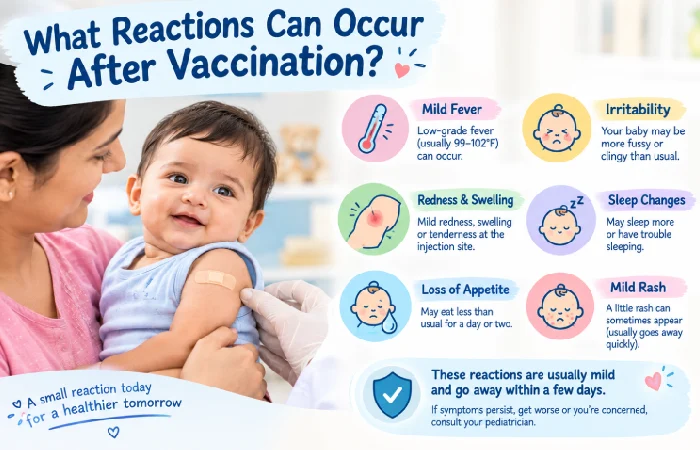
Vaccines can have a variety of effects in babies. Some may not show any reaction, while others may have mild and transient reaction.
Some of the possible reactions are:
- Mild fever
- Pain or tenderness where the injection was given
- A redness at the injection site.
- Mild swelling
- Fussiness or fussiness/crying up-ups
- Temporary tiredness
- A change of feeding or sleeping for a brief period of time.
AEFI guidelines for India, 2024, state that minor events like fever, pain, and swelling may occur after vaccination and tend to resolve within a few days.
Reactions may be different and may occur at varying times depending on vaccine and baby. Parents should be told what to do by the health care professional who gave the vaccine.
Baby vaccination is an important part of routine preventive healthcare and helps protect babies from several vaccine-preventable diseases. Explore our complete baby vaccination guide for an overview.
Common Mild Reactions
Common Mild Reactions
One of the most frequent worries parents have following their baby’s immunizations is mild reactions.
Fever
Some babies may develop a mild fever after vaccination. Parents are responsible for keeping an eye on the baby’s temperature and overall condition.
When the baby is very sick, has a fever that doesn’t go down or has a fever that lasts longer than 3 days, or the parent is worried, it is appropriate to call a health care professional.
Pain or Tenderness
Injection site may be tender for a brief period. Baby may cry more if area is touched or moved.Baby may cry more if area touched or moved.
Redness or Swelling
There could be some redness and swelling near the injection area. These reactions typically get better over time.
Fussiness
Babies might be fussier or more unsettled following vaccination. Extra comfort, feeding and rest may be helpful.
Minor changes in eating or sleeping activities.Slight shifts in feeding or sleeping.
Feeding and/or sleeping patterns may change for a short time following an appointment. Parents need to watch the baby’s general condition.
Not all reactions are due to vaccination. If there are unusual, severe, or worsening symptoms, parents should seek professional advice rather than make the assumption that the vaccine caused the symptoms.
Following a recommended vaccination schedule helps parents keep track of vaccines given at different ages. Explore our baby vaccination schedule guide for practical information.
What to Expect After a Vaccination Appointment
The healthcare provider can give information on what to look for at home after vaccination.
The parents are expected to:
- Baby might cry right after receiving the shot.
- The injection site may become slightly sore.
- There may be a slight fever or fussiness.
- Baby may require extra support.
- Most minor reactions will get better without permanent effects.
- If your health care provider says to stay at the clinic for observation, do so.
The parents must also keep up to date the vaccination record with the name of the vaccine and the date. This information can assist health care professionals in determining the vaccines the baby has had.
How to Keep Your Baby Comfortable
Parents are able to focus on feeling comfortable without losing sight of the baby.
Some useful measures might be:
- Do offer breast milk or baby’s usual feeds as recommended.
- Provide the baby with lots of rest.
- If the baby is fussy, hold and comfort the baby.
- Dress the baby in an appropriate manner.
- Do not let the area where the shot was given get dirty.
- Follow the healthcare professional’s directions.
- Do not administer medicine without doctor’s advice for your baby.
Avoiding any cream, ointments, herbal remedies or other products being applied to the site of the injection unless advised by a health care provider.
If it is not clear whether a symptom is normal, it is better to contact the baby’s healthcare provider than make a diagnosis at home.
Infants receive important vaccines during their early months and may experience temporary reactions afterward. Explore our infant vaccination guide for more information.
Monitoring Your Baby After Vaccination
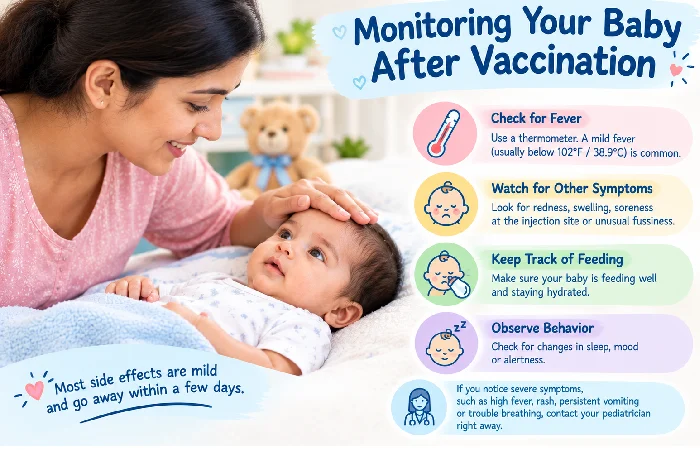
Parents should pay attention to the baby’s overall condition after vaccination.
A simple monitoring checklist can include:
| What to Monitor | What Parents Can Notice |
| Temperature | Check if the baby feels unusually warm or develops a fever |
| Feeding | Notice major changes in normal feeding |
| Behavior | Watch for unusual or persistent irritability |
| Injection site | Check for redness, swelling, or tenderness |
| Activity | Notice unusual weakness or reduced responsiveness |
| Breathing | Watch for breathing difficulties |
| Other symptoms | Report anything unusual or concerning |
It can also be useful to document some of the changes in a symptom that occurred after it began. This information could be helpful if you have to talk to a health care provider.
Keep in mind that anything that happens after vaccination does not always prove that the vaccine is responsible for the event. In India, adverse events after immunisation are monitored and investigated in the AEFI system for determining the likelihood of the relationship between the vaccine and the AE.
Knowing what to do after vaccination can help parents monitor their baby and manage common temporary reactions. Explore our after-vaccination care guide for helpful tips.
When Should Parents Contact a Healthcare Professional?
If parents are concerned about their baby’s condition after the vaccination, they should get a health care professional’s advice.
When to seek medical advice:
- The baby is clearly very unwell.
- High fever, chronic fever or fever that is of concern.
- Baby is very hard to arouse or not responsive.
- The baby is having a serious respiratory problem.
- A large amount of swelling or a reaction that is getting worse quickly.
- The baby is vomiting repeatedly or it has other concerning symptoms.
- Parent doesn’t know if a reaction is normal or not.
- Symptoms getting worse rather than better.
- If your baby looks very unwell or has symptoms of a medical emergency, please seek immediate medical attention.
The AEFI guidelines in India recommend health workers to be notified of the vaccine triggered adverse reactions if the child becomes severely unwell after vaccination, and to bring the child to the nearest hospital for treatment.
Understanding Serious Reactions
The serious adverse events after vaccination are not the same as common, mild reactions. They need to be assessed medically as a prompt as possible.
A severe allergic reaction may cause:
- Difficulty breathing
- Wheezing
- Significant weakness
- Pale appearance
- Dizziness or collapse
Severe allergic reaction symptoms other than anaphylaxis include:
serious reactions are rare and vaccine safety is constantly monitored. The AEFI surveillance programme in India is aimed at identifying, investigating and respond to adverse events including rare ones.
It should also be noted that an adverse event after vaccination does not always mean the event was caused by the vaccine. A causality assessment by healthcare professionals and public health authorities may identify a likely relationship.
Many parents are worried about potential mild side effects to routine vaccination, and they don’t want to delay routine vaccination for that reason. Rather, talk to the baby’s healthcare provider about concerns and follow the current vaccination recommendations.
Keeping vaccination records updated can help parents track completed doses and upcoming immunizations. Explore our baby vaccination records guide for useful guidance.
Where to Find Reliable Medical Information
Parents should get information on baby vaccine side effects from trusted medical and government sources.
In India, useful sources include:
- Ministry of Health and Family Welfare, Government of India
- National Health Mission
- Central Drugs Standard Control Organisation (CDSCO)
- A qualified paediatrician or other health care professional
- Health centres of government or authorized providers for vaccinations.
- Do not use unverifiable posts or forwarded messages on social media to inform medical decisions. Recommendations and information on vaccines may be updated as new research is available.
- AEFI guidance given by the Government of India gives details about vaccine safety monitoring, reporting, investigation and response.
Ministry of Health and Family Welfare (MoHFW), Government of India — AEFI Surveillance and Response Operational Guidelines 2024. It explains vaccine safety monitoring and adverse events following immunization.
Vaccination recommendations may differ between countries and local immunization programs. Explore our baby vaccination guide for India for country-specific information.
Final Takeaway
Doses of vaccines that are given to infants may have a few unexpected Baby Vaccination Side Effects that are short-lived, including a fever, fussiness, soreness, redness, and swelling. Parents should watch their baby, comfort them and take the advice of the healthcare professional.
Severe reactions should be treated promptly. Don’t diagnose your baby’s reaction to the vaccine; contact your health care provider if you have any concerns.
To get accurate and current information, refer to official Indian health sources and your baby’s health care provider.
Dr. Khizrana Begum is a qualified medical professional with MBBS and MD qualifications and 5+ years of experience in the medical field. She works as a General Physician and Dermatologist, with knowledge spanning general medicine, dermatology, preventive healthcare and skin health.
As a medical reviewer, Dr. Khizrana Begum reviews health and wellness content for medical accuracy, clarity and authenticity.
Sameena Begum reviews content for clarity, accuracy and reader usefulness. Her review process helps ensure that published information is clearly presented, relevant and easy for readers to understand.
Syeda Yasmeen is a Health & Wellness Writer at InHumanBeing.com. She creates clear and reader-focused content across health, nutrition, wellness, women’s health, men’s health and babies’ health.