
 Syeda Yasmeen
Health & Wellness Writer Syeda Yasmeen creates clear and
reader-focused content covering health,
nutrition, wellness, women’s health,
men’s health and babies’ health.
Read Full Bio of Author →
Syeda Yasmeen
Health & Wellness Writer Syeda Yasmeen creates clear and
reader-focused content covering health,
nutrition, wellness, women’s health,
men’s health and babies’ health.
Read Full Bio of Author →
 Sameena Begum
Health, Technology & Digital Content Reviewer Sameena Begum reviews selected content
for clarity, factual presentation,
consistency and reader usefulness.
Read Full Bio of Reviewer →
Sameena Begum
Health, Technology & Digital Content Reviewer Sameena Begum reviews selected content
for clarity, factual presentation,
consistency and reader usefulness.
Read Full Bio of Reviewer →
 Dr. Khizrana Begum
General Physician and Dermatologist Dr. Khizrana Begum is a qualified medical
professional with MBBS and MD qualifications
and 5+ years of experience. She reviews health
and wellness content for medical accuracy,
clarity and responsible presentation.
Read Full Bio of Medical Reviewer →
Dr. Khizrana Begum
General Physician and Dermatologist Dr. Khizrana Begum is a qualified medical
professional with MBBS and MD qualifications
and 5+ years of experience. She reviews health
and wellness content for medical accuracy,
clarity and responsible presentation.
Read Full Bio of Medical Reviewer →
In all likelihood, you’ve already used a smart scale or had a fitness assessment where you were given your body fat percentage along with your weight. Although the number on the scale is important to many, body fat percentage is a much better indicator of your body’s overall health and fitness. Two individuals may weigh the same but have different levels of body fat resulting in different outcomes of health.
Knowing what Body Fat Percentage is and what is considered healthy can help achieve realistic fitness goals, keep track of progress and minimize the likelihood of chronic diseases. Body fat is not something to be feared of as it has its own purpose, it is used in protecting organs, regulating hormones, and storing energy. Too much or too little body fat, though, can impact health.
This guide will help you understand the meaning of body fat percentage, healthy ranges for male body fat, the difference between essential fat and storage fat, risks of having too much body fat, and risks of having too little body fat, and how you can lose fat and maintain your muscle mass.
❝
This article is part of
Weight Management Hub
What Is Body Fat Percentage?
Body fat percentage is the percentage of fat in your body. Body fat percentage more precisely reflects body arrangement compared to Body Mass Index (BMI) which takes into account only height and weight.
A 20% body fat percentage, for example, means that 16 kg from a 80 kg body weight is fat and 64 kg is muscle, bone, organs, and water.
Understanding your body composition gives you a clearer picture of your overall health than body weight alone, especially when tracking body fat percentage.
The Benefits of Body Fat Percentage
Body fat percentage can help you:
- Assess overall fitness.
- Focus on fat loss rather than weight loss.
- Monitor muscle-building progress.
- Gain an awareness of chronic health issues.
Common Ways to Measure Body Fat
| Method | Accuracy | Availability |
| DEXA Scan | Very High | Hospitals & clinics |
| Bioelectrical Impedance (Smart Scale) | Moderate | Home & gyms |
| Skinfold Calipers | Moderate | Fitness centers |
| Bod Pod | High | Sports facilities |
| Hydrostatic Weighing | Very High | Specialized centers |
Healthy Body Fat Ranges for Men
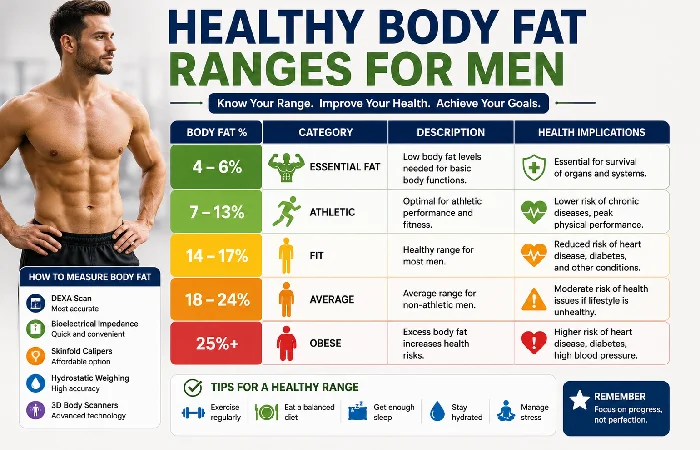
Body fat levels are considered healthy based on age, activity level and overall health. In general, athletes will have lower body fat percentages than the average adult. And older adults will have slightly higher percentages due to natural aging.
Healthy Body Fat Percentage for Men
| Category | Body Fat % |
| Essential Fat | 2–5% |
| Athletes | 6–13% |
| Fitness | 14–17% |
| Healthy Range | 18–24% |
| Overweight | 25–29% |
| Obesity | 30% or higher |
These ranges are guidelines only and can be slightly different from health organization to health organization.
Why Healthy Ranges Matter
To help maintain a healthy body fat percentage, do the following:
- Support heart health.
- Improve blood sugar control.
- Reduce joint stress.
- Increase energy levels.
- Enhance physical performance.
Don’t strive for an extremely low body fat level; just strive for a level that is good for health and function.
While Body Mass Index (BMI) provides a general estimate of weight status, body fat percentage offers a more accurate assessment of your fitness level.
Essential Fat vs Storage Fat
There’s not a single type of fat in your body. There is a necessary level of fat in your body that is important to its functioning.
Essential Fat
Essential fat is necessary for normal body functions.
It plays a role in:
- Hormone production
- Brain function
- Organ protection
- Temperature regulation
- Vitamin absorption
Fat is vital to the body and without adequate amounts, the body cannot function properly.
Storage Fat
Storage fat is the body fat that is stored as an energy reserve.
A healthy fat level in the body is:
- Protect internal organs.
- Provide insulation.
- Save up reserves of energy for later.
But, having too much stored body fat, particularly around the belly, can increase the risk of chronic diseases.
Following a balanced nutrition plan for body composition can help reduce body fat while preserving lean muscle mass.
Essential Fat vs Storage Fat
| Type | Function |
| Essential Fat | Supports normal body functions |
| Storage Fat | Stores energy and protects organs |
Knowing this difference is a key to understanding that body fat is not bad, it’s about how much there is and how it’s distributed.
Risks of High Body Fat
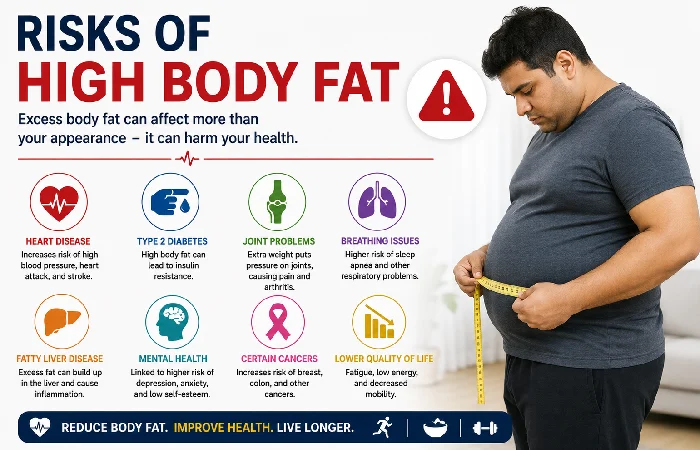
Too much body fat, especially in the abdominal area, can lead to several health problems.
Potential Health Risks
| Condition | Increased Risk |
| Heart disease | ✔ |
| High blood pressure | ✔ |
| Type 2 diabetes | ✔ |
| Stroke | ✔ |
| Sleep apnea | ✔ |
| Fatty liver disease | ✔ |
Other Effects of High Body Fat
High body fat levels can also lead to:
- Reduced mobility
- Joint pain
- Lower energy levels
- Poor sleep quality
Reduced fitness
Visceral fat—the fat stored around internal organs—is specifically concerning because it’s linked to senior cardiovascular and metabolic dangers.
Luckily, even modest fat loss can recover overall health.
Risks of Extremely Low Body Fat
Abdominal body fat, which mounts internal organs, is notably worrisome since it is associated with encouraged cardiovascular and metabolic danger.
There are advantages to losing weight even if it’s only a minor bit, so that’s why it’s worthy to further overall health.
Combining healthy eating with regular exercise for body composition is one of the most effective ways to improve your body fat percentage over time.
Potential Risks
| Health Concern | Why It Matters |
| Hormonal imbalance | Affects normal body function |
| Low energy | Reduced fuel for daily activities |
| Weakened immune system | Increased illness risk |
| Nutrient deficiencies | Poor vitamin absorption |
| Reduced athletic performance | Less recovery and endurance |
Men with very low body fat may suffer from:
Chronic fatigue
The inability to bounce back from exercise.Problems recuperating after exercise.
- Increased injury risk
- Reduced strength
- Hormonal changes
The body fat level in which most people feel healthy is healthier than getting them really low.
How to Reduce Body Fat Safely
The best method to lose body fat is to make relaxed and reliable lifestyle changes, not crash diets.
Eat a Balanced Diet
Eat foods like:
- Lean proteins
- Whole grains
- Fruits
- Vegetables
- Healthy fats
- Legumes
Limit:
- Sugary drinks
- Highly processed foods
- Excess sweets
- Fried foods
- Exercise Regularly
It’s best to do a mix of both cardio and strength training.
Examples include:
- Brisk walking
- Running
- Cycling
- Swimming
- Resistance training
Strength training is mainly key as it can help maintain muscle mass while burning fat.
If your goal is to build muscle while reducing fat, learning about body recomposition can help you achieve a healthier body composition.
Get Enough Sleep
Adults should get 7-9 hours of good sleep per night.
Poor sleep can have an impact on:
- Hunger hormones
- Appetite
- Recovery
- Energy levels
Stay Consistent
Achieving healthy fat loss typically takes time.
Aim to:
- Get plenty of exercise, most days of the week.
- Eat stable meals.
- Stay hydrated.
- Manage stress.
- Measure progress on a monthly basis, rather than daily.
Successful sustainable practices mean success in the long run.
Using reliable methods to measure body composition allows you to accurately track changes in body fat percentage and monitor your progress.
FAQs
What is the best body fat level for men?
The normal range of 18-24% is found in most adult males, though athletes may have lower percentages.
Should BMI be replaced by body fat percentage?
Yes. Body fat percentage is a better indicator of body composition as it separates fat from muscle.
Can I lose body fat without losing muscle?
Yes. When strength training is performed in conjunction with proper protein consumption and moderate amounts of calories cut back, then muscle is preserved.
Is belly fat bad?
Yes. Visceral fat, which is fat around the abdomen, has been linked to increased risks of heart disease, diabetes and other chronic conditions.
When should I measure my body fat?
A body fat check is typically effective if it is performed every 4-8 weeks.
Final Thoughts
One of the top methods to keep track of health beyond the scales is to understand the meaning of Body Fat Ratio and fit ranges. Body fat percentage is more useful than weight itself or BMI, giving a much improved sign of what your body is made up of: fat or lean muscle.
Focus on reaching a healthy body fat percentage, as an alternative of trying to reach a specific percentage as low as feasible. With a healthy diet, daily workouts, good rest and slow, steady lifestyle changes, you can tightly shed extra body fat while conserving muscle and improving your quality of lifetime.
Dr. Khizrana Begum is a qualified medical professional with MBBS and MD qualifications and 5+ years of experience in the medical field. She works as a General Physician and Dermatologist, with knowledge spanning general medicine, dermatology, preventive healthcare and skin health.
As a medical reviewer, Dr. Khizrana Begum reviews health and wellness content for medical accuracy, clarity and authenticity.
Sameena Begum reviews content for clarity, accuracy and reader usefulness. Her review process helps ensure that published information is clearly presented, relevant and easy for readers to understand.
Syeda Yasmeen is a Health & Wellness Writer at InHumanBeing.com. She creates clear and reader-focused content across health, nutrition, wellness, women’s health, men’s health and babies’ health.