

 Syeda Yasmeen
Health & Wellness Writer Syeda Yasmeen creates clear and
reader-focused content covering health,
nutrition, wellness, women’s health,
men’s health and babies’ health.
Read Full Bio of Author →
Syeda Yasmeen
Health & Wellness Writer Syeda Yasmeen creates clear and
reader-focused content covering health,
nutrition, wellness, women’s health,
men’s health and babies’ health.
Read Full Bio of Author →
 Sameena Begum
Health, Technology & Digital Content Reviewer Sameena Begum reviews selected content
for clarity, factual presentation,
consistency and reader usefulness.
Read Full Bio of Reviewer →
Sameena Begum
Health, Technology & Digital Content Reviewer Sameena Begum reviews selected content
for clarity, factual presentation,
consistency and reader usefulness.
Read Full Bio of Reviewer →
 Dr. Khizrana Begum
General Physician and Dermatologist Dr. Khizrana Begum is a qualified medical
professional with MBBS and MD qualifications
and 5+ years of experience. She reviews health
and wellness content for medical accuracy,
clarity and responsible presentation.
Read Full Bio of Medical Reviewer →
Dr. Khizrana Begum
General Physician and Dermatologist Dr. Khizrana Begum is a qualified medical
professional with MBBS and MD qualifications
and 5+ years of experience. She reviews health
and wellness content for medical accuracy,
clarity and responsible presentation.
Read Full Bio of Medical Reviewer →
Women’s health screening may be an integral part of any preventive health program. Screening for early diagnosis of a variety of cancers, risk factors for cardiovascular disease, diabetes, bone loss, infections, and other health problems can be performed before symptoms arise.
The optimal screening schedule will be different for each woman. Factors such as age, family history, previous screening results, pregnancy, reproductive history, lifestyle, use of medications or drugs, and health problems determine which screening tests are offered and when.
Recommendations also vary by country and by medical society. The screening recommendations discussed in this article are those of the current U. S. Preventive Services Task Force recommendations. Still, women should follow the recommendations of their country and discuss with their doctor their own screening needs.
Why Preventive Screening Matters for Women
The process of secondary prevention involves screening, the systematic application of a test, examination, or inquiry to identify apparently healthy individuals who have already developed risk factors or preclinical diseases.
Some conditions remain undetected. An example of these is high blood pressure and pre-cancerous cell changes of the cervix that may be asymptomatic.
Screening can help healthcare professionals:
- Identify health risks early
- Detect certain cancers at an earlier stage
- Identify abnormal blood pressure
- Detect elevated blood glucose
- Assess cholesterol and cardiovascular risk
- Identify osteoporosis risk
- Monitor reproductive and sexual health
- Determine whether additional testing is needed
Bear in mind that screening can neither prevent nor diagnose a disease, and that some illnesses have inadequate or inappropriate routine tests available.
Therefore, screening tests in prevention need to be evidence-based, decided upon the individual level of risk and best practice that can be followed through, rather than trying to predetermine as many tests as possible.
Breast Cancer Screening
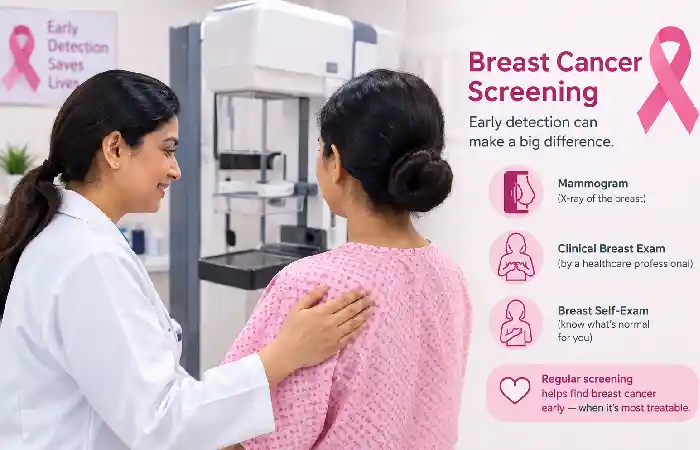
There are several important areas of cancer screening that are of particular importance to women.
Mammography is the most commonly used method for screening for breast cancer before symptoms present. The USPSTF recommends mammography either annually or biannually for women between the ages of 40-74 at average risk of breast cancer. Women with higher-than-average risk may need a different screening strategy. Factors that can affect breast cancer risk include:
- Strong family history
- Certain inherited genetic variants
- Previous breast cancer
- Certain high-risk breast lesions
- Previous high-dose radiation to the chest at a young age
The USPSTF has stated that the average risk recommendation does not apply for “patients with high-risk genetic syndromes, a history of breast cancer, or high-risk breast lesions.”
A doctor and nurse go through the list. 2.3.2 Concerns should be referred to a healthcare professional rather than relying on the next well-woman screening.
Cervical Cancer Screening
The goal of cervical cancer screening is to identify abnormal cervical cells, or a precursor high-risk human papillomavirus (HPV) infection.
Common screening methods include:
- HPV testing
- Pap testing
- HPV testing combined with cytology in some screening programs
The USPSTF prefers screening for cervical carcinoma in women 21 to 65 years of age. USPSTF prefers screening with cytology every 3 years in women 21 to 29 years of age. The USPSTF prefers screening with cytology every 3 years, high-risk HPV DNA testing every 5 years, or co-testing with cytology and high-risk HPV testing every 5 years in women aged 30 to 65 years.
No periodic screening is recommended for women over 65 who have had adequate prior screening and are not at high risk. A woman with one of the following histories may need different recommendations.
An abnormal result of Pap or HPV does not necessarily mean women have cervical cancer; it depends on the result. Sometimes further testing may be necessary.
Blood Pressure Screening
Blood pressure screening is an essential part of routine women’s healthcare.
Hypertension can lead to increased risk of cardiovascular disease, stroke, renal disease and other health problems. If women experience no signs or symptoms of high blood pressure, it is always useful to take blood pressure readings.
The USPSTF recommends screening adults aged 18 years and older for hypertension. It also recommends confirming an elevated office reading with measurements outside the clinical setting before starting treatment.
How often should screening be performed? According to the USPSTF guidelines, however, screening should be performed annually in those 40 years of age or older and those at increased risk, while some lower-risk adults between 18 and 39 may be screened less frequently, i.e., every 3 to 5 years, if previous screening results are normal.
Blood pressures are routinely recorded during pregnancy, as pregnancy-related hypertensive disorders can affect both mother and baby.
Cholesterol and Heart Health
Cholesterol screening helps identify lipid levels associated with cardiovascular risk.
A lipid profile may include:
- Total cholesterol
- LDL cholesterol
- HDL cholesterol
- Triglycerides
The fear of the condition can encompass more than just cholesterol. Physicians and other healthcare providers may consider blood pressure, history of diabetes, smoking habits, physical activity, family history, age, weight, or other concerns.
Women should discuss cardiovascular risk, particularly when there is:
- A family history of early heart disease
- High blood pressure
- Diabetes
- High cholesterol
- Smoking
- Obesity or other metabolic risk factors
- Previous cardiovascular disease
However, these issues are not only for postmenopausal women, as the risk of cardiovascular disease builds up over years, so it would be prudent to include it in a long-term plan.
Diabetes Screening
Heart disease is also not exclusive to postmenopausal women; it is only that the risk of cardiovascular disease builds up over the years and so necessarily needs to be addressed in a ‘long-term plan ’.
Common tests include:
- A1C
- Fasting blood glucose
- Oral glucose tolerance testing
The United States (US) Preventive Services Task Force (USPSTF) suggests testing for prediabetes in all overweight adults from 35 to 70 years with no other CVD risk factors. Any adult with additional risk factors for DM2 should be tested earlier and/or more regularly.
Having had gestational diabetes also confers an increased chance of developing type 2 diabetes in the future, so proper follow-up after delivery and in the long term is necessary.
If a woman has a family history of diabetes, history of abnormal glucose, previous history of gestational diabetes, or any other risk factors, she has to consult with her health care provider about screening for diabetes.
Bone Health Screening
Bone health is an important area of concern in the later years, especially after menopause.
Osteoporosis leads to deterioration of the bone structure; therefore, there is an increased risk of fracture. Screening can detect the presence of osteopenia before a fracture has occurred.
The USPSTF recommendation states that women 65 years of age and older should be screened for osteoporosis, along with women below 65 years of age who are postmenopausal with a high risk factor (clinical).
Bone mineral density is often measured by Dual-energy X-ray absorptiometry (also called a DXA or DEXA scan).
Factors that may contribute to fracture risk include:
- Older age
- Menopause
- Previous fractures
- Low body weight
- Family history of osteoporosis or fractures
- Certain medications
- Smoking
- Excessive alcohol use
- Certain medical conditions
Is bone-density screening needed? This can be assessed by any healthcare professional.
Sexual and Reproductive Health Screening
Sexual and reproductive health care involves screening for STI‘s, reproductive health issues, and issues related to fertility or pregnancy.
Depending on age and individual risk, screening may include testing for:
- Chlamydia
- Gonorrhea
- HIV
- Syphilis
- Hepatitis or other infections when indicated
For example, the USPSTF suggests the screening of sexually active women under the age of 24 for Chlamydia and Gonorrhea, and older women if they are at increased risk.
Prevention and screening should not be done on the assumption that everyone in a relationship is monogamous or on the assumption that everyone has had multiple recent partners.
Mention fluctuations in the menstrual cycle, pelvic pain, abnormal bleeding, vaginal symptoms, concerns about fertility and contraception, and menopausal symptoms as appropriate.
Screening During Pregnancy
Increased screening and surveillance require during pregnancy since certain health conditions can impact the pregnant individual as well as the developing fetus.
Prenatal care may include assessments for:
- Blood pressure
- Gestational diabetes
- Blood type and Rh status
- Certain infections
- Anemia
- Fetal growth and development
- Other pregnancy-related complications
Blood pressure should be monitored throughout pregnancy. The United States Preventive Services Task Force recommends screening for hypertensive disorders of pregnancy by blood pressure measurement for all pregnant women.
Diabetes screening during pregnancy appears on the pregnancy-specific care schedule and may not be the same as type 2 diabetes screening in adult patients outside of pregnancy.
The timing of screening can vary depending upon the pregnancy and the woman’s medical history and local guidelines and on who is providing the screening.
Age-Based Women’s Health Screening
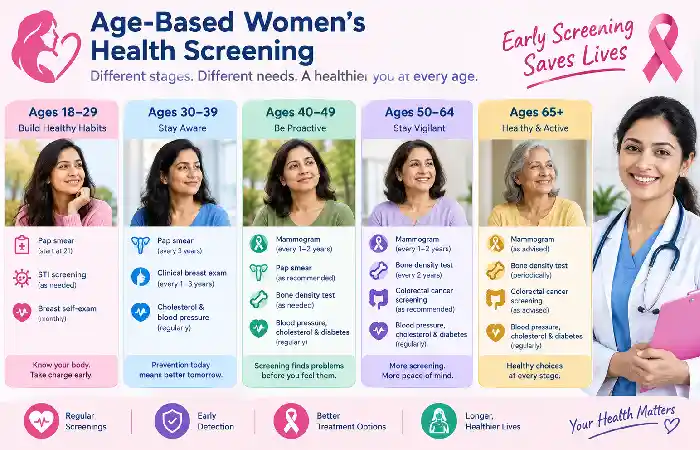
Preventive screening needs for women evolve across the age spectrum.
| Life Stage | Common Screening Areas |
| Teens and young adults | Blood pressure, sexual health when appropriate, mental health and other risk-based screening |
| 20s–30s | Cervical cancer screening, blood pressure, sexual health, cardiovascular and diabetes risk assessment when indicated |
| 40s | Breast cancer screening, cervical screening, blood pressure, cholesterol, diabetes and other risk-based assessments |
| 50s–60s | Continued breast and cervical screening when appropriate, colorectal screening, cardiovascular risk, diabetes, bone health assessment based on risk |
| 65+ | Osteoporosis screening, continued cancer screening when appropriate, cardiovascular health, diabetes and other age-related preventive care |
Changes in age and previous results may lead to different cancer screening recommendations. For example, USPSTF recommends women with average risk to have screening with mammography every two years from age40to74.
These are broad categories and not set schedules. For example, a woman with family history, high genetic risk, previous abnormal results, or a chronic medical condition may need a different schedule.
Understanding Your Screening Results
A screening result may not be diagnostic.
A ‘normal result’ must have a negative meaning; that is, the test did not find the abnormality it was testing for at that time.
The presence of an abnormal result does not always imply the detection of cancer or any other disease. Further examination may be necessary to assess the finding further.
For example:
- An abnormal Pap test may require follow-up testing.
- A high blood pressure reading may need confirmation.
- An elevated glucose result may require repeat or additional testing.
- An abnormal mammogram may require additional breast imaging or biopsy.
- A low bone-density result may lead to fracture-risk assessment.
Find out from your healthcare professional what the results mean, if further testing needs to done, and when to repeat the screening.
Final Thoughts
Women’s health encompasses a broad spectrum including screening for breast and cervical cancer, heart disease, diabetes, bone health, sexual health and pregnancy-related issues.
The screening program appropriate for an individual determine by the person’s age, history, family history, past test results, present pregnancy, risk factors, and local protocols. Standards used should revise periodically to take into account recommendations for screening.
Focused screening is most effective if negative results are follow up with an appropriate work-up, and routine testing is supplemented with attention to symptoms and general health.
Medications disclosure: For educational information intent only, the article is not a substitute for medical counseling, diagnosis, and can not regard as specific screening urging. The screening programs vary from country to country and can be subject to alterations. Ask your health specialists about any screening program.
Dr. Khizrana Begum
Dr. Khizrana Begum is a qualified medical professional with MBBS and MD qualifications and 5+ years of experience in the medical field. She works as a General Physician and Dermatologist, with knowledge spanning general medicine, dermatology, preventive healthcare and skin health.
As a medical reviewer, Dr. Khizrana Begum reviews health and wellness content for medical accuracy, clarity and authenticity.
Sameena Begum
Sameena Begum reviews content for clarity, accuracy and reader usefulness. Her review process helps ensure that published information is clearly presented, relevant and easy for readers to understand.
Syeda Yasmeen
Syeda Yasmeen is a Health & Wellness Writer at InHumanBeing.com. She creates clear and reader-focused content across health, nutrition, wellness, women’s health, men’s health and babies’ health.