
 Syeda Yasmeen
Health & Wellness Writer Syeda Yasmeen creates clear and
reader-focused content covering health,
nutrition, wellness, women’s health,
men’s health and babies’ health.
Read Full Bio of Author →
Syeda Yasmeen
Health & Wellness Writer Syeda Yasmeen creates clear and
reader-focused content covering health,
nutrition, wellness, women’s health,
men’s health and babies’ health.
Read Full Bio of Author →
 Sameena Begum
Health, Technology & Digital Content Reviewer Sameena Begum reviews selected content
for clarity, factual presentation,
consistency and reader usefulness.
Read Full Bio of Reviewer →
Sameena Begum
Health, Technology & Digital Content Reviewer Sameena Begum reviews selected content
for clarity, factual presentation,
consistency and reader usefulness.
Read Full Bio of Reviewer →
 Dr. Khizrana Begum
General Physician and Dermatologist Dr. Khizrana Begum is a qualified medical
professional with MBBS and MD qualifications
and 5+ years of experience. She reviews health
and wellness content for medical accuracy,
clarity and responsible presentation.
Read Full Bio of Medical Reviewer →
Dr. Khizrana Begum
General Physician and Dermatologist Dr. Khizrana Begum is a qualified medical
professional with MBBS and MD qualifications
and 5+ years of experience. She reviews health
and wellness content for medical accuracy,
clarity and responsible presentation.
Read Full Bio of Medical Reviewer →
Healthy sleep habits include simple daily and night time routines that will allow you to get the restful and good quality sleep you need. Sleep is not a process that can be timed. Sleep serves as a fuel for your body and mind for physical health, emotional wellness, attention, memory, metabolism and recovery. The CDC says that the amount of sleep people require varies by age and that most adults should get at least seven hours of sleep a night.
Improving sleep doesn’t necessarily involve costly products or a complex routine. The bedtime routine, a comfortable bedroom, daytime activity, sensible caffeine consumption and a relaxing bedtime routine can have a significant impact.
What Are Healthy Sleep Habits?
Sleep hygiene, also known as healthy sleep habits, are environmental factors and activities that promote healthy sleep patterns.
Some good sleep habits are:
- Walking barefoot and in the nude, or wearing simple shoes and clothes
- Rest is essential for the body.Make sure to get proper rest.
- Maintaining quiet, cool, comfortable bedroom environment
- Avoid bright lights and electronic devices before sleep time.
- Eating a healthy diet with an adequate amount of water
- Avoid caffeine too near to bedtime.
- Managing stress before going to sleep
- Keeping bedtime snacking to a minimum
Quality and quantity are important for healthy sleep. Even though you may be getting enough sleep, you can feel exhausted if you are getting so many wake-ups or if you have an untreated sleep disorder. A good night’s sleep is sleep without interruption and sleep that is refreshing, according to the CDC.
Why Are Healthy Sleep Habits Important?
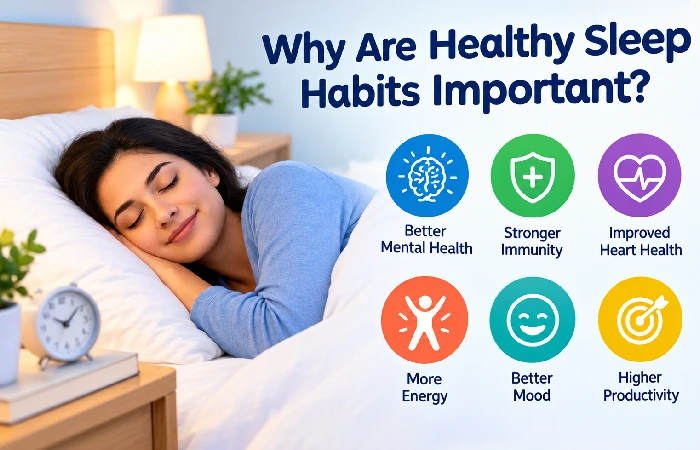
Sleep is involved in almost all aspects of living. In the sleep state, the body helps maintain a healthy brain and body repair.
Good sleep contributes to maintaining:
- Attention and concentration
- Memory and learning
- Emotional and mental well-being, including stress management.
- Healthy metabolism
- Immune function
- Heart health
- Daily energy
- Safe driving and decision making
Regularly not getting enough sleep is linked to a variety of health issues. According to current CDC data, the average sleeping time for U.S. adults was 30.5% of a full night’s sleep in 2024.
It’s particularly crucial to develop healthy sleep habits for people who frequently forgo sleep due to work, school, family duties, or screen time.
How Much Sleep Do You Need?
Sleep needs change with age.
| Age Group | Recommended Sleep |
| Newborns, 0–3 months | 14–17 hours |
| Infants, 4–12 months | 12–16 hours, including naps |
| Toddlers, 1–2 years | 11–14 hours, including naps |
| Preschoolers, 3–5 years | 10–13 hours, including naps |
| Children, 6–12 years | 9–12 hours |
| Teens, 13–17 years | 8–10 hours |
| Adults, 18–60 years | 7 or more hours |
| Adults, 61–64 years | 7–9 hours |
| Adults, 65+ years | 7–8 hours |
The following are general guidelines and individual requirements may differ.
Lots of sleeping doesn’t necessarily equal good sleep. Talk to a healthcare professional if you feel tired after sleeping for a long time regularly or if you cannot get to sleep in spite of having time available to sleep.
How to Create a Healthy Sleep Schedule
Your body has a built-in clock to control your state of wakefulness and sleepiness. Taking it at a regular schedule will help maintain this rhythm.
First pick a wake up time that you can stick to the majority of the time. Then work backwards to provide sufficient sleep time.
Try these steps:
- Wake up at approximately the same time every day.
- Establish a reasonable bedtime.
- Minimise changes to the weekend timetable.
- Don’t regularly stay up late and sleep late on weekends.
- Take advantage of natural outdoor light in the day when available.
- Allow time to relax before sleep.
The NIH suggests regularization of sleep and wake cycles and warns that significant differences between schedules on weekdays and weekends may cause alterations in sleep/wake cycles.
If you are up-and-down on your schedule now
Avoid making changes for the first night or two. Gradually bring bedtime forward and set a regular morning alarm. It is easier to stick to a small modification to the routine than it is to make a complete change to the routine.
Building a Healthy Bedtime Routine
A nighttime schedule helps your brain and body realize that it is getting close to bedtime.
Begin 30-60 minutes prior to bedtime with quiet activities.
This simple exercise might be:
- 60 minutes in the evening: Complete strenuous activities or school work.
- An hour before going to sleep: Dim lights, decrease screen time.
- 30 minutes before going to bed: Take a warm bath, read a book, stretch or listen to calming music.
- Bedtime: Ensure the bedroom is dark, quiet and comfortable.
Don’t make it a stressful checklist at bedtime. The aim is to develop a regular programme for transition between activity and rest.
Avoid repeatedly checking the clock if you can’t fall asleep after getting into bed. Worrying about being able to sleep can make it difficult to relax.
Creating a Sleep-Friendly Bedroom
The quality of your sleep can be greatly affected by your bedroom.
A good sleeping room is typically:
- Quiet
- Dark
- Comfortable
- Cool or at a comfortable temperature
This is perfect for when you need to get tasks done quickly and without any distractions.
The NIH suggests a bedroom to be quiet, cool and dark.
Simple bedroom improvements
- Limit lighting: If light is coming into the room from outside, try to use curtains or blinds.
- Minimize noise: Use ear plugs or background noise, if appropriate.
- Control temperature – maintain a comfortable temperature, not too hot.
- Maintain a comfortable bed: A supportive mattress and comfortable bedding can help make it easier to get comfy.
- Eliminate distractions: If possible, avoid having things like work materials, unnecessary notifications, and bright devices in the sleeping area.
But don’t let the bedroom look like a luxury hotel room to ensure good sleep. It’s the comfort and consistency that count, not the pricey décor.
Healthy Daytime Habits for Better Sleep
To ensure a good night’s sleep, it is essential to have healthy habits during the day.
Sleep is a process that starts in the daytime.
Exercise can help sleep and spending time outdoors will provide natural light to help maintain your daily cycle.
Some good habits to get into during the day are:
- Staying physically active
- Spending time outdoors
- Eating regular meals
- Forgetting to take the medication on time
- Managing stress
- Avoiding excessive caffeine
- Avoiding extended or late naps
Consider napping earlier or shorter in the day, and trying to not fall asleep during the night if that is a problem. According to the NIH, adults should not take naps more than 20 minutes long if it is an issue they have with sleep at night.
Food, Caffeine, and Sleep
The food and when you eat it can influence your comfort at night.
Eating larger and heavier meals just before sleep can make it more difficult to feel comfortable. According to the NIH, it is not a good idea to consume large amounts of food within a couple of hours of sleep.
Better evening eating habits
Try to:
- Have a meal at a proper hour.
- Don’t eat very big meals right before you go to sleep.
- If you are really hungry, select a lighter snack.
- Steer clear of foods that commonly upset your stomach or heartburn.
- Adequate fluid intake throughout the day; not too much fluids just before sleep.
Caffeine and sleep
It is a stimulant which can disrupt sleep, particularly in the later part of the day.
Caffeine may be found in:
- Coffee
- Tea
- Energy drinks
- Some soft drinks
- Chocolate
- Certain medicines and supplements
The effects of caffeine can last several hours, according to the NIH, and should be avoided in the hours leading up to sleep.
If you’re sensitive to caffeine, pause an earlier time, rather than cutting back on consumption at night.
Drinking alcohol can also impact sleep. It can induce sleepiness in some people at first, but it might lead to lighter and/or disrupted sleep.
Exercise and Sleep
Exercise is a key element of a healthy lifestyle and can help sleep.
Activities such as:
- Walking
- Jogging
- Cycling
- Swimming
- Strength training
- Dancing
- Sports
- Yoga
can assist you to keep physically active.
In order to reap the benefits of movement, it doesn’t require any strenuous exercise. The basics are short walks and gradually increase.
When should you exercise?
Workouts in the day can be beneficial for many. If you need some extra energy to get to bed, do it earlier.
The NIH says people should “exercise frequently throughout the day” and mentions that some people may find it difficult to get to sleep this way.
The key is consistency. Select something that you love so that you can continue it.
Stress Management and Sleep
Worry and stress can make it hard to sleep. Racing thoughts can be caused by work deadlines, money, relationships, school, family duties or health worries.
Stress is also associated with insomnia risk.
Develop a stress downshift procedure
Do two or one calming activity prior to bed:
- Deep breathing
- Gentle stretching
- Reading
- Journaling
- Meditation
- Prayer or quiet reflection
- Playing calming music for them to listen to
- There is nothing more energizing than a hot tub.
- Discuss with a trusted individual
There is no need to use all the techniques. Select something realistic.
Try a “worry list”
If you have a lot of thoughts going through your mind at night, jot down tomorrow’s agenda or any worries before you go to bed.
For example:
Tomorrow:
- Call the doctor
- Finish work report
- Buy groceries
- Reply to an email
Writing things down can help to distinguish the time for planning from the time for sleeping.
If you are having difficulties sleeping because of anxiety, stress or a prolonged low mood, professional help might be helpful.
Screen Time and Sleep
Several reasons make bedtime more challenging with phones, tablet, computers, televisions and gaming devices.
When you want to relax, screen time helps engage the brain. Excessive lighting during the evening can also impact the body’s sleep-wake cycle.
One of the CDC’s sleep health recommendations is to turn off electronics at least 30 minutes prior to bedtime.
Form a screen free cool down time.
Try:
- Charging your phone at all but not in bed.
- Disabling irrelevant notifications.
- Not working on your device right before sleep.
- If you find it distracting to look at your phone, use a regular alarm clock instead.
- Avoid late night television in favor of reading or quiet music.
Establishing guidelines for devices at night may be a good idea for kids and teens. CDC recommendations focus on good sleep hygiene and sufficient sleep for children and adolescents.
The CDC’s existing guidance for youth also suggests limits on digital media use during the hours before bedtime and the idea of keeping phones out of bedrooms for adolescents to help them get better sleep.
Healthy Sleep Habits for Children
Children require more sleep than adults, as sleep is essential for children’s growth, development, learning, and emotional health.
To help develop a predictable routine, parents can:
- Having a schedule for sleep
- It is important to maintain regular bed and morning routines.
- A calming bed time routine, such as:
- Before you sleep, try to avoid doing any stimulating activities before bedtime.
Child sleep needs
| Age | Recommended Sleep |
| 4–12 months | 12–16 hours |
| 1–2 years | 11–14 hours |
| 3–5 years | 10–13 hours |
| 6–12 years | 9–12 hours |
| 13–17 years | 8–10 hours |
These totals include naps where applicable.
If a child snores and/or struggles with breathing while sleeping, or if they feel very sleepy during the day, talk to a pediatric healthcare provider.
Healthy Sleep Habits for Adults
Work, family obligations, commuting, stress, schedules and technology are all common factors that hinder adults in their sleep.
Some healthy habits that are beneficial for adults are:
- Creating a sleep schedule that is followed consistently.
- Avoiding unnecessary late night work
- Consuming less caffeine later in the day
- Exercising regularly
- Creating a relaxing pre-bed routine
- A comfortable bedroom is crucial.A comfortable bedroom is essential.
- Eating at an appropriate time
Adults of 18 to 60 years old should sleep for a minimum of 7 hours for a night’s sleep; adults of 61 to 64 years old should get between 7 to 9 hours of sleep; for adults over 65 years old, it is recommended to sleep for 7 to 8 hours each night.
Parents and caregivers
Parents might have had their sleep cycle disrupted by their babies or young children. Under these circumstances, perfection is unattainable.
Instead, it is important to work on practical things like sharing the night shift if you can, limiting available sleep time, and seeking help when sleep deprivation gets to be too much.
Shift workers
Night workers or workers on rotating schedules often experience additional problems because their work schedule may interfere with the normal sleep-wake cycle.
A dark, quiet bedroom at night and avoiding caffeine toward the end of a day might help.
A Simple Sleep Habit Checklist
| Habit | Goal |
| Sleep schedule | Keep bedtime and wake time consistent |
| Food | Avoid large meals close to bed |
| Caffeine | Limit late-day intake |
| Exercise | Stay active during the day |
| Stress | Use a relaxing wind-down routine |
| Screens | Reduce nighttime device use |
| Bedroom | Keep it cool, dark, and quiet |
| Children | Maintain age-appropriate sleep schedules |
Common Sleep Problems
There are several types of sleep problems.
Insomnia
Insomnia is either a problem with falling asleep or staying asleep, or not getting a good night’s rest, even when you have the chance.
These can include:
- Stress
- Anxiety
- Irregular sleep schedules
- Caffeine
- Nicotine
- Alcohol
- Certain medicines
- Excessive screen use
- Long daytime naps
- Medical conditions
Changes in routine, lack of physical activity, caffeine, nicotine, alcohol and excessive use of electronic devices near bedtime are associated with insomnia, according to the NIH.
Sleep apnea
Sleep apnea is a condition characterized by periodic breathing during sleep. Warning signs include loud snoring, gasping during sleep, and excessive daytime sleepiness and headaches in the morning.
Not all snorers suffer from sleep apnea, but if these symptoms are chronic or alarming, they need medical attention.
Restless legs syndrome
This may lead to an urge to move the legs, which may be worse when at rest or sleeping.
Circadian rhythm problems
Your body clock can go off the rhythm with your schedule. This can occur with shift work, jet lag or highly irregular sleep times.
When your sleep-wake cycle is consistently misaligned with school or work, there are steps you can take to uncover practical solutions.
How to Improve Sleep Quality
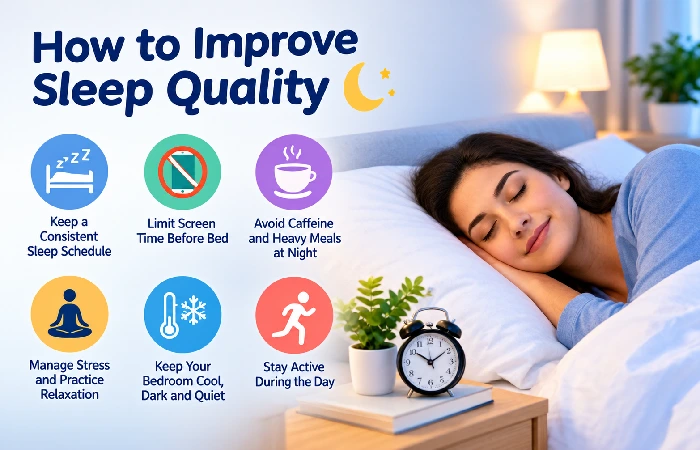
Making better sleep a reality doesn’t require major changes all at once.
Begin with the habits that are likely to impact the most on your lifestyle.
Step 1: Fix your wake-up time
Select a time to get up that you can do, and stick to it.
You must take steps to protect your sleep opportunity.
Step 2: Protect sleep opportunity.
Allow enough time in bed to get the sleep you need for your age.
Step 3: To enhance the bedroom.
Keep the room dark, quiet and comfortable.
Step 4: Reduce evening stimulation
Have more quiet activities at the end of the day.
Step 5: Review caffeine
Try to determine how much and when you are taking in caffeine, if you are having trouble sleeping.
Step 6: Walk around the day
Being active can help you get a good night’s sleep.
Step 7: Manage stress
Take time to relax or deal with stressors earlier in the day.
Step 8: Track patterns
A sleep diary will provide you with clues to make connections between sleep and things like caffeine, naps, medications, alcohol, and your daily routine. The NIH has a sleep diary designed to track these patterns.
A 7-Day Healthy Sleep Reset
If your schedule has become inconsistent, try this simple seven-day approach.
| Day | Focus |
| Day 1 | Choose a consistent wake-up time |
| Day 2 | Adjust bedtime to allow enough sleep |
| Day 3 | Make the bedroom darker and quieter |
| Day 4 | Reduce late-day caffeine |
| Day 5 | Add daytime physical activity |
| Day 6 | Create a 30-minute wind-down routine |
| Day 7 | Review what improved or worsened your sleep |
Don’t count on sleeping perfectly every night. The idea is that they help to set up a routine that will last longer than one week.
When to Talk to a Healthcare Professional
Recognize when it is appropriate to discuss the use of a health care professional.
While good sleep habits may be helpful, they are not a cure-all for all sleep disorders.
If you have any of these symptoms, talk to a health care provider:
- You often have trouble getting to sleep.
- Often wake up in the night.
- Waking up too early and not being able to fall back asleep.
- You are still extremely fatigued after a full night’s sleep.
- You regularly fall asleep unintentionally during the day.
- You snore loudly or wake up gasping or choking.
- You wake up tired after sleep.
- Sleep issues affect functioning at work, school, relationships or activities.
- Your symptoms continue even though you’ve made better sleeping habits.
The NIH recommends talking to a health care provider about any current sleeping problems. Your doctor or other health care professional may ask about your schedule, physical activity, caffeine, medications, daytime sleepiness and more. A sleep diary can also be helpful.
Long-term insomnia
However, if you continue to have trouble sleeping, you will not get restful sleep by trying harder to fall asleep.
Cognitive behavioral therapy for insomnia (CBT-I) is a proven method of treatment for chronic insomnia. CBT-I is a structured therapy that can be used to change thoughts and behaviors that impact sleep, according to the NIH.
Avoid taking sleeping pills or supplements on a regular basis without talking with a health care professional.
Frequently Asked Questions About Healthy Sleep Habits
So, what constitutes healthy sleep behaviors?
The healthy sleep habits are a set of daily activities and setting that promotes enough, regular, healthy sleep.
What is the recommended amount of sleep for adults?
Adults require at least 7 hours of sleep. Adults aged 61-64 years usually require 7-9 hours of sleep, and adults over the age of 65 usually require 7-8 hours of sleep.
Do you think 6 hours of sleep is enough?
Average sleep time of 6 hours is inadequate for regular adults. Usual minimum requirement for adults is 7 hours, depending on individual need.
Which time of day would you prefer to go to sleep?
Everyone has their own individual bedtime. The ideal bedtime is when you can get a proper night’s sleep while also having a schedule that is easy for you to follow based on your daily activities.
Does screen time impact sleep?
Television watching at night can disrupt relaxation and sleep schedules. CDC recommends that you turn off electronic devices at least 30 minutes before your bedtime.
Does caffeine have an impact on sleep?
Yes. Caffeine is a stimulant and may make it difficult to fall asleep if eaten too near the bedtime. The NIH mentions that its effects persist for several hours.
Is exercise good for sleep?
Exercise can help with healthy sleep. Some people, however, experience stimulation by intense exercise just prior to sleep so shifting to earlier in the day may benefit them.
Is there a child’s bedtime routine?
Yes. Having a routine that helps children get ready for sleep can be helpful. Children who fall asleep to the same bedtime routine tend to get sufficient sleep.
Why do I feel tired after I have slept?
There are many possible causes of daytime tiredness, such as insufficient sleep, disturbed sleep, stress, medication and medical conditions or sleep disorders. If ongoing, consult a health care professional.
Are healthy sleep habits a cure for insomnia?
While healthy habits can help, if insomnia persists, more treatment is needed. CBT-I is a treatment based on evidence for persistent insomnia.
When to seek medical advice for sleep?
Professional consultation should be sought if sleep difficulties are ongoing, disruptive or if there is loud snoring, gasping, breathing pauses or excessive daytime sleepiness.
Healthy Sleep Habits: Conclusion
Good sleep is a key element of wellbeing. Good sleep and adequate amounts of sleep can help with physical health, emotional well-being, focus, memory, body metabolism and performance.
Fortunately, there are a number of helpful sleep strategies that are easy and inexpensive. First, try to follow a regular sleep-wake routine. Set aside adequate time to fall asleep, make bed a comfortable place, avoid stimulating activities prior to bedtime, and avoid caffeine later in the day.
In the daytime, remain physically busy and active; spend time outside, where possible; eat regular, balanced meals; and use healthy strategies to reduce stress. Regular bedtime habits and guidelines about screen time at night may be particularly beneficial to children and teens.
Keep in mind that it’s normal to experience some poor sleep from time to time. It’s not necessary that you have an ideal sleep schedule each day. The purpose is to establish habits that will last without fail over time.
If you have a problem with sleeping despite making good changes, do not assume that you just need to be more disciplined. If insomnia, sleep apnea, restless legs syndrome, circadian rhythm disorders, and other afflictions endure, they may need to be evaluated and treated by a professional.
Final Sleep Checklist
- Get the suggested sleep time for your age.
- Try to have a routine for getting to bed and getting up in the morning.
- Create a relaxing bedtime routine.
- Have a comfortable, dark, quiet bedroom.
- Avoid caffeine in the afternoon and evening.
- Don’t eat large meals at night.
- Exercise regularly.
- Get stress in check before bedtime.
- Limit screen time at night.
- Keep children’s sleep patterns regular.
- Discuss ongoing sleep issues with a health care provider.
Sleep is NOT a luxury! It’s a fundamental component of a healthy lifestyle, and simple regular adjustments can help keep you on track for a good night’s sleep.
Dr. Khizrana Begum is a qualified medical professional with MBBS and MD qualifications and 5+ years of experience in the medical field. She works as a General Physician and Dermatologist, with knowledge spanning general medicine, dermatology, preventive healthcare and skin health.
As a medical reviewer, Dr. Khizrana Begum reviews health and wellness content for medical accuracy, clarity and authenticity.
Sameena Begum reviews content for clarity, accuracy and reader usefulness. Her review process helps ensure that published information is clearly presented, relevant and easy for readers to understand.
Syeda Yasmeen is a Health & Wellness Writer at InHumanBeing.com. She creates clear and reader-focused content across health, nutrition, wellness, women’s health, men’s health and babies’ health.