

Last Updated: September 15, 2026
One of the easiest ways to stay one step ahead of possible health issues is to practice preventive care. Preventive health care highlights regular checkups, optional screening, vaccinations, healthy lifestyle selections and early detection, rather than waiting till symptoms are serious. Preventative care may differ from individual to individual in the USA, depending on age, sex, family history, lifestyle, and other risk factors.
For many, healthcare is synonymous with visits to a doctor when they are ill. Preventive care takes a different approach. It enables people to pay attention to their health when they are well, to detect potential hazards early, and to make practical changes that can be part of their efforts to protect health over time.
Preventative care does not mean that someone will never get a disease. But routine preventive services can be used to detect some problems sooner and to allow individuals to take action to reduce health risks before
What Is Preventive Care?
Preventive care refers to services and healthy behaviors that are provided to prevent disease, or to detect health issues early or minimize the chance of complications.
This could be as easy as having your blood pressure checked at your routine health check up, or receiving a recommended vaccine. It may also include cancer screenings, cholesterol screening, diabetes screening, dental exams, mental health screening, lifestyle counseling, and more.
A convenient method for thinking about preventive care is to break it up into 3 phases.
| Type | Main Goal | Examples |
| Primary prevention | Prevent a disease before it starts | Vaccination, exercise, healthy eating |
| Secondary prevention | Find a problem early | Cancer screening, blood pressure checks |
| Tertiary prevention | Reduce complications | Disease management and rehabilitation |
Primary Prevention
Primary prevention happens before a disease develops.
For example, vaccination helps protect against certain infectious diseases. Avoiding tobacco, maintaining a healthy diet, staying physically active, and practicing sun protection are also examples of preventive habits.
Secondary Prevention
Secondary prevention focuses on early detection.
A person may feel perfectly healthy but still have high blood pressure, high cholesterol, or another health problem. Screening can sometimes identify these issues before noticeable symptoms develop.
Tertiary Prevention
Tertiary prevention applies when someone already has a health condition. The goal is to help control the condition, prevent complications, and support quality of life.
For example, regular monitoring and treatment for an existing condition can help reduce the chance of future health problems.
If, for instance, someone is dealing with a condition and getting regular check-ups and treatment, they may lower the likelihood of developing another health problem.
Why Is Preventive Care Important?
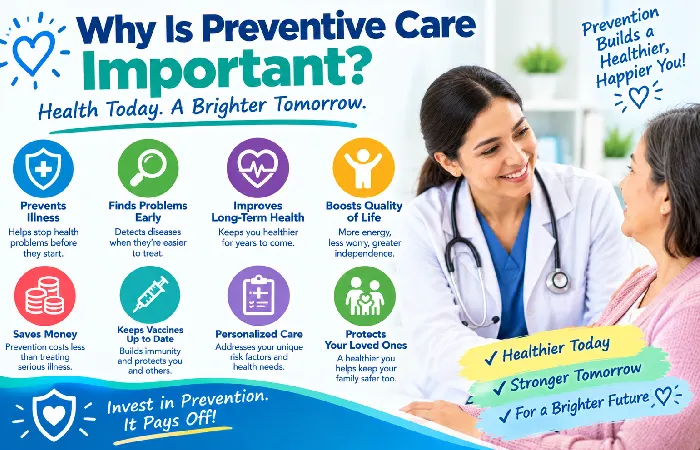
Preventive health care is essential because certain health issues can occur without you knowing it. One might not see something amiss until a situation has developed.
You can have regular healthcare visits where you can talk to a qualified health care professional about your health and see what healthcare services might be suitable for you.
1. It Can Help Find Problems Early
One of the key objectives of preventive health care is early detection.
Screening may help identify: depending on your age and risk factors:
- High blood pressure
- High cholesterol
- Diabetes or prediabetes
- Certain cancers
- Osteoporosis
- Mental health concerns
- Other health risks
While having a problem diagnosed early does not always result in treatment, it provides you and your health care professional with more information and options for decision making.
2. It Helps You
Your family history can give you clues to your future health risks.
For instance, if close family members have had some cancers, heart disease, or diabetes, this info will be taken into account by your healthcare provider in determining what preventive facilities to recommend.
Other factors also may contribute to risk, such as:
- Age
- Smoking history
- Alcohol use
- Diet
- Physical activity
- Weight
- Existing health conditions
- Medications
- Pregnancy history
It Helps with Healthy Lifestyle Changes
3. It Supports Healthy Lifestyle Changes
At a health check-up, you can also talk about:
- Nutrition
- Physical activity
- Sleep
- Stress
- Tobacco use
- Alcohol
- Weight management
- Mental health
It’s easier to make small changes when you understand your own health objectives.
4. It Keeps
It Maintains Up-to-date Vaccinations
Child and adult immunizations are a vital element of precautionary care.
The conclusion is that suggested vaccines depend on several factors, including age, previous immunization, medical history, employment, traveling, etc.
Vaccination agendas may change, so it’s a good idea to periodically check with a health care professional about vaccination status.
5. It Encourages Long-Term Health Planning
Preventive care isn’t a single visit to the doctor.
Consider it a long-term health care plan.
Your needs will vary between childhood and adolescence, adulthood and middle age, and older adulthood. The appropriate screening at one age may not be recommended at another.
Types of Preventive Care
There are a number of services provided under preventive healthcare. Not all of the following services may be needed and the timing of the service will vary for each person.
Routine Checkups
A regular health check-up can be one way to address your health in general.
Your provider might talk with you about:
- Blood pressure
- Weight
- Medical history
- Family history
- Medications
- Vaccinations
- Lifestyle
- Mental health
- Recommended screenings
When you make your appointment, you may have a chance to ask questions about your health.
Health Screenings
Screening is a test to detect specific health problems before symptoms appear.
Common examples include:
- Blood pressure screening
- Cholesterol testing
- Diabetes screening
- Colorectal cancer screening
- Breast cancer screening
- Cervical cancer screening
- Screening for cancer of the lungs for those who are eligible
- Osteoporosis screening
- Not all screens are used for all individuals.
The decision to recommend a screening may depend on other factors, such as age, smoking history, family history and previous test results.
Vaccinations
Immunization provides immunity against some diseases.
Preventive vaccination may involve:
- Childhood immunizations
- Adolescent vaccines
- Adult vaccines
- Seasonal vaccines
- Age-based vaccines
- Risk-based vaccines
- Travel-related vaccines
Dental and Vision Care
Having Vaccination History in order helps identify those vaccines that may need to be discussed with your health care provider.
Preventive health doesn’t have to end at your primary care office.
Oral hygiene is important and can be achieved through regular dental care, which also may help detect oral issues early. Visions care can also be used to discover modifications in vision and some vision troubles.
These services may be recommended to be repeated at different intervals depending on your age and risk factors.
Mental Health Screening
Another aspect of preventive care is mental health.
At visits to health services it can be helpful to talk about:
- Stress
- Anxiety
- Depression
- Sleep problems
- Work-related pressure
- Major life changes
- Substance use
- Emotional well-being
It’s not a mental health problem until it’s a problem.Mental health problems don’t have to be a problem before you talk about it with a health care provider.
Regular Health Checkups and Physical Exams
There is no standard schedule for routine care that will be appropriate for everyone.
A 25-year-old person might need something else as a 55-year-old with family history of heart disease. Children have other preventative needs than older people, too.
When you have a routine check-up, your health care provider will check your:
| Health Area | What May Be Discussed |
| Blood pressure | Cardiovascular risk |
| Weight | Weight-related health risks |
| Medical history | New or ongoing conditions |
| Family history | Inherited or family-related risks |
| Medications | Current medicines and supplements |
| Vaccinations | Whether recommended vaccines are current |
| Lifestyle | Diet, exercise, sleep, tobacco, alcohol |
| Mental health | Mood, stress, and emotional well-being |
| Screenings | Age- and risk-appropriate tests |
Prepare Before Your Appointment
To get the most value out of your preventive care appointment, there are a few things you can do in advance.
Take or have access to:
- This is the list of medicines that you are taking now.
- Supplement information
- Vaccination records
- When available, previous test results.
- Family health history
- Comments on the emergence of symptoms
- Questions regarding recommended screening(s)
You may want to jot your questions down, so you’ll remember to ask important ones.
Preventive Health Screenings
Sometimes, healthcare providers can identify some conditions at an earlier stage by conducting preventive screenings.
Common health checks are for cardiovascular health, diabetes, and certain cancer types.
Common Preventive Screenings
| Screening | What It May Help Identify |
| Blood pressure | High blood pressure |
| Cholesterol | Abnormal cholesterol levels and cardiovascular risk |
| Blood glucose | Diabetes or abnormal blood sugar |
| Colorectal screening | Colorectal cancer or precancerous changes |
| Breast cancer screening | Breast cancer |
| Cervical screening | Cervical cancer |
| Lung cancer screening | Lung cancer in eligible high-risk adults |
| Bone density testing | Osteoporosis |
The important point is that screening recommendations are individualized.
Don’t think that a test that’s recommended for a friend or family member is necessarily correct for you. Talk with your doctor about your medical history, family history and risk factors, as well as your age.
Some health issues can be identified BEFORE they cause symptoms by doing preventive screenings. The appropriate screening schedule is determined by your age, health record and personal risk factors. Check current recommendations for preventive care from the U.S. Preventive Services Task Force (USPSTF) to learn which screenings can be recommended at various ages.
Preventive Care by Lifestyle, Age, and Gender
There is more to preventive healthcare than doctor visits and medical tests. Age-specific care, daily habits and vaccinations also have a significant impact. You may need to adjust your approach over time and it’s important to review your preventive care plan regularly with a healthcare professional.
Vaccinations and Immunizations
Vaccinations are a component of preventative care that can help to prevent infections. There are specific ages for specific vaccines and some adults may require extra vaccines due to age, job, medical issues, travelling, or other risk factors.
Most children are given multiple routine vaccinations early in their childhood and adults may require additional or booster immunizations.
Common Vaccination Categories
| Life Stage | Preventive Focus |
| Babies and children | Routine childhood immunizations |
| Teenagers | Recommended adolescent vaccines |
| Young adults | Catch-up and routine adult vaccines |
| Middle-aged adults | Age- and risk-based vaccines |
| Older adults | Vaccines recommended for older age groups |
| Travelers | Destination-specific vaccines when appropriate |
Seasonal vaccination may also be a valuable preventive health measure. For instance, some people should get the flu vaccine every flu season; other vaccinations might be recommended depending on age and health factors.
Maintain up-to-date immunization records
Centralizing the information on vaccinations helps identify missed or late vaccinations.
These records may be kept of:
- Vaccine name
- Date received
- Dose number
- Healthcare provider
- Any relevant notes
If you don’t know your vaccination status, inquire about your records and what you should do from your health care provider or pharmacist.
Note: Vaccine recommendations may change. Please refer to current CDC recommendations and consult with your healthcare provider for personal needs
Healthy Lifestyle and Disease Prevention
Prevention care also takes place outside of the doctor’s office. The things you do in your daily life can impact your future health.Healthy eating habits, exercise, sufficient sleep, not smoking, stress management and healthy relationships are all factors that can affect general well-being.
Eat a Balanced Diet
The easiest way to maintain a balanced diet is not to over think it.
Make an effort to use a diversity of:
- Vegetables
- Fruits
- Whole grains
- Beans and lentils
- Lean proteins
- Fish and seafood
- Nuts and seeds
- Healthy fats
Low-fat or fat-free dairy or alternatives (unless specified)
To avoid completely banning food categories unless medically necessary, try to get more variety and the right amount of that food.
Simple Healthy Plate
| Plate Section | Examples |
| Vegetables | Broccoli, spinach, carrots, peppers |
| Fruits | Apples, berries, oranges |
| Protein | Fish, chicken, beans, eggs, tofu |
| Whole grains | Brown rice, oats, whole-grain bread |
| Healthy fats | Nuts, seeds, avocado, olive oil |
One practical approach to these principles is a healthy lunch. For instance, a whole-grain wrap filled with chicken or beans, vegetables and fruit can offer a balanced meal.
Stay Physically Active
Exercise is also a key component of disease prevention.
Movement can support:
- Cardiovascular health
- Muscle strength
- Bone health
- Mobility
- Sleep
- Mood
- Weight management
It’s not a must to have an expensive gym membership.
Walking, cycling, swimming, dancing, gardening, and home exercises are all ways to have an active lifestyle.
Make Movement Easier
If you sit a lot throughout the day:
- Get regular short walks.
- Take stairs if possible.
- Talk on the walk.
- Stretch between tasks.
- Make physical activity a priority.
- Select activities that YOU like.
It’s often better to stick with a more moderate activity that you can keep up than opt for something really hard.
Get Enough Sleep
People don’t usually think about sleep when they are considering preventive health.
Lack of sleep may impact on concentration, mood, energy and functioning throughout the day. Chronic sleep issues can also be linked to some health issues.
If you have experienced difficulties sleeping regularly, despite an improvement in sleep routine, consult a health care provider for advice.
Avoid Tobacco
Tobacco is one of the most significant things that individuals can do to safeguard their health.
Smoking is linked to many serious health conditions, such as cardiovascular disease, respiratory disease and several cancers.
If you are a smoker and would like to stop, don’t think you must stop smoking all on your own. Healthcare professionals can provide you with information on smoking cessation methods, medications, counseling, and other resources that can connect with your chances of quitting.
This is because anyone who doesn’t smoke shouldn’t start, and cutting down on second-hand smoke may offer further protection.
Reduce stress and improve emotional wellness.
Emotional and mental health are part of preventive care, too.
Every day is a stress day, but constant stress has an impact on sleep, mood, relationships, and a healthy lifestyle.
Simple strategies include:
- Taking short breaks
- Practicing slow breathing
- Walking outdoors
- Maintaining social connections
- Writing in a journal
- Engaging in pleasant pastimes
- Setting realistic goals
- Use the support of someone you trust
When stress, anxiety, depression and other emotional or psychological issues start to impact daily activities, professional help can be beneficial.
Preventive Care by Age
The nature of preventive health care evolves with aging.
A child, teenager, young adult, middle aged adult and older adult do not have the same healthcare needs.
Life stage general preventive care
| Life Stage | Important Areas to Discuss |
| Infants | Immunizations, growth, development |
| Children | Vaccines, development, vision, hearing, dental care |
| Teenagers | Vaccines, mental health, healthy habits |
| Young adults | Vaccines, mental health, lifestyle, sexual health |
| Middle-aged adults | Cardiovascular risk, cancer screening, lifestyle |
| Older adults | Vaccines, cancer screening, bone health, falls prevention |
These categories are intended as a guideline only. The kinds of preventive services that may be recommended may vary based on personal health history and risk.
Preventive Care for Women
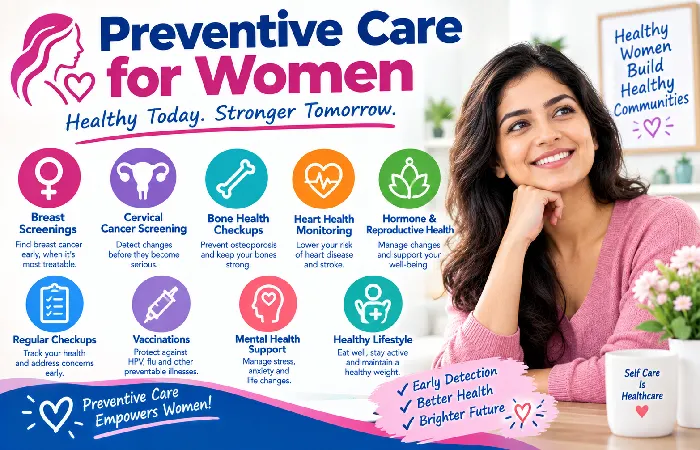
Women’s preventive health care needs can differ across their life span.
Through regular health care, one can have opportunities to discuss:
- Blood pressure
- Cholesterol
- Diabetes risk
- Breast health
- Cervical health
- Bone health
- Reproductive health
- Pregnancy-related care
- Mental health
- Vaccinations
- Lifestyle habits
Breast Health
The advice for breast cancer screening is based on a person’s age and level of risk.
A woman’s personal screening plan should be determined with the counseling of a health care professional, particularly if she has a strong family history or other risk factors.
Cervical Health
Another important aspect of disease prevention is cervical cancer screening.
Screening might include HPV testing, cervical cytology, or both, depending on age and other factors.
Since screening guidelines may evolve, women should always practice screening according to current guidelines from reliable U.S. health authorities and her health-care provider.
Bone Health
With age, bone health becomes more and more important.
Factors that contribute to healthy bones are:
- Adequate nutrition
- Calcium-rich foods
- Vitamin D
- Weight-bearing activity
- Strength training
- Avoiding tobacco
Bone density testing may be recommended for individual women as a function of age and risk.
Women’s Heart Health
Heart disease is a serious health problem and a worry for women’s health and wellness.
Risk factors can be managed by:
- Checking blood pressure
- Monitoring cholesterol
- Staying physically active
- Eat a healthy diet.
- Avoiding tobacco
- Managing diabetes
- Eating well to stay fit and healthy.
Talking to a health care provider about family history.
Sometimes these symptoms of the heart may vary from one person to another and should not be ignored if they are unusual or of concern.
Preventive Care for Men
Even if men feel healthy, they benefit from regular preventive health care.
Some areas of importance might be:
- Blood pressure
- Cholesterol
- Diabetes
- Colorectal cancer screening
- Annual screening for eligible people for lung cancer.
- Prostate health
- Mental health
- Sexual health
- Vaccinations
- Tobacco use
- Alcohol use
- Physical activity
Prostate Health
Screening for prostate cancer is not the best option for all men of the same age.
The decision may be made based on:
- Age
- Family history
- Race and ethnicity
- Personal health history
- Individual risk factors
- Personal preferences
Prostate screening should be considered by men in consultation with their health care provider, and the pros and cons of screening should be discussed.
Men’s Heart Health
There are a number of cardiovascular risk factors that can be lowered with everyday habits and regular health care for men.
Some precautions that can be taken include:
- Monitor blood pressure.
- Do check cholesterol as recommended.
- Stay physically active.
- Follow a well-balanced diet.
- Avoid tobacco.
- Control diabetes (if present).
- Get adequate sleep.
- Discuss family history.
- Maintain a healthy weight.
Preventative health care is especially beneficial because high blood pressure and high cholesterol can go undiagnosed.
Preventive Care Comparison: Women vs. Men
| Preventive Area | Women | Men |
| Blood pressure | Important | Important |
| Cholesterol | Risk-based | Risk-based |
| Diabetes screening | Risk-based | Risk-based |
| Colorectal screening | Age/risk-based | Age/risk-based |
| Breast screening | Applicable | Usually not routine |
| Cervical screening | Applicable | Not applicable |
| Prostate screening | Not applicable | Individual decision |
| Bone health | Important | Also important |
| Mental health | Important | Important |
| Vaccinations | Age/risk-based | Age/risk-based |
This comparison is designed to highlight general differences; it is not meant to be used to replace an individual preventive care plan.
Preventive Care and Everyday Health Tracking
Some health habits are easier to maintain with the use of technology.
Examples include:
- Fitness trackers
- Digital Blood Pressure Monitors.
- Smart scales
- Medication reminder apps
- Sleep trackers
- Health journals
Home Health Tools
| Tool | What It Can Track | Important Note |
| Blood pressure monitor | Blood pressure | Use correctly and discuss abnormal readings |
| Fitness tracker | Steps and activity | Estimates may vary |
| Smart scale | Weight trends | Not a diagnostic device |
| Thermometer | Body temperature | Useful for monitoring illness |
| Health journal | Symptoms and habits | Helps organize information |
These tools can support preventive habits, but they should not be used to diagnose a medical condition on your own.
Preventive Care for Children
Preventative health care is essential for the health and growth of children. Through regular pediatric visits, health care professionals watch the child’s physical growth, behavior, learning, nutrition and more.
The following are general areas of children’s preventive health care services:
- Routine checkups
- Vaccinations
- Growth monitoring
- Developmental screening
- Vision checks
- Hearing checks
- Dental care
- Healthy nutrition
- Physical activity
Mental health and behavioral health; mental disorders.
Children’s Health and Safety Checklist
| Area | Why It Matters |
| Vaccinations | Helps protect against certain infections |
| Growth | Tracks physical development |
| Development | Identifies potential concerns early |
| Vision | Supports learning and daily activities |
| Hearing | Supports communication and learning |
| Dental care | Helps protect oral health |
| Nutrition | Supports healthy growth |
| Physical activity | Supports bones, muscles, and overall health |
Parents should have vaccination, health, and development/behaviour, sleep, nutrition and learning records neatly in order, and discuss with the child’s health care provider any concerns they may have.
How to Create a Preventive Care Plan
A preventive care plan does not have to be complicated. A simple yearly system can help you stay organized.
You can include:
You don’t need to have a complicated area plan for a preventive care. There is a simple system you can follow every year that can help you get organized.
Step 1: Know Your Health History
Start by collecting information about:
- Previous medical conditions
- Surgeries
- Allergies
- Medications
- Vaccinations
- Previous screening results
- Family health history
Family history can be helpful in some instances, as there may be a higher prevalence of certain conditions in families.
Step 2: Start an action plan
Your primary care provider can tell you which preventive services you might need due to your age and risk factors.
At your appointment request:
- What are some of the screenings I should have?
- Do I have up-to-date vaccinations?
- Should I have any blood tests?
- Do I need to make any changes in my lifestyle?
- Are there any family history issues that impact screening?
Step 3: Make a Health Calendar
Keep important appointments in a notebook, on a smartphone calendar or health app.
You can include:
| Task | Status |
| Routine checkup | ☐ |
| Vaccination review | ☐ |
| Dental appointment | ☐ |
| Vision check | ☐ |
| Recommended screenings | ☐ |
| Medication review | ☐ |
| Lifestyle goals | ☐ |
The specific timing for each service should be based on your health-care provider’s orders and latest preventive-health recommendations.
Step 4: Review Your Plan Every Year
Needs for prevention can change.
If you have a new job, are pregnant, taking medication, have a family history, health condition or change in age, care may change.
Look at your preventive plan often, rather than doing the same checklist forever.
Common Preventive Care Mistakes
Some people who are concerned about health may not do a good job with preventive care.
Mistake 1: Waiting Until You Feel Sick
Sometimes, symptoms of some conditions don’t become apparent until they are in a later stage.
Better approach: Follow the proper routine medical and suggested screening procedures.
Mistake 2: Taking on someone else’s screening routine.
Your friend’s health care plan might not work for you.
A better approach is to plan preventive care based on the individual’s age, health history, family history and risk factors.
Mistake 3: Ignoring Mental Health.
Preventative care goes beyond just physical.
Better approach: Talk with a trained or trained specialist about any distressing thoughts, feelings, or issues that persist or are causing any concern, particularly regarding sleep or stress, anxiety or depression.
Mistake 4: Forgetting Vaccination Records
It is possible that people may not be aware of which vaccines they have received.
Better approach: Maintain vaccination data in an orderly fashion and regularly check on it.
Mistake 5: Attempting to do all things at one time.
There are a lot of health objectives listed here that may seem overwhelming.
The better idea is to build in some small, achievable habits, like getting to the gym regularly, taking your lunch to better foods, or getting to bed at the same time every day.
Preventive Care Troubleshooting Guide
| Problem | Practical Solution |
| I don’t know which screenings I need | Ask your healthcare provider to review your age and risk factors |
| I missed a checkup | Schedule an appointment and ask what is currently due |
| My vaccine records are incomplete | Ask your healthcare provider or pharmacist about available records |
| Healthcare costs are a concern | Review your insurance benefits and ask about lower-cost healthcare resources |
| I feel healthy, so I skip checkups | Ask whether you have age- or risk-based preventive services due |
| I have a family history of disease | Share the information with your healthcare provider |
| I receive conflicting health advice online | Use current guidance from trusted medical and government organizations |
| I have too many health goals | Choose one or two manageable changes first |
Preventive Care Tools for Everyday Health
Some simple products and digital tools can make health tracking easier.
| Tool | Useful For | What to Remember |
| Digital blood pressure monitor | Tracking blood pressure | Correct technique matters |
| Fitness tracker | Monitoring activity | Data are estimates |
| Health journal | Recording symptoms and habits | Bring useful information to appointments |
| Medication organizer | Organizing medicines | Follow medication instructions |
| Digital thermometer | Checking temperature | Does not diagnose illness |
| Meal planner | Organizing nutritious meals | Focus on balanced eating |
These tools can support healthy habits but should not replace professional medical evaluation.
Frequently Asked Questions About Preventive Care
What types of preventive care are there?
These can include routine health checks, vaccinations, blood pressure, cancer screening, cholesterol, diabetes screening, dental care, and/or mental health screening.
When should I get a health checkup?
No all-people calendar. The needs you have for healthcare will vary based on your age, health history, family history, and risk factors.
What are the prevention screenings that adult should have?
Blood pressure, cholesterol, diabetes, colorectal cancer, breast cancer, cervical cancer, and lung cancer screening for eligible individuals are examples of common screenings. Recommendations vary from age and risk.
Are there any insurance plans that cover preventive care?
Some preventive services may be covered by health insurance if they meet certain eligibility and plan requirements. Please consult the individual insurance policy for details.
What should be the preventive care for women?
Breast and cervical cancer screening, cardiovascular risk assessment, bone health, reproductive healthcare, vaccines and mental health care could be included in women’s preventive care.
What are the child’s prevention needs?
Typical childhood needs include well-child checks, immunizations, growth and development checks, dental care, and vision, hearing and other age-appropriate screenings.
Are there healthy lifestyle options that are forms of preventative care?
Yes. Exercise, good nutrition, sufficient sleep, abstaining from tobacco and stress management are all important components of good health and risk reduction.
Final Takeaway
Preventative care is a way to take proactive steps now that can help provide better health down the road. All preventive-health measures belong to a comprehensive program including routine checkups, recommended screenings, vaccinations, healthy eating, regular exercise, sufficient sleep, mental health services and tobacco avoidance.
The most critical factor is that preventive care is individual. No one size fits all list exists. Your decisions about health care should be based on your age, medical history, family history, lifestyle and individual risk factors.
Don’t wait until it doesn’t feel right to be proactive when it comes to preventing the issue. Stay organized, ask questions when receiving medical care, be aware of the recommended screening tests, make some lifestyle changes that you can sustain over time.
Use current recommendations from trusted U.S. sources for 2026, such as CDC, U.S. Preventive Services Task Force, NIH, and HHS, screening and vaccination recommendations may change.