
Last Updated: September 14, 2026
First foods are the beginning of your baby’s new and exciting adventure with solid foods. After months of milk – breast milk, infant formula, or both – your baby is now becoming more familiar with new tastes, textures, and feeding skills.
You probably have many questions about first foods. What should a baby eat first? Are fruits and vegetables the best first foods? Should baby start with cereal? How to introduce allergenic foods? What foods should I avoid?
There is no one size fits all first food for every baby. A variety of good, nutritious foods suitable for your baby’s age and stage can be introduced as part of a healthy complementary feeding pattern, as your baby learns new skills and textures.
The following provides all you need to know about best first foods for your baby including iron rich foods, fruits, vegetables, grains, proteins, textures, allergens, and foods to avoid.
What Are the Best First Foods for Babies?
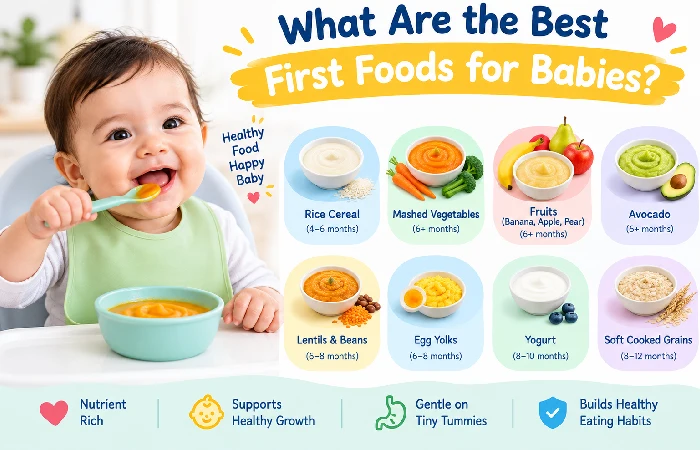
Healthy, soft, and textured – the top first foods for your baby Nutrition first foods that are textured and prepared to match your baby’s developing skills.
Introduce solid foods to your child at approximately six months of age, although the timing depends on your baby’s individual progress. When To Introduce Baby First Foods
What are the signs your baby is ready for the first foods?
These may include:
- Good head and neck control
- Ability to sit with support
- Interest in food
- Opening the mouth when food is offered
- Ability to move food in the mouth and swallow
- Reduced tendency to push food out of the mouth with the tongue
Your pediatrician can help determine whether your baby is ready to begin complementary feeding.
There Is No Single “Best” First Food
Sometimes adults feel that there is a right one for babies to start with. In fact any healthy food may be suitable.
Good first foods often include:
- Iron-rich foods
- Soft vegetables
- Fruits
- Soft grains
- Protein-rich foods
Offering different foods over time can expose babies to a variety of flavors and textures.
Start With Small Amounts
When babies first begin solids, they may eat only a small amount.
At the beginning, solid foods are often about learning and exploration as well as nutrition.
Your baby may:
- Taste a small amount
- Spit food out
- Make unusual facial expressions
- Play with food
- Refuse a new food
These behaviors can be normal.
Repeatedly offering a food can help babies to get to know the taste.
Iron-Rich First Foods
When Is Iron Needed?
Baby’s body needs iron during infancy, especially as baby grows and requires a wider variety of foods and drinks, in addition to milk feeds.
This is why foods rich in iron are commonly considered to be an essential part of complementary feeding.
Feeding and dietary ingredients
What Does Iron Do?
Iron has an important function in the body particularly to grow and develop. Your baby’s nutritional needs are always changing at every age.
- Meat
- Poultry
- Fish
- Eggs
- Beans
- Lentils
- Iron-fortified infant cereals
- Tofu
Keep the following in mind when preparing food for your growing baby – and serve foods as age appropriate.
For example, meat may require cooking until soft then in an appropriate texture for your baby’s age.
Combining Iron With Other Foods
As babies become accustomed to solids, parents can gradually offer combinations of nutritious foods.
For example:
- Lentils with vegetables
- Iron-fortified cereal with fruit
- Soft meat with mashed vegetables
- Beans with soft grains
Offering variety can help babies experience different tastes while receiving a range of nutrients.
Fruits and Vegetables for Babies
Additional breast milk may be another food for some babies. Fruits and vegetables can be great foods to introduce and them to new tastes, colours and textures.
| Examples and Key Information | Category |
| Fruits and vegetables provide a range of nutrients and allow your baby to learn different flavours, textures and colours. | Why Fruits and Vegetables Are Important |
| Banana, pear, mango, papaya, peach, avocado and other ripe, soft fruits prepared appropriately. | Baby-Friendly Fruits |
| Sweet potato, carrot, pumpkin, peas, broccoli, cauliflower, zucchini etc, cooked until soft when necessary. | Baby-Friendly Vegetables |
| Soft, ripe fruits can usually be mashed or prepared appropriately. | Soft Fruits |
| Firmer fruits such as apples and pears can usually be cooked and softened until suitable. | Cooked Fruits |
| Hard vegetables should generally be cooked until suitable for the stage of development. | Soft-Cooked Vegetables |
| Allow your baby time to explore new foods gradually and offer a range of colours for variety. | Introducing New Foods |
| Combine the colors – a variety of colored fruits and vegetables can help with dietary variety. | Different Colors |
| Observe your baby’s feeding skills before offering different textures – just as your baby masters a level of feeding skills, introduce textured foods as your baby is ready to chew and swallow. | Different Textures |
| It can take several times offering a food before a baby will eat it. Please do not force feed and offer again later. | If Your Baby Refuses a Food |
| Wash all produce, prepare foods by cooking, peeling, mashing or cutting food to reduce choking hazards. | Safe Preparation |
| Consider the size, shape and texture of food, and supervise your baby while eating. | Choking Safety |
Baby-Friendly Grains
Grain foods can be nutritious foods that provide energy and nutrients as part of a healthy diet.
When starting grains, select ones that a baby can safely manage according to their development.
Examples of Baby-Friendly Grains
Appropriate options may include:
- Oats
- Rice
- Wheat
- Barley
- Millet
- Other whole grains prepared in an appropriate texture
Some babies may begin with soft porridge or infant cereal.
Infant Cereals
Iron-fortified infant cereals can be one option for introducing grains and iron.
Cereal can be mixed with water, milk or liquid from cooking and softened to a suitable texture for the infant.
Parents can introduce new cereal foods and textures as their babies become more comfortable with a range of solid foods.
Offer Variety
There is no need to rely on only one type of grain.
Offering different foods can help create a more varied diet.
For example, babies may gradually try:
- Oatmeal
- Soft rice
- Millet porridge
- Soft pasta
- Other appropriately prepared grains
Food texture should always match the baby’s developmental skills.
Protein Foods for Babies

Protein is a essential nutrient for growth and development.
Babies can begin to slowly add other protein foods as complementary foods.
Animal-Based Protein Foods
Depending on age and developmental readiness, options may include:
- Chicken
- Turkey
- Beef
- Fish
- Eggs
These foods should be thoroughly cooked and prepared in a safe texture.
Plant-Based Protein Foods
Plant-based options may include:
- Lentils
- Beans
- Chickpeas
- Tofu
- Peas
These foods can often be mashed or softened to make them easier for babies to eat.
Introducing Protein Variety
Offering different protein sources can help provide nutritional variety.
Parents can gradually introduce new foods while observing how their baby responds.
There is no need to introduce many foods at once.
Taking a gradual approach can make it easier to observe your baby’s preferences and any unusual reactions.
Introducing Different Textures
Texture is an important part of learning to eat.
Babies do not need to remain on completely smooth purees for an extended period.
As babies develop, they can gradually learn to manage different textures.
Starting With Smooth Textures
Some babies begin with:
- Purees
- Mashed foods
- Soft foods
These textures can help babies become familiar with eating from a spoon.
Moving to Thicker and Mashed Foods
As babies gain experience, they may be ready for thicker foods.
Examples include:
- Mashed vegetables
- Mashed fruits
- Soft lentils
- Thick porridge
This stage helps babies experience more variety.
Introducing Soft Pieces
Older babies who have developed appropriate eating skills may begin exploring soft pieces of food.
Examples may include:
- Soft-cooked vegetables
- Ripe fruit
- Soft grains
- Appropriately prepared protein foods
Food should always be prepared to reduce choking risks.
Why Texture Progression Matters
Learning different textures can support the development of feeding skills.
Babies gradually learn to:
- Move food around the mouth
- Chew
- Swallow different textures
- Use their hands
- Feed themselves
Every baby develops at an individual pace.
If you have concerns about your baby’s ability to manage food textures, speak with a pediatrician or feeding specialist.
How to Introduce Potential Allergens
Introducing potential food allergens is an important topic for parents.
Common food allergens include:
- Peanuts
- Eggs
- Milk
- Wheat
- Soy
- Fish
- Shellfish
- Tree nuts
- Sesame
Recommendations may differ based on the risk factors and medical history of your baby. That’s why we recommend you to consult your doctor, if you have any concerns about the exposure of your baby to the allergenic foods.
Introducing Allergens Safely
When introducing a new potentially allergenic food:
- Choose a time when you can observe your baby.
- Introduce the food in an age-appropriate form.
- Start with a small amount.
- Avoid forms that create a choking risk.
- Watch for unusual reactions.
For example, whole nuts and thick spoonfuls of nut butter can present choking hazards for young children.
Foods should always be modified into an age-appropriate form.
Signs of a Possible Food Reaction
Food reactions can vary.
Possible symptoms may include:
- Hives
- Swelling
- Vomiting
- Skin changes
- Breathing difficulties
Be aware of the signs of severe allergic reaction which requires urgent medical attention If your baby has a known allergy, severe eczema, previous food reaction or other medical problem, speak to your doctor before exposing your baby to potential food allergens.
Don’t delay seeking medical advice
If you think your baby has had a food reaction, call a medical professional.
Do not keep feeding the suspected food.
Foods to Avoid for Babies
Not all foods are suitable for your baby. There may be some foods that are not suitable for your baby for a variety of reasons. These foods may be associated with a choking risk or for reasons related to food safety or food and nutrition concerns.
Honey
Do not give honey (including honey in foods and drinks) to infants under 12 months of age because of the risk of infant botulism. Cow’s milk as the main drink. During the first year, the main milk for your baby is breast milk or infant formula (see above). Your doctor will tell you when and how you should start to introduce cow’s milk.
Foods with added salt
Total amount 0-6 months 7-12 months 1-4 years 5+ 6 years – adults Do not add salt to baby food. Use foods with little processing as much as possible. Foods high in added sugar.
There are no benefits to giving your baby foods or drinks high in added sugar. It’s best to avoid using sugar foods.
Choking Hazards
Some foods can create a choking risk.
Examples may include:
- Whole nuts
- Popcorn
- Hard candy
- Whole grapes
- Large chunks of raw vegetables
- Large pieces of hard food
Foods that are cut into soft, mushy, or unprocessed forms are needed to be tailored to your baby’s created constraints (such as the age and abilities).
Unpasteurized Foods
These can present deadly bacteria.
Parents should always abide by local food safety tips when providing foods for your baby.
Undercooked Protein Sources
Foods like meat, seafood, and poultry may be contaminated. May perhaps pose foodborne disorder threats. All of these food sources ought to be eaten well-cooked and sourced safely.
Final Thoughts
Deciding on first foods for your baby What to feed your baby doesn’t have to be confusing. Remember there isn’t one specific first food that all babies have to eat. A healthy approach is to feed your baby lots of different, healthy foods that are appropriate for your baby’s age. Iron-rich foods, vegetables, fruits, grains and proteins foods are all likely to have a place in your baby’s diet as they learn to eat different foods.
Take into account that your baby learns to eat. She might like something today and not tomorrow. She might eat two bites the first time and then eat all day simply touching the food.
Be patient. Vary what she eats and watch for her preferences or distress and stop when she is full. Feed her safely and see the doctor when you are concerned about allergies, feeding or nutrition.