

Last Updated: September 14, 2026
The infant feeding schedule is subject to considerable modifications during the first year of their life. The newborn requires multiple feeds of milk during the day and night periods, while the older babies start to develop feeding patterns and eat solid foods. Most infants by the age of one year already have feeding times including breast feeding/formula feeding as well as solid foods.
However, each infant has an individual schedule of feeding that is influenced by appetite, development rate, sleeping patterns, nutrition type, etc.
Therefore, it would be better to follow the baby’s signals of hunger/satiety and overall health, but not the strict feeding schedule.
The feeding schedule described below is quite flexible and will meet the needs of the infant in feeding during all developmental stages ranging from newborn to 12 months of age.
Newborn Feeding Schedule
Feeding is the most erratic activity in the newborn period. The infant has a small stomach that grows fast, hence requiring feeding at frequent intervals.
During the first few days, some infants will require 2-3 feeds an hour, while some others will require to be fed even more frequently.
A breastfed infant will take 8-12 feeds in a day, and an infant who takes bottles will take 8-12 feeds a day.
A typical feeding schedule for newborns
The feeding schedule of newborn babies is as follows:
- Early morning feed
- Morning feed
- Late morning feed
- Afternoon feed
- Evening feed
- Night feed
There is yet another type of feeding pattern some newborn babies display, and it is called cluster feeding, in which the baby is happy to have multiple feeds in one day, especially during growth and particularly in the evening.
Should There Be a Feeding Schedule for Infants?
Infants cannot be put on a feeding schedule since most of them are not ready for that.
What parents need to do within the first few weeks is to follow responsive feeding practices.
Early hunger cues may be as follows:
- Rooting
- Mouth open
- Turning head towards the breast/bottle
- Hand sucking
- Smacking lips
Crying is a late hunger cue.
Parents are obliged to follow the advice of their infant’s pediatrician in case there are any medical problems or the baby is born prematurely/has problems gaining weight.
Feeding Schedule for Babies 2 Months Old

When it comes to two-month-old babies, some of them begin having certain feeding patterns. However, feedings may differ greatly.
They are still receiving their nourishment either from breast milk or formula.
Breastfed 2 Month Old Baby
Formula-Fed 2 Month Old Baby
Sample 2 Months Feeding Schedule
Feeding Schedule for 4-Month-Old Babies
Baby food such as breast milk or formula should be a baby’s main source of nutrition.
Changes You Might See at Four Months
The four-month-old baby can:
- Have bigger feedings
- Feed more efficiently
- Get more distracted while feeding
- Have a more predictable day routine
- Have some changes in sleeping habits
Some babies become very distracted since they pay more attention to what is happening around.
Feeding a baby in a calm and comfortable environment will be easy.
Should a 4-Month Baby Have Solid Foods?
The majority of babies are not ready for solid foods just because they are four months old.
The parents should not give solid foods to their babies just because the babies are hungrier.
Sample 4-Month Feeding Routine
There can be several milk feedings at different times during the day:
- Morning feeding
- Mid-morning feeding
- Midday feeding
- Afternoon feeding
- Evening feeding
- Before-bedtime feeding
- Overnight feeding when necessary
Feeding Schedule for 6-Month-Old Babies
Most babies will reach another highly critical feeding stage at around six months.
There is nutritional value in breast milk or formula feeding, but it may be the right time to feed complementary foods.
The feeding of complementary foods does not mean that one needs to stop breastfeeding abruptly.
Introduction of Solid Foods
The feeding of complementary foods is done if there are developmental milestones attained by the babies.
Some of the signs include:
- Good control of the head and neck
- Able to sit with support
- Some interest in foods
- Opening the mouth upon offering them some foods
- They can move food to the back of the mouth in order to swallow.
Parents should seek advice from their pediatricians on the best way to introduce complementary foods.
What Can a Six Month Old Eat?
There are different varieties of soft and age-appropriate foods that one can feed the infant.
Some foods can include:
- Foods that contain iron
- Softer vegetables
- Mashed fruits
- Softer grains
- Pureed or mashed foods
- And other foods for the family appropriate for the babies
Feeding Schedule for 9-Month-Old Babies
At nine months, infants might be getting used to eating solid foods.
Infants at nine months old can already be consuming a number of solid food meals and will still be taking their milk or formula milk.
Changes at 9 Months Old
The 9-month-old infant may:
- Consume varied foods
- Try varied textures
- Consume foods by chewing
- Utilize their fingers in picking up food
- Consume water in cups
- Participate more in meals
Infants at this age are just learning.
Typical Feeding Schedule for 9-Month-Old Babies
It may comprise the following:
- Milk in the morning time
- Breakfast
- Milk at midmorning time or a snack
- Lunch
- Milk in the afternoon time
- Supper
- Milk before sleeping
Healthy Eating Practices
Parents can foster healthy eating practices in babies by:
- Providing a variety of foods
- Letting babies explore foods in a safe way
- No pressure in consumption of food
- Paying attention to cues for hunger and satiety
- Establishing a comfortable mealtime atmosphere
Feeding Schedule for 12-Month-Old Babies
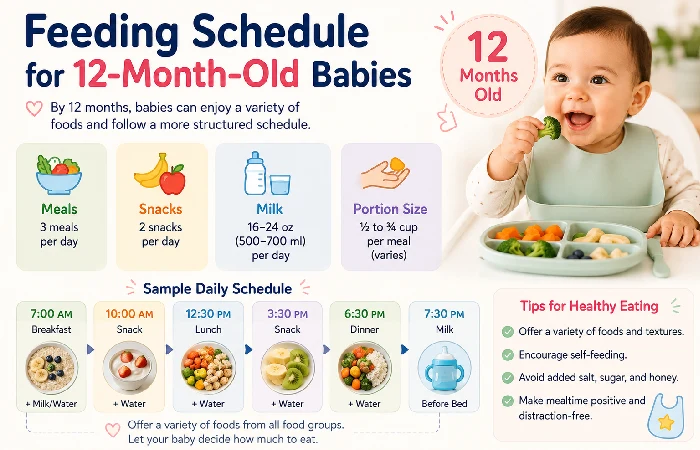
However, their feeding requirements may still differ greatly.
For example, the average one-year-old baby can have:
- Breakfast
- Lunch
- Dinner
- Healthy snacks between the meals
There may also be a difference in the consumption of milk and feeding recommendations.
Foods for a One-Year-Old
Foods that one-year-old children can eat include:
- Fruits
- Vegetables
- Whole grains
- Protein foods
- Dairy foods
- Quality fats
It is important to make the food free from choking hazards.
In some cases, foods may be cut, softened, etc., depending on the chewing abilities of the child.
12-Month Feeding Schedule Sample
The common schedule includes:
Morning
- Breakfast
- Milk or beverages
Mid-morning
- Snacks if needed
Afternoon
- Lunch
Afternoon snack
- Healthy snack
Evening
- Dinner
How Baby Feeding Needs Change With Age
There is a lot of variation in a baby’s nutritional requirements in the first year.
Knowledge of this variation can assist parents in adapting the feeding process without necessarily adhering to the same timetable all the time.
From Birth to About 6 Months
In the early months, the baby gets her nutritional requirements through breast milk or infant formula.
The reasons for the frequent feeds include the following:
- Low stomach capacity
- Fast growth rate
- Nutritional requirements
The main concern is still with milk feeding.
About 6 Months
Most babies get started on complementary foods.
At this stage, the emphasis should not only be on feeding the baby more foods.
It is at this point that babies learn:
- Novel tastes
- Novel textures
- Chewing
- Swallowing
- Eating habits
Breast milk or formula remains important for nutritional intake.
About 9 Months
At this age, there will be more focus on solid foods.
The baby will be eating more meals and trying out new textures.
Milk feeds will still be done.
About 12 Months
At this point, most children are already getting used to family-style meals, including more meals and snacks.
Final Thoughts
There are huge changes in the feeding schedule of babies that occur within one year of a baby’s life. Babies need many feedings, and by the time they are six months old, they will be able to take solid food.
Until about six months, the baby will be taking either breast milk or formula. Within a matter of a few months, the babies begin introducing complementary foods and new feeding patterns. At the age of nine to twelve months, feeding becomes a scheduled meal/snack time for the babies.
The most important thing that should be known is that not all babies are the same. Instead of comparing the feeding schedule of your baby with another baby’s, it is better to concentrate on the baby’s signs of hunger or fullness as well as growth and development.
In case of any queries regarding feeding schedule, intake of milk, introduction to solids, and growth and development, don’t hesitate to get in touch with your pediatrician.