
 Syeda Yasmeen
Health & Wellness Writer Syeda Yasmeen creates clear and
reader-focused content covering health,
nutrition, wellness, women’s health,
men’s health and babies’ health.
Read Full Bio of Author →
Syeda Yasmeen
Health & Wellness Writer Syeda Yasmeen creates clear and
reader-focused content covering health,
nutrition, wellness, women’s health,
men’s health and babies’ health.
Read Full Bio of Author →
 Sameena Begum
Health, Technology & Digital Content Reviewer Sameena Begum reviews selected content
for clarity, factual presentation,
consistency and reader usefulness.
Read Full Bio of Reviewer →
Sameena Begum
Health, Technology & Digital Content Reviewer Sameena Begum reviews selected content
for clarity, factual presentation,
consistency and reader usefulness.
Read Full Bio of Reviewer →
 Dr. Khizrana Begum
General Physician and Dermatologist Dr. Khizrana Begum is a qualified medical
professional with MBBS and MD qualifications
and 5+ years of experience. She reviews health
and wellness content for medical accuracy,
clarity and responsible presentation.
Read Full Bio of Medical Reviewer →
Dr. Khizrana Begum
General Physician and Dermatologist Dr. Khizrana Begum is a qualified medical
professional with MBBS and MD qualifications
and 5+ years of experience. She reviews health
and wellness content for medical accuracy,
clarity and responsible presentation.
Read Full Bio of Medical Reviewer →
A healthy breakfast for weight loss must be a lot extra than just calorie burners. It would make you feel full. It delivers helpful nutrients and make you feel energized for the morning. Usually a practical breakfast contains a source of protein, fibre, whole food carbohydrates and a little healthy fat.
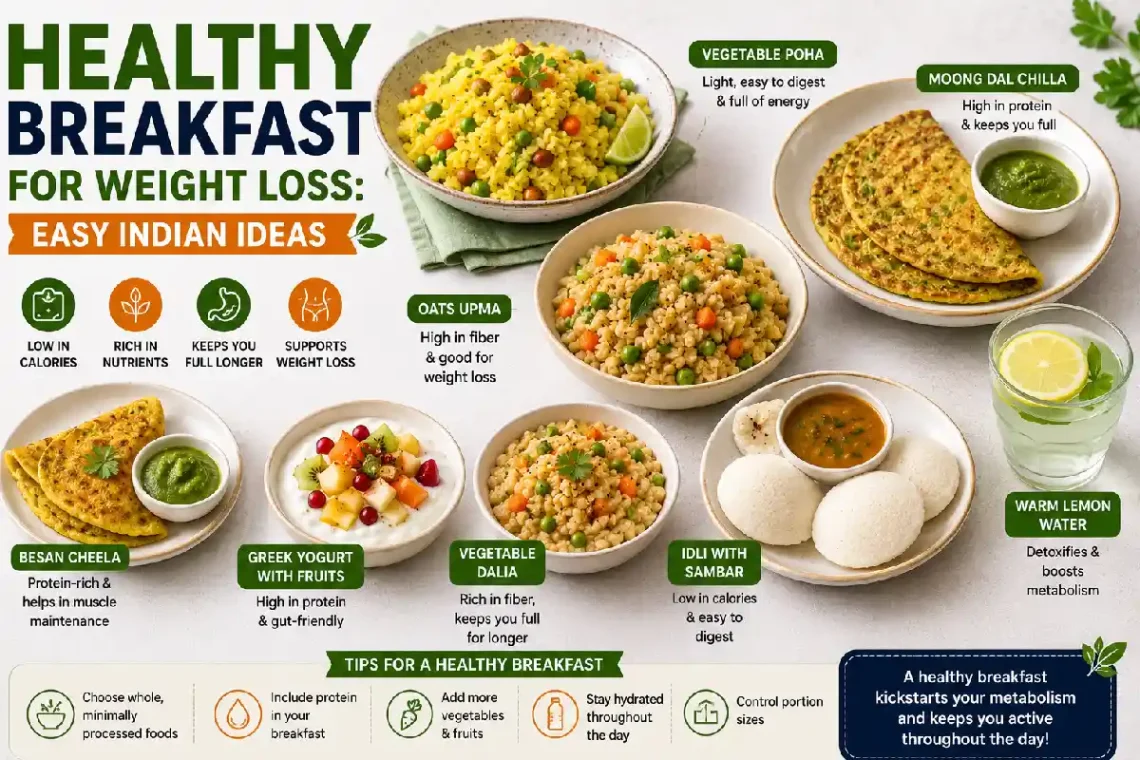
It is not a stuff of fancy recipes or complex foods which is luxurious. Indian options like idli, eggs, dal chilla, oats, poha, curd, vegetables, sprouts and millets can fit into a diet-friendly breakfast. If taken in proper amounts and prepared in an right manner.
❝
This article is part of
Weight Loss Nutrition Hub
Why Breakfast Matters for Weight Loss
Not everybody desires to eat breakfast. Missing breakfast does not guarantee weight loss. It’s all about your calorie intake, food quality, activity and uniformity.
But eating a well-balanced breakfast can benefit some to combat hunger throughout the day. Foods that are high in refined carbs and sugar can make for a more unfilled meal. While eating foods that are higher in protein and fibre can aid fill you up.
| Breakfast pattern | What you may notice | Better approach |
| Sugary cereal + sweet drink | Low protein, easy to overeat | Add milk/curd and fruit |
| 2–3 biscuits + tea | Small meal with little protein | Add eggs, sprouts or curd |
| Large portion of poha | Can become calorie-heavy | Add vegetables and peanuts in a controlled portion |
| Paratha + butter | High calorie if portions are large | Use less oil and add curd/vegetables |
| Protein + fiber breakfast | More balanced and filling | Keep this as the regular pattern |
The takeaway: It’s not essential to have a big breakfast. The goal is to make a breakfast that is appropriate for your energy requirements and aids to maintain a fruitful eating strategy.
A healthy breakfast can provide a nutritious start to the day and fit into a balanced approach to weight management. Explore our complete diet plan for weight loss for practical guidance.
What Makes a Healthy Weight Loss Breakfast?
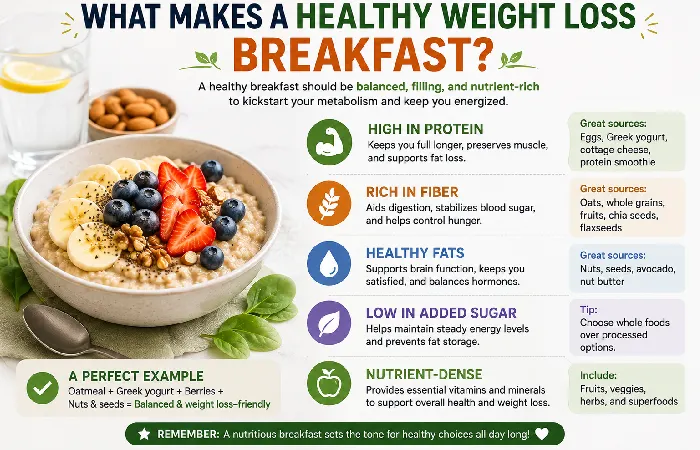
The formula is as simple as:
Protein + fibre rich food + whole-food carbohydrate + fruit/vegetable + controlled healthy fat
| Food component | Indian examples | Why include it? |
| Protein | Eggs, curd, paneer, dal, sprouts | It supports in fullness and helps meet protein needs |
| Fiber | Vegetables, oats, fruits, whole grains | It help in adding volume and supports digestive health |
| Carbohydrates | Oats, poha, idli, millet, whole-wheat roti | It Provides energy |
| Healthy fat | Nuts, seeds, limited peanut chutney | It Gives adds flavor and nutrients |
| Fruit/vegetables | Apple, guava, papaya, tomato, spinach | It helps in adds vitamins, minerals and fiber |
The ICMR-NIN Dietary Guidelines for Indians state that instead of concentrating on one ‘super food’ it is healthier to follow a diversified diet consisting of various food groups.
A balanced breakfast can include whole grains, fruits, vegetables, and protein-rich foods. For more evidence-based guidance, see Healthy Eating for Weight Management from NIDDK.
High-Protein Breakfast Ideas
Protein is helpful in a diet for weight loss because it can help to make a meal more filling. But it’s not necessary to make breakfast a very high-protein meal.
| Breakfast | Simple serving idea | Protein source | Weight-loss tip |
| 2 eggs + vegetables | Eggs with tomato/spinach | Eggs | Limit added oil |
| Moong dal chilla | 2 small chillas | Moong dal | Add vegetables |
| Besan chilla | 2 small chillas | Gram flour | Use little oil |
| Curd + oats | Plain curd with oats | Curd | Avoid sweetened curd |
| Paneer bhurji | Small bowl + roti | Paneer | Choose a suitable portion |
| Sprouts bowl | Sprouts + vegetables | Sprouts | Avoid sugary sauces |
| Idli + sambar | 2 idlis + sambar | Lentils in sambar | Keep coconut chutney moderate |
In a vegetarian diet, a variety of pulse, dairy, soy, nuts and seeds can be used throughout the day to make up for a protein-heavy diet.
Choosing nutritious foods in the morning can help create balanced meals that support a consistent eating routine. Explore our best foods for weight loss for helpful ideas.
High-Fiber Breakfast Ideas
Low-glycemic diets that are high in fibre can be used to bulk up meals. It follows a healthy eating pattern. Fruits and vegetables, whole grains, pulses and legumes are useful sources.
| Breakfast | Fiber source | Easy improvement |
| Vegetable poha | Vegetables + flattened rice | Add peas and vegetables |
| Oats porridge | Oats + fruit | Add seeds without overdoing portions |
| Vegetable upma | Semolina + vegetables | Increase vegetables |
| Ragi dosa | Ragi | Pair with sambar |
| Whole-wheat vegetable sandwich | Whole grains + vegetables | Use less spread |
| Fruit + plain curd | Fruit | Choose whole fruit instead of juice |
| Moong chilla | Moong + vegetables | Add a vegetable filling |
A handy advice is ‘add’ rather than ‘remove’. Do not just eliminate food from breakfast. But also introduce some vegetables, pulses, fruit or other fewer processed food. It will enhance the nutritional value of the meal.
Low-Calorie Breakfast Ideas
Low calorie does not mean low calories. If you eat a very small breakfast then you can be hungry during the day. Less likely to manage your food consumption.
| Breakfast idea | Approximate calorie level | How to make it lighter |
| Vegetable oats | Moderate | Use vegetables and limited oil |
| 2 idlis + sambar | Moderate | Keep chutney portion controlled |
| Moong dal chilla | Moderate | Cook with minimal oil |
| Vegetable poha | Moderate | Increase vegetables |
| Plain curd + fruit | Moderate | Avoid added sugar |
| 2 boiled eggs + vegetables | Moderate | Avoid calorie-heavy sauces |
Calories vary considerably with recipe, ingredients, portion size and cooking oil. These are not set calorie limitations.
Including protein-rich options at breakfast can add variety and help create a more balanced morning meal. Explore our high-protein diet plan for weight loss for practical tips.
Don’t select only a breakfast that has a certain number of calories, just because that’s what a website recommends. Your total calorie requirement depends on factors such as body size, age, activity and individual goals.
Healthy Indian Breakfast Options
Indian food is beneficial for weight loss. The traditional food does not need to be eliminated for the “diet foods” of the Western countries.
Make Indian breakfast more weight-loss friendly.
| Indian breakfast | Make it more weight-loss friendly |
| Idli + sambar | Choose a sensible idli portion and more sambar |
| Vegetable poha | Add vegetables and control peanuts/oil |
| Upma | Increase vegetables and control oil |
| Dal chilla | Add vegetables and use limited oil |
| Besan chilla | Pair with curd or vegetables |
| Ragi dosa | Pair with sambar instead of large chutney portions |
| Vegetable paratha | Use limited oil and pair with plain curd |
| Egg bhurji + roti | Add vegetables and control oil |
| Sprouts chaat | Use lemon and vegetables instead of sugary sauces |
Quick Breakfasts for Busy Mornings
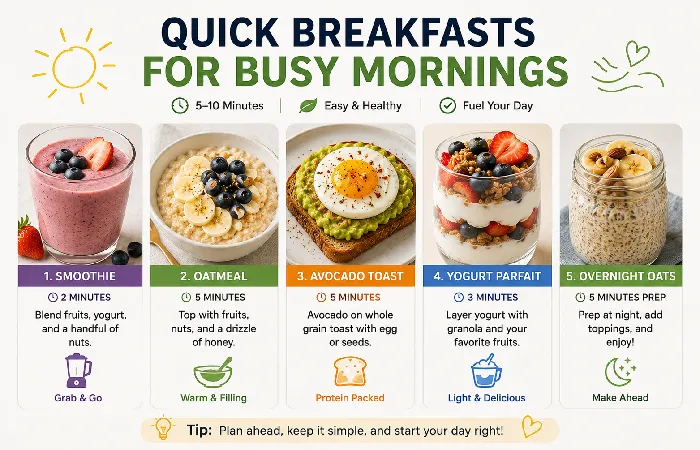
Not having sufficient time does not mean you cannot make breakfast something other than biscuits or snack packets.
Calorie-conscious breakfast choices can be incorporated into a balanced eating routine when paired with nutritious ingredients and appropriate portions. Explore our low-calorie diet plan for weight loss for useful guidance.
| Time available | Breakfast | Preparation |
| 5 minutes | Curd + fruit + small amount of nuts | No cooking |
| 5–10 minutes | Boiled eggs + fruit | Prepare eggs in advance |
| 10 minutes | Vegetable oats | Quick stovetop meal |
| 10 minutes | Moong chilla batter | Keep batter ready |
| 10 minutes | Vegetable sandwich | Use whole-grain bread |
| 15 minutes | Idli + sambar | Use previously prepared food |
Have 2 – 3 good breakfast thoughts that you can count on calling out in the morning rather than having to discovery a new recipe each day.
Make-Ahead Breakfast Ideas
When time is limited, making your own meals can diminish the craving for sugar and highly processed food options.
| Make ahead | Storage idea | Morning use |
| Boiled eggs | Refrigerate safely | Pair with fruit/vegetables |
| Chilla batter | Refrigerate | Cook fresh in minutes |
| Chopped vegetables | Refrigerate properly | Add to poha/oats/eggs |
| Overnight oats | Refrigerate | Add fruit before eating |
| Cooked sprouts | Refrigerate safely | Make a quick chaat |
| Homemade idli batter | Refrigerate | Steam fresh idlis |
Follow standard food safety procedures. Don’t let cooked foods sit out for extended times in unsafe temperatures.
Breakfast Foods to Limit
Quitting your favorite foods is not all or nothing it’s just quitting them less often. Instead, focus on foods which can contribute a lot of calories without filling breakfast up very much.
Planning breakfast ahead can make it easier to maintain consistent meals and healthy eating habits throughout the day. Explore our weight loss meal plan for practical ideas.
| Food to limit | Why it can be a problem | Better choice |
| Sugary cereals | Added sugar, low satiety | Oats with fruit |
| Sweetened tea/coffee | Liquid calories can add up | Reduce sugar gradually |
| Biscuits | Easy to eat in large amounts | Eggs, curd or fruit |
| Pastries | Often high in sugar and fat | Whole-food breakfast |
| Fried breakfast foods | More calorie-dense | Steamed/grilled options |
| Sweetened yogurt | Added sugar | Plain curd + fruit |
| Fruit juice | Less filling than whole fruit | Whole fruit |
There is no need to be perfect. Even an occasional favorite food will fit into a balanced diet.
Nutritious snacks can complement a healthy breakfast and help add variety to your daily eating routine. Explore our healthy snacks for weight loss for helpful options.
How to Build a Balanced Breakfast
Follow this easy checklist when making breakfast:
| Step | What to do | Example |
| 1 | Choose protein | Eggs, dal, curd or sprouts |
| 2 | Add fiber | Vegetables or whole fruit |
| 3 | Add a carbohydrate source | Oats, poha, idli or millet |
| 4 | Control added fat | Measure oil, nuts or seeds |
| 5 | Avoid unnecessary sugar | Choose unsweetened drinks |
| 6 | Check portion size | Eat enough, not excessively |
| 7 | Adjust to your day | More food may be needed if activity is high |
Adjust to your day – 7: More food may be required if activity is high
Example Balanced Breakfasts
- Option 1: 2 moong dal chillas made and filled with vegetable and plain curd.
- Either 2 idlis with vegetable sambar and a small portion of chutney.
- Option 3: Vegetable oats + 1-2 eggs
- Plan 4: Plain curd, oats, whole fruit and a small amount of nuts
- Option 5: Vegetable poha + sprout/curd
Final Takeaway
The ideal healthy breakfast to lose weight is a meal that you can eat regularly. It doesn’t have to be costly, complicated or very low calorie.
Eat Protein, Fiber, whole-food carbohydrates, fruits and/or vegetables, and appropriate amounts of food. Idli, poha, dal chilla, oats, ragi dosa and eggs are all perfect options to include in a weight loss diet.
Most of all, don’t treat breakfast as individual meal – treat it as part of the day’s diet. A balanced breakfast is a great help to reach your goals, but if you want to lose weight sustainably, it’s all about your eating pattern, your activity, your sleep and long-term consistency.
Dr. Khizrana Begum is a qualified medical professional with MBBS and MD qualifications and 5+ years of experience in the medical field. She works as a General Physician and Dermatologist, with knowledge spanning general medicine, dermatology, preventive healthcare and skin health.
As a medical reviewer, Dr. Khizrana Begum reviews health and wellness content for medical accuracy, clarity and authenticity.
Sameena Begum reviews content for clarity, accuracy and reader usefulness. Her review process helps ensure that published information is clearly presented, relevant and easy for readers to understand.
Syeda Yasmeen is a Health & Wellness Writer at InHumanBeing.com. She creates clear and reader-focused content across health, nutrition, wellness, women’s health, men’s health and babies’ health.