
 Syeda Yasmeen
Health & Wellness Writer Syeda Yasmeen creates clear and
reader-focused content covering health,
nutrition, wellness, women’s health,
men’s health and babies’ health.
Read Full Bio of Author →
Syeda Yasmeen
Health & Wellness Writer Syeda Yasmeen creates clear and
reader-focused content covering health,
nutrition, wellness, women’s health,
men’s health and babies’ health.
Read Full Bio of Author →
 Sameena Begum
Health, Technology & Digital Content Reviewer Sameena Begum reviews selected content
for clarity, factual presentation,
consistency and reader usefulness.
Read Full Bio of Reviewer →
Sameena Begum
Health, Technology & Digital Content Reviewer Sameena Begum reviews selected content
for clarity, factual presentation,
consistency and reader usefulness.
Read Full Bio of Reviewer →
 Dr. Khizrana Begum
General Physician and Dermatologist Dr. Khizrana Begum is a qualified medical
professional with MBBS and MD qualifications
and 5+ years of experience. She reviews health
and wellness content for medical accuracy,
clarity and responsible presentation.
Read Full Bio of Medical Reviewer →
Dr. Khizrana Begum
General Physician and Dermatologist Dr. Khizrana Begum is a qualified medical
professional with MBBS and MD qualifications
and 5+ years of experience. She reviews health
and wellness content for medical accuracy,
clarity and responsible presentation.
Read Full Bio of Medical Reviewer →
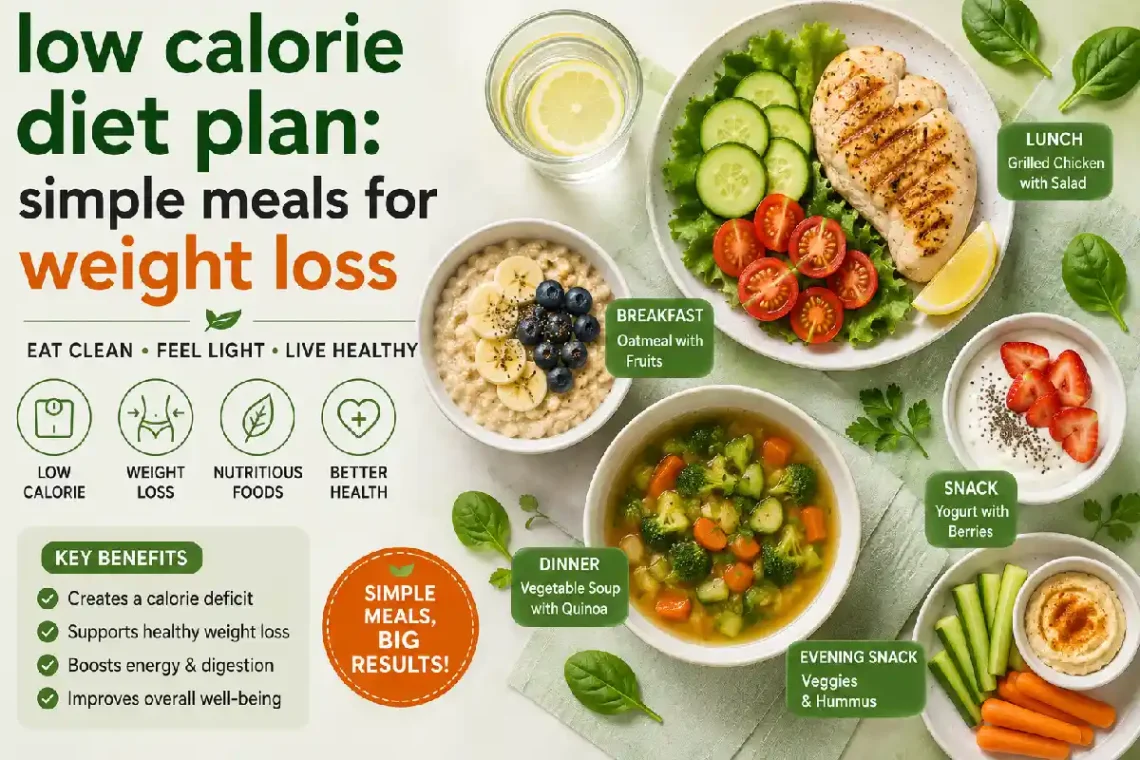
A low calorie diet plan can be used to aid you lose weight. If it allows you to eat fewer calories than your body requires. But still get the protein and fiber, vitamins, minerals and other nutrients you required. This isn’t the idea of consuming as little as possible. On the contrary, opt for filling foods, manage portions and establish a calorie deficit which you can sustain.
A healthy weight loss plan must also be part of regular lifestyle. It should be able to follow easily at home, at work. And also, when eating Indian foods and when meeting people.
❝
This article is part of
Weight Loss Nutrition Hub
What Is a Low-Calorie Diet?
A diet that is lower in calories than usual, used for weight loss.
Having a low calorie does not have a exact number for all adults. The amount of any nutrient you need varies according to your age, sex, body size, metabolism and physical activity. The NIDDK also suggests selecting an eating plan that is lower in calories and takes your health needs and preferences into account, instead of a generic plan.
A low-calorie approach can be part of a balanced weight loss routine when meals focus on nutritious foods and appropriate portions. Explore our complete diet plan for weight loss for practical guidance.
A good low calorie diet is going to contain:
- Vegetables and fruits
- Protein-rich foods
- Pulses and beans
- Healthy fats (in moderation)
- Enough fluids
- Foods high in fibre, vitamins and minerals
Avoid food with added sugars and food that has been highly processed.
ICMR-NIN Dietary Guidelines for India 2024 also highlight the consumption of foods from different food groups and not consuming foods from one food group.
Choosing nutrient-rich foods can help you create satisfying meals while keeping your overall eating routine balanced. Explore our best foods for weight loss for helpful ideas.
How a Calorie Deficit Supports Weight Loss
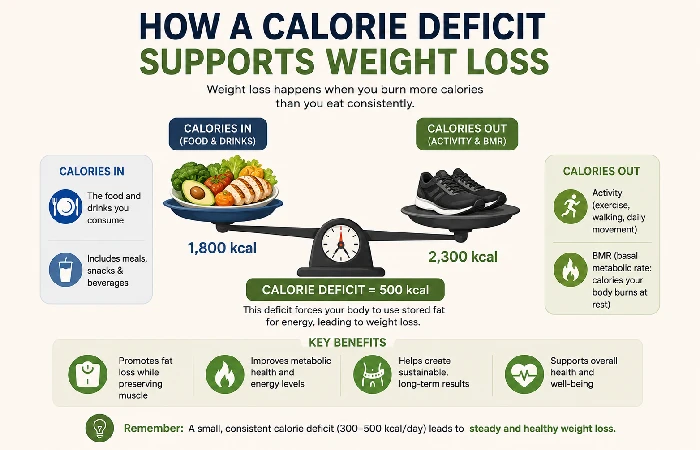
You requires the energy for breathing, digesting, moving, exercising and any other action.
If you eat more calories than you burn on a usual basis, you may increase weight as a result of this. A calorie shortage can benefit you to lose weight if you eat fewer calories than body needs.
However, sometimes size is not everything.
Severely preventive diets are complicated to follow and can be stimulating to get satisfactory nutrition from. NIDDK advises a realistic, sustainable weight-loss program instead of any that capacity quick weight loss.
Calorie deficit vs. extreme restriction
| Approach | What it means | Better choice? |
| Moderate calorie reduction | Eat slightly less while keeping meals nutritious | Yes |
| Portion control | Reduce oversized servings | Yes |
| Food swaps | Replace calorie-dense foods with lower-calorie choices | Yes |
| Skipping every meal | Severe restriction | No |
| Extremely low-calorie diet | Very little food without appropriate supervision | No |
How Many Calories Should You Eat?
An exact calorie count cannot be determined by your weight.
Calories will vary by age, height, weight, sex, metabolism, and action level.
For adults, the NIDDK Body Weight Organiser is a tool that can be used to estimation the calorie and activity supplies for the individual. It’s actually created specifically to develop a plan around a person’s impartial weight and time frame.
Don’t just sign up from an internet source for a diet that claims to provide 1200 calories a day. Not all adults can benefit from one calorie goal.
Protein-rich foods can complement a calorie-conscious eating plan by adding variety and helping create balanced meals. Explore our high-protein diet plan for weight loss for practical tips.Pregnant or breastfeeding individuals, children and adolescents, and individuals with certain medical conditions should seek individual advice before self-restricting calories.
Best Low-Calorie Foods
Low calorie foods do not essentially need to be “diet products.” There are numerous simple foods that are naturally packed with nutrients, and not too high in calorie.
Vegetables
- Cucumber
- Tomato
- Spinach
- Cabbage
- Cauliflower
- Bottle gourd
- Carrot
- Capsicum
- Beans
- Bhindi
Fruits
- Guava
- Orange
- Apple
- Papaya
- Watermelon
- Berries
- Melon
Protein-rich foods
- Eggs
- Curd
- Dal
- Chana
- Rajma
- Sprouts
- Tofu
Small amounts of paneer is allowed.
- Fish
- Skinless chicken
Useful food swaps
| Instead of | Try |
| Sugary soft drink | Water or unsweetened beverage |
| Chips | Roasted chana |
| Creamy dressing | Lemon, herbs or lighter dressing |
| Fried snack | Roasted or steamed snack |
| Large dessert | Fruit with plain curd |
| Large rice serving | Moderate rice + extra vegetables + protein |
Low-Calorie Breakfast Ideas
A small breakfast is not essentially a low calorie breakfast.
- Eat foods that include protein or fiber and a reasonable amount of carbohydrates.
- Take a single dish of vegetable poha and curd.
- Add 2 moong-dal chillas and mint chutney.
- Vegetable oats + boiled egg
- 2 idlis + sambar
- Vegetable upma + curd
- Whole grain toast, eggs and vegetables
- Protein- and fiber-rich breakfasts can also help keep you full till lunch.
Planning meals ahead can make it easier to manage portions and maintain consistent eating habits throughout the day. Explore our weight loss meal plan for useful ideas.
Low-Calorie Lunch Ideas
Lunch should be a good size and be sufficient to keep you going for the afternoon without becoming a large meal.
Indian lunch examples
- This is a simple cup of dal, 2 small rotis, vegetable sabzi and salad.
- Rice, rajma and cucumber salad (moderate)
- The visitor is to eat 2 rotis, chicken and vegetables.
- Rice, vegetables, and fish; brown or regular rice.
- Vegetable Khichdi, Curd + Salad
- Paneer/tofu + vegetables + 1–2 rotis
- You do not have to completely remove rice or roti.
ICMR-NIN’s “My Plate for the Day” reference includes cereals and millets, fruits, pulses, vegetables, eggs or flesh foods, nuts and seeds, milk/curd and fats/oils as part of a stable Indian dietary pattern.
Low-Calorie Dinner Ideas
Here is your content in a clean tabular format, suitable for the article.
| Dinner Type | Low-Calorie Dinner Idea |
| Vegetarian | Dal mixed with vegetables + 1 roti |
| Paneer / Tofu | Paneer or tofu bhurji + mixed vegetables + 1 roti |
| Non-Vegetarian | Grilled fish or chicken + vegetables + a small portion of rice |
| Light Meal | Vegetable soup + a protein-rich side |
| Indian Option | Vegetable khichdi + plain curd |
Healthy Low-Calorie Snacks
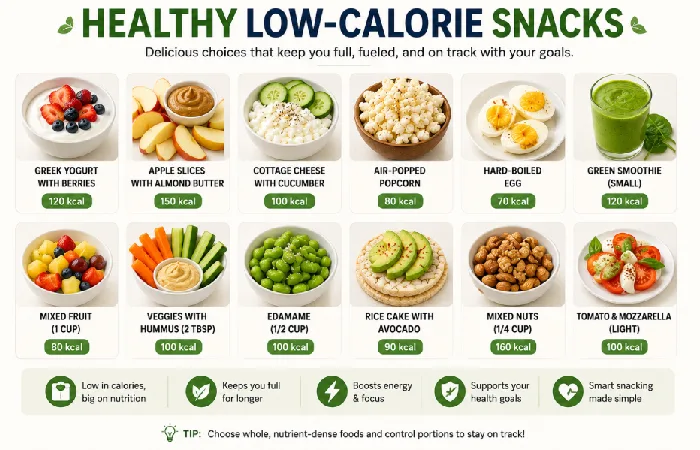
Snacks can be useful when you are genuinely hungry between meals.
Good options include:
- Whole fruit
- Roasted chana
- Plain curd
- Sprouts chaat
- Cucumber and tomato
- Roasted makhana
Nuts have a small portion of them.A small part of nuts.
Buttermilk (unsweetened)
Use caution with “good” snacks that can be overindulged. Nuts, seeds, peanut butter, granola and dried fruit are good sources of nutrients, but also contain high calorie content.
A nutritious, calorie-conscious breakfast can provide a balanced start to the day as part of a healthy eating routine. Explore our healthy breakfast ideas for weight loss for practical options.
Portion Control and Calorie Tracking
Don’t have to keep every food forever.
The first step is to learn what a normal portion is.
A very simple approach using a plate.
- ½ plate: vegetables or salad
- ¼ plate: protein-rich food
- ¼ plate: rice, roti, millet or another carbohydrate
This is a practical method, rather than a rigorous prescription for the doctor.
The calorie counting system can be beneficial in certain instances.
When calorie tracking helps
The tracking can be helpful when:
- Don’t know how to measure amounts.
- Weight has not changed any further.
- You frequently eat restaurant food.
- You would like to know where the extra calories are coming from.
Be additional careful of foods that can be ignored such as sugary beverages, cooking oil, sauces, sweets, snacks, and large quantities.
According to NIDDK, everyone’s portion needs is different and focusing on portions can aid in weight management.
Common Low-Calorie Diet Mistakes
Eating too little
Trying to follow a diet that keeps you hungry all the time is not going to be easy. Eat nutrient-rich foods, rather than just reduce food intake as much as possible.
Removing all carbohydrates
Carbohydrate foods like rice, roti, oats, potatoes etc. can be included in a healthy diet. The ICMR-NIN guidelines are not a ‘no’ list of foods and are not a blanket prohibition on any food group.
Ignoring protein
Don’t confuse a low calorie meal with a low protein meal. Add dal/beans/eggs/curd/ tofu/ paneer/fish or lean meat as appropriate.
Forgetting cooking oil
Large servings of oil can increase the calorie content of a healthy meal.
Drinking calories
Sugary tea, coffee, soft drinks and sweetened juices can add calories without providing the same fullness as whole foods.
Following a fixed diet forever
As your weight, activity and routine fluctuate, your calorie requirements may vary. Any plan ought to be flexible.
Choosing nutritious snacks can help you maintain balanced eating habits while being mindful of your overall calorie intake. Explore our healthy snacks for weight loss for helpful ideas.
How to Make a Low-Calorie Diet Sustainable
Don’t have to eat perfectly all the time, make a plan that works most of the time.
Follow these easy tips:
- Stock your kitchen on the basics of whole foods.
- Have protein at meal times.
- Serve vegetables at lunchtime and dinner.
- Make sure to leave out fruit for snacks.
- Consume less amounts of food that are high in calories.
- Drink water regularly.
- Stay physically active.
Measure your progress over a number of weeks and not just one day.
Long-term behavior changes and a reduced-calorie eating plan combined with proper exercise for weight management are recommended by NIDDK.
For personalized calorie and activity planning, readers can use the NIDDK Body Weight Planner from the U.S. National Institutes of Health.
Final Takeaway
Low calorie diet plans aren’t about eating the least amount.
Instead, it’s best to cut back on calories while maintaining a satisfying and healthy meal. Follow the principles of planning meals around vegetables, fruits, protein foods, pulses, whole grains and sensible portions.
There are foods like rice, roti, dal, idli, poha and paneer which are still available to enjoy. It’s the portion amount of these foods in your diet that counts.
When in doubt, talk to a trained health care provider before going on a calorie-restricted diet, or if you have a health problem.
Dr. Khizrana Begum is a qualified medical professional with MBBS and MD qualifications and 5+ years of experience in the medical field. She works as a General Physician and Dermatologist, with knowledge spanning general medicine, dermatology, preventive healthcare and skin health.
As a medical reviewer, Dr. Khizrana Begum reviews health and wellness content for medical accuracy, clarity and authenticity.
Sameena Begum reviews content for clarity, accuracy and reader usefulness. Her review process helps ensure that published information is clearly presented, relevant and easy for readers to understand.
Syeda Yasmeen is a Health & Wellness Writer at InHumanBeing.com. She creates clear and reader-focused content across health, nutrition, wellness, women’s health, men’s health and babies’ health.