
 Syeda Yasmeen
Health & Wellness Writer Syeda Yasmeen creates clear and
reader-focused content covering health,
nutrition, wellness, women’s health,
men’s health and babies’ health.
Read Full Bio of Author →
Syeda Yasmeen
Health & Wellness Writer Syeda Yasmeen creates clear and
reader-focused content covering health,
nutrition, wellness, women’s health,
men’s health and babies’ health.
Read Full Bio of Author →
 Sameena Begum
Health, Technology & Digital Content Reviewer Sameena Begum reviews selected content
for clarity, factual presentation,
consistency and reader usefulness.
Read Full Bio of Reviewer →
Sameena Begum
Health, Technology & Digital Content Reviewer Sameena Begum reviews selected content
for clarity, factual presentation,
consistency and reader usefulness.
Read Full Bio of Reviewer →
 Dr. Khizrana Begum
General Physician and Dermatologist Dr. Khizrana Begum is a qualified medical
professional with MBBS and MD qualifications
and 5+ years of experience. She reviews health
and wellness content for medical accuracy,
clarity and responsible presentation.
Read Full Bio of Medical Reviewer →
Dr. Khizrana Begum
General Physician and Dermatologist Dr. Khizrana Begum is a qualified medical
professional with MBBS and MD qualifications
and 5+ years of experience. She reviews health
and wellness content for medical accuracy,
clarity and responsible presentation.
Read Full Bio of Medical Reviewer →
A healthy eating plan is not a “diet”. It is simply a diet that permits you to eat your favourite foods. Eating the correct balance of nutrients and energy for your body. But not too indulging your lifestyle, tastes or budget. Present diet strategies will still include eating nutrient-dense. Foods like vegetables, fruits, healthy fats, protein foods, dairy products and whole grains. And to maximum highly processed foods, added sugars, too much sodium, and refined carbohydrates in 2026.
The important thing to save in mind is that healthy eating is not something you do once. It’s a lifestyle. Of course, it is okay to indulge sometimes. Enjoy a meal in a restaurant and still have a healthy diet.
❝
This article is part of
Healthy Lifestyle Hub
What Is a Healthy Eating Plan?
A healthy eating plan includes eating a variety of food from all food groups. The nutrients that numerous groups of foods provide differ. And you should eat a various food group to get the nutrients your body needs.
A structured healthy eating plan can make it easier to build consistent nutrition habits and balanced meals throughout the week. Explore our 7-day healthy eating plan for practical meal ideas.
There are six mechanisms to a healthy meal:
- Vegetables or fruit
- A protein source
- Whole grain or other nutrient containing carbohydrate
- Healthy fats are the source of good fats.Good fats are healthy fats.
- Dairy or suitable fortified substitute (as specified)
- Grilled chicken, mixed vegetables, brown rice and some avocado could be a simple lunch.
- Lentils, vegetables, whole-grain roti and yogurt may be a vegetarian option.
Benefits of Following a Healthy Eating Plan
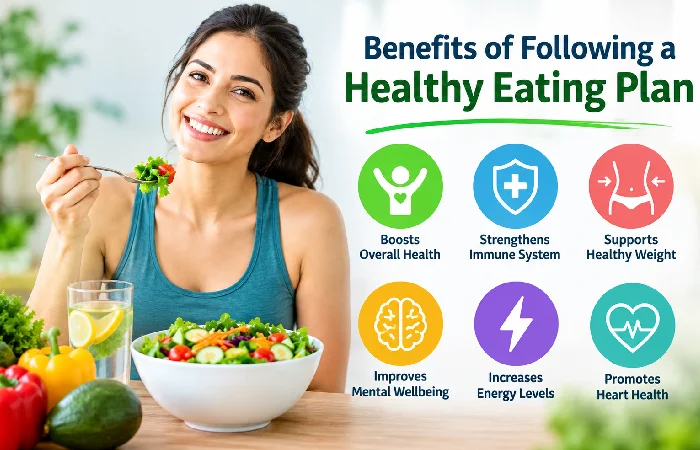
Consuming a balanced eating pattern can have a positive impact on a number of health outcomes. The CDC reports that healthy eating can help maintain bones, immunity, muscles digestion, healthy weight controlling and overall health. In addition, it also aids decrease the likelihood of heart disease and type 2 diabetes.
Assists in upholding a healthy weight.
Eating well does not have to be expensive when you focus on affordable, nutritious ingredients and simple meal choices. Explore our healthy eating plan on a budget for helpful tips.
1. Supports a healthy weight.
Fruits, Vegetables, whole grains and legumes, are a worthy source of fiber and can aid you feel full.
Fruits and Vegetables are also full of water. It tend to be lower in calories than numerous processed foods. So exchange out some of the higher calorie foods for vegetables and fruits can benefit. It fill up meals without satisfying up on additional calories. Even healthy food, though, can contain calories. The quantity served and how much you eat in a day leftovers significant.
2. Supports heart health
A healthy eating plan is one that emphases on eating vegetables, fruits, whole grains, foods rich in fibre and healthful fats, and decreasing excess sodium and soaked and trans fats to provision cardiovascular health.
The CDC also says that dropping sodium intake can aid keep blood pressure in check, and foods that comprise fiber can aid manage cholesterol.
Starting the day with a nutritious breakfast can help you build a balanced eating routine. Explore our healthy breakfast eating plan for practical ideas.
3. Supports digestive health
Fiber is particularly vital to digest food properly.
Good sources include:
- Beans
- Lentils
- Oats
- Vegetables
- Fruits
- Nuts
- Seeds
According to the CDC, fiber aids uphold good digestive health. It may also make persons feel fuller longer.
If you do not get a lot of fiber in your diet now, slowly add it. Improved quickly can result in stomach harms or bloating.
4. Provides important nutrients
Foods contain various vitamins and minerals.
For example:
| Food | Key nutrients |
| Leafy greens | It contain folate, vitamin K, and fiber |
| Citrus fruits | It is full of vitamin C, and fiber |
| Eggs | In its rich in protein, choline, and vitamins |
| Lentils | It has protein, fiber, and iron |
| Nuts | It contain healthy fats, protein, and minerals |
| Yogurt | It has protein, and calcium |
| Whole grains | It is rich in fiber and several vitamins and minerals |
| Fish | It is rich in protein and, reliant on the type, omega-3 fats |
A various diet will therefore get you more usage than a single “superfood”.
A balanced eating routine can complement healthy lifestyle habits when working toward sustainable weight management goals. Explore our healthy eating plan for weight loss for useful guidance.
How to Build a Balanced Healthy Eating Plan
There’s no requirement for difficult calculations to get started.
A simple advice to follow is to make four components of main meals:
Diets that include a mixture of vegetables or fruit, whole grain, protein and healthy fat.
For example:
Breakfast:
Oatmeal, berries , Greek yogurt and nuts
Lunch:
Dal, vegetables, brown rice and plain yogurt
Dinner:
Grilled fish, roasted vegetables, quinoa and olive oil
Vegetarian dinner:
Tofu is healthy and delicious. It offers a source of protein. It is good protein source and tastes great!
Add more colour to your plate
Variety can be simply provided through color.
Rather than just potatoes or rice at dinners, add the following vegetables in:
- Spinach
- Broccoli
- Carrots
- Bell peppers
- Tomatoes
- Green beans
- Cauliflower
There are different nutrients in many vegetables, so it is essential to have variety.
Fresh vegetables are great. Frozen or canned vegetables can be healthy, too. Purchase lower sodium canned vegetables. Purchaser beware of canned fruit with added sugar/syrup.
Essential Nutrients Your Body Needs
Vegetables are not the only things in a healthy eating plan. Nutrients are essential for your body in numerous forms.
Including a variety of food groups in your meals can help create a more balanced and sustainable approach to everyday nutrition. Explore our balanced healthy eating plan for practical tips.
Protein
Proteins are used for upholding muscles and other tissues.
Select protein foods such as:
- Eggs
- Fish
- Chicken
- Lean meats
- Beans
- Lentils
- Peas
- Tofu
- Soy foods
- Nuts
- Seeds
Plan adding some protein to every meal. Rather than having a lot of protein at dinner time.
Fiber
Plant foods are the main source of fibre. It aids in digestion and aids you to feel full.
Fat is important to a healthy diet. The aim is not to eliminate fat, but to select healthy sources and portion sizes.
Good options include:
- Nuts
- Seeds
- Avocado
- Olive oil
- Seafood
Nut and seed butters are a great option.
Vitamins and minerals
Vitamins and minerals are provided naturally when eating foods from various food groups.
The first step for most should take priority – diversify their diet instead of taking supplements straight out of the gate. In certain cases, supplementation may be needed, but everyone’s requirements are different.
Including a variety of food groups in your meals can help create a more balanced and sustainable approach to everyday nutrition. Explore our balanced healthy eating plan for practical tips.
Best Foods For A Healthy Diet
There is no single food that can make your diet healthy. It’s best to serve a variety of nutritious foods.
Vegetables
Don’t forget to include veggies at lunchtime and at dinner. Leafy greens, broccoli, carrots, tomatoes, peppers, mushrooms and other vegetables can all be included as part of a healthy plan.
Use them in roasts, steam, sauté, grill, and in soups, curries, omelets and stir-fry.
Fruits
Eat whole fruits frequently, including:
- Apples
- Bananas
- Oranges
- Berries
- Pears
- Mangoes
- Kiwi
- Peaches
Whole fruit is generally better than fruit juice as it is more filling and a better source of fibre.
Protein foods
Avoid eating the same type of protein one day after another.
For instance, you can enjoy eggs for breakfast, lentils for lunch, and fish or tofu for dinner.
Whole grains
Fiber and nutrients can be found in oats, brown rice, quinoa, whole-wheat bread, and other whole grains.
Don’t remove all refined grains at once. It can be more believable to make a gradual transition.
How Much Protein, Fiber, and Healthy Fat Do You Need?
Nutrient needs vary by age, size, activity and health objectives. No one size fits all for one of these.
For a practical approach, concentrate on making all three a part of your meals:
- Fruits: wild blueberries, blueberry juice, strawberries, watermelon, and blue raspberry (also high in omega-3s)
- Water: milk, water, juice, broth or soup.Protein: meat, fish or any other protein foods.
- Low-glycemic foods: fruit, vegetables, whole grains, nonfat or low-fat dairy, nuts and seeds
Protein
Muscle development and good body functioning require protein. Don’t consume a lot of protein at night.
Fiber
The primary food sources of fiber are plant food. The recommended amount of fiber for adults is 22 to 34 grams per day, depending on age and sex.
There are ways to boost your consumption, such as:
- Instead of juice, opt for whole fruit.
- Including vegetables with your meal (lunch and dinner)
- Consuming beans and lentils on a regular basis
- The best options are to choose oats and whole grains.
- Incorporation of nuts and seeds in foods
- Have more fibre slowly and drink plenty of liquids to help you digest.
Healthy fats
The good fats are those found in nuts, seeds, avocado, olive oil and seafood. These foods are healthy but they’re also energy dense so portions still matter.
A serving size of 20-30 nuts or a couple of tablespoons of seeds can help provide some healthy fats without turning a meal into a heavy meal.
Healthy Meal Planning and Portion Control
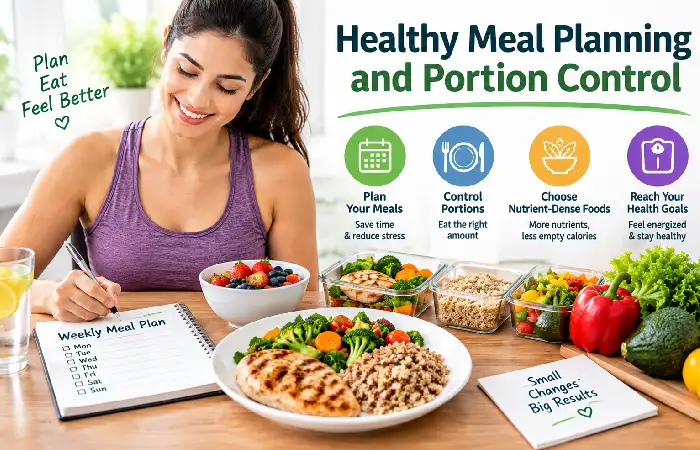
Portion control does not mean eating tiny meals. It means understanding how much food your body needs.
A simple plate method can make portioning easier:
- ½ plate: vegetables and/or fruit
- ¼ plate: protein
- ¼ plate: Grains or another carbohydrate
- Small amount: healthy fat
This is a overall visual guide rather than a medical prescription.
Use your hands when you have no measuring tools
A applied technique is to use your hand as a rough helping guide:
- Protein: Almost one palm-sized Carbohydrates: around one cupped handful
- Vegetables: one to two handfuls
- Fats: a small thumb-sized portion
Your actual requirement can be higher or lower conditional on your body and action level.
Plan meals before you become hungry
Meal preparation can avoid last-minute picks. That are regularly higher in added sugar, sodium, or calories.
Try planning:
- Three or four breakfast options
- Three lunch combinations
- Four or five dinner combinations
- Two or three simple snacks
Repeat these meals all over the week instead of cooking something totally different every day.
What about drinks?
Water should be your primary choice of beverage.
Other beverages may be unsweetened tea, coffee with no too much added sugar, milk or fortified milk alternatives.
Sweets drinks are a convenient way to get added sugar and offer little nutrition. Altering to water from sugary drinks, or sweetened drinks like soda, sweetened tea, and energy drinks, can be one of the easy alterations you can make.
Healthy Eating on a Budget
Healthy eating does not essential buying exclusive health foods.
There are foods that are low-cost and nutritious.
Budget-friendly healthy foods
| Food | Budget advantage | Easy use |
| Oats | Low-cost staple | Breakfast |
| Lentils | Affordable protein & fiber | Soups, dal, curries |
| Beans | Filling and versatile | Salads, bowls, curries |
| Eggs | Suitable protein | Can eat in breakfast, salads |
| Frozen vegetables | It has long shelf life | You can stir-fries, or make a soups |
| Seasonal fruit | Often cheaper | Snacks |
| Brown rice/whole grains | Satisfying staple | You can have in lunch or dinner |
| Plain yogurt | It contain Protein and calcium | You can have it in breakfast or as a snacks |
| Potatoes | Its very affordable carbohydrate | You can use Roasted or cooked with vegetables |
| Nuts/seeds | It is full of Nutrient | Have it as a small snack portions |
Buy according to a plan
Before buying groceries, see what you have at home.
Next make a short list based on:
- Protein foods
- Vegetables
- Fruits
- Whole grains
- Healthy fats
- Basic ingredients
This helps to minimize food waste and avoid impulse buying.
Frozen and canned foods can help
There is more to food than fresh food.
While frozen vegetables can be convenient and nutritious, preserved beans can save on cooking time. When buying canned foods, look at labels. Pick the lower sodium or sugar options.
A Simple Grocery List for a Healthy Week
When you are watching for a great bargain but you do not want to do too much research, imagine:
Protein
- Eggs
- Chicken or fish
- Lentils
- Beans
- Tofu
- Plain yogurt
Vegetables
- Leafy greens
- Broccoli
- Carrots
- Tomatoes
- Bell peppers
- Frozen mixed vegetables
Fruit
Apples
- Bananas
- Oranges
- Seasonal fruit
- Berries, fresh or frozen
Grains
- Oats
- Brown rice
- Whole-grain bread
- Whole-wheat roti
- Quinoa
Healthy fats
- Nuts
- Seeds
- Avocado
- Olive oil
- Natural nut butter
The objective isn’t to stock your kitchen with a host of ingredients. There are many balanced meals that can be made from a small number of versatile foods
How to Make the 7-Day Plan Easier
It doesn’t have to be a Sunday-long project to get your meals ready.
Work up a few of the basics:
- Cook some lentils or beans.
- Wash and cut vegetables.
- Boil eggs.
- Serve nuts in small plastic containers.
- Have fruits in sight and easily available.
- Make a simple sauce/dressing, or two.
- Then mix these ingredients in various combinations for the week.
For instance, vegetables can be added to an omelet in the morning, a grain bowl or side dish in the middle of the day, or a side dish later in the day.
Don’t aim for perfection
If you have a meal at a restaurant on Wednesday, there is no need to “start over” on Thursday.
Just resume a normal diet at the next meal.
This attitude is vital as healthy eating is not a 7-day program. It’s a longstanding habit.
Healthy Eating for Different Life Stages
A healthy eating strategy should change as your body, action level and nutritional wants evolve. There is no one food that is best for all ages.
Children and teenagers
Children of growth require sufficient energy and nutrients for growth, learning, building bones and muscles.
Regularly include the following in meals:
- Vegetables and fruits
- Protein foods
- Fortified alternatives to dairy
- Healthy fats
Instead of limiting children’s food selections, work on emerging good dietary habits. Request them to eat new foods and to aid prepare simple meals.
Adults
Adults tend to distillate on a stable diet for their energy, muscles, heart, digestion and long-term health.
Highly processed foods, added sugars and too much sodium are also for the adults.
Older adults
As persons become older, their hungers and energy requests might also change. Meanwhile, safeguarding a adequate protein and nutrient intake is particularly essential.
Meals that contain protein-rich foods like eggs, beans, fish, dairy, and lentils, tofu, nuts, poultry and seeds are good for older adults.
Foods should also be easy to chew and make when necessary.
Pregnancy and breastfeeding
There are certain nutrients that are more vital during pregnancy and breastfeeding. Nutritional supplies vary from person to person.
Avoid taking a “one-size-fits-all” method to pregnancy nutrition, and consult with a health care worker for individual instruction. It is mainly serious to safeguard food safety while a woman is pregnant.
Common Healthy Eating Mistakes
Even if you are eating well, you can make mistakes. Thankfully, there are lots of those that can be addressed without an entire dietary overhaul.
The first one is the elimination of entire food groups when this is not necessary.
Removing any single food group, such as carbs, fats or proteins is not essentially a healthy choice.
All whole grains, fruits, vegetables, legumes and healthy fat sources can fit into a healthy plate.
Therefore, it would be better to adjust food quality and portion sizes instead of simply cutting out a food group.
Not getting enough calories at nighttime meals
You might think that avoiding breakfast or lunch is a good way to cut back on calories, but then you’ll be very hungry later.
A more effective approach is to create satisfying meals with protein, fiber and nutrient-dense carbohydrates.
Drinking too many calories
Sugar sweetened coffee, soda, fruit drinks, energy drinks and sweetened tea are good examples of beverages that can contribute a considerable amount of sugar to your diet.
Change your drink habit and opt for water as your go-to drink and stick to sugary drinks as treats.
If healthy is just unlimited then there is no such thing as being too healthy.
However, certain foods like nut butter, granola, nut, avocado, and cooking oils can be healthy and yet high in calories.
Even healthy foods require the right portion sizes.
Depending too much on supplements
No supplement can substitute for a diet that is rich in different foods.
When you suspect you might be deficient in one or more nutrients, or have a medical or dietary condition, consult your doctor or health care practitioner instead of self-prescribing high doses of supplements.
Attempting to change all at once
Revolutionizing your lifestyle can sound like a motivator, but can be hard to keep up.
Begin with 2-3 realistic changes.
For example:
- Week 1: Add more water to your diet.
- Week 2: Incorporate vegetables into lunch and dinner.
- Week 3: Take a protein to breakfast.
- Week 4: Substitute some refined grain snacks for whole grain snacks.
Little changes can be big habits.
How to keep healthy eating habits.
It’s not always enough to know what to eat. One might ask, how to keep doing it?
- Make healthy foods easily accessible.
- Eating is more likely to happen when the food is readily available.
- Have fruit where they can be seen. Prep veggies. Store cooked protein/fats and grains that will be used for a quick meal.
Use simple meals
It’s not necessary to have a different recipe each day.
There are a few healthy eating combinations that will make it easier to get a healthy meal:
Eggs and vegetables served with whole grain toast.
- Oatmeal + fruit + nuts
- Lentils + rice + vegetables
Aim for chicken + vegetables + whole grains.
- Tofu + vegetables + rice
- Yogurt + fruit + seeds
Follow the 80/20 mindset
It is not about perfection when it comes to healthy eating.
The majority of meals can be made up of nutrient-rich foods, but can also include foods you like.
A delicious birthday cake, dinner at a restaurant or a favourite snack can’t make up for weeks of good behaviour.
Identify progress beyond the scale
Weight is not the only indicator of health!
Also, look into:
- Energy levels
- Hunger and fullness
- Digestive comfort
- Sleep
- Physical performance
- Meal consistency
Increase the consumption of fruits and vegetables.Eat more fruits and vegetables.
Frequently Asked Questions About Healthy Eating Plans
So, what’s the healthiest diet?
The best diet for some individuals is not necessarily the best for others. A healthful eating pattern is typically a diet that is rich in vegetables, fruits, whole grains, protein foods, and healthy fats and reduced in added sugars, sodium, and highly processed foods.
Is it OK to eat rice in a healthy diet?
Yes. Rice can be part of a healthy eating plan. Be mindful of size and serve with vegetables and a protein source. Add brown rice or other whole grains if desired for extra fibre.
What is the correct number of meals to have per day?
There is no universal number. A few opt to eat three meals and a few opt to eat snacks. It’s important to know what happens if your total diet plan is not providing enough nutrition and fits your lifestyle.
Are snacks allowed on a healthy eating plan?
Yes. When feeling hungry between meals, try a healthy snack. Examples include fruit, plain yogurt, nuts, seeds, vegetables with hummus, or a boiled egg.
To completely avoid sugar?
Not all foods with sugar need to be avoided. The primary aim is to reduce the amount of additional sugar consumed, especially sugary beverages, sweets, desserts, and overly processed foods.
Is healthy eating cost prohibitive?
Not necessarily. Beans, lentils, eggs, oats, seasonal fruit and vegetables, frozen vegetables and whole grains can all be inexpensive options.
Final Thoughts
A healthy eating plan should make your life healthier, not harder!
Follow the basics: Increase vegetables and fruits, add protein regularly, eat healthy fats in moderation, drink a lot of water, and minimize highly processed foods, too much sodium and added sugars.
You don’t need to make an overarching decision to switch to a healthy diet from the moment you wake up on the 1st. Pick some enhancements that you can maintain for a few years and work on from there.
The best diet is not the strictest diet. You can do it for months and years, and it’s the one you can stick to.
Dr. Khizrana Begum is a qualified medical professional with MBBS and MD qualifications and 5+ years of experience in the medical field. She works as a General Physician and Dermatologist, with knowledge spanning general medicine, dermatology, preventive healthcare and skin health.
As a medical reviewer, Dr. Khizrana Begum reviews health and wellness content for medical accuracy, clarity and authenticity.
Sameena Begum reviews content for clarity, accuracy and reader usefulness. Her review process helps ensure that published information is clearly presented, relevant and easy for readers to understand.
Syeda Yasmeen is a Health & Wellness Writer at InHumanBeing.com. She creates clear and reader-focused content across health, nutrition, wellness, women’s health, men’s health and babies’ health.