
 Syeda Yasmeen
Health & Wellness Writer Syeda Yasmeen creates clear and
reader-focused content covering health,
nutrition, wellness, women’s health,
men’s health and babies’ health.
Read Full Bio of Author →
Syeda Yasmeen
Health & Wellness Writer Syeda Yasmeen creates clear and
reader-focused content covering health,
nutrition, wellness, women’s health,
men’s health and babies’ health.
Read Full Bio of Author →
 Sameena Begum
Health, Technology & Digital Content Reviewer Sameena Begum reviews selected content
for clarity, factual presentation,
consistency and reader usefulness.
Read Full Bio of Reviewer →
Sameena Begum
Health, Technology & Digital Content Reviewer Sameena Begum reviews selected content
for clarity, factual presentation,
consistency and reader usefulness.
Read Full Bio of Reviewer →
 Dr. Khizrana Begum
General Physician and Dermatologist Dr. Khizrana Begum is a qualified medical
professional with MBBS and MD qualifications
and 5+ years of experience. She reviews health
and wellness content for medical accuracy,
clarity and responsible presentation.
Read Full Bio of Medical Reviewer →
Dr. Khizrana Begum
General Physician and Dermatologist Dr. Khizrana Begum is a qualified medical
professional with MBBS and MD qualifications
and 5+ years of experience. She reviews health
and wellness content for medical accuracy,
clarity and responsible presentation.
Read Full Bio of Medical Reviewer →
An active lifestyle is not only about going to the gym or doing difficult workouts It is increasing the amount of walking, physical activity, household tasks, hobbies, sport and other movement throughout the day.
For most people, work, study, travel or screen time is a significant aspect of their daily life that they are required to do for extended periods. The more you move, the more you are fit, mobile, heart-healthy, muscletoned, and healthy.
The important thing is to select activities that are appropriate to your daily schedule and activities you can carry out over time. It’s not necessary to begin with heavy exertion. It’s easy to make small, steady adjustments that will make it easier to keep being active.
What Is an Active Lifestyle?
An active lifestyle is one where you move your body often during the day, rather than sitting or not being active for most of the day.
Physical activity can consist of:
- Walking
- Cycling
- Swimming
- Dancing
- Playing sports
- Gardening
- Household chores
- Strength exercises
- Stretching
- Recreational activities
Everyone’s active life can be different. A person can take a walk to work and another person can exercise at home or play a sport in the evening.
The aim is to minimise prolonged periods of inactivity and to ensure that movement becomes a part of daily life.
Benefits of Regular Physical Activity
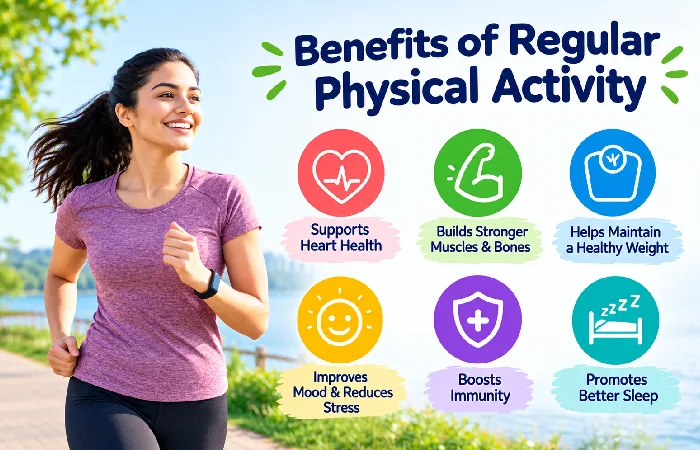
Exercising regularly can help with both physical and mental health.
The potential benefits are:
- Promoting heart and cardiovascular wellness
- Helping maintain healthy muscles and bones
- Improving physical fitness
- Encouraging good nutrition practices
- Improving balance and mobility
- Supporting better sleep
- Helping reduce stress
- Improving mood
- As you grow older, allow them to be more independent.
Don’t have to finish the entire activity in a single session. Some walking, household activities, recreational and planned exercise can all help make one a good day to be active.
Walking and Everyday Movement
Walking is one of the easiest methods of being active.
Consider increasing walking time by doing the following:
- Sitting Down: Performing brief strolls during breaks
- Walking to nearby shops – if feasible
- Taking stairs when they are available and required rather than elevators where feasible, such as in an office building.
- Drinking plenty of water throughout the day
- While you are talking on the phone walk together.Walk while you are talking on phone.
- Parking farther away from an entrance
- Taking an evening or a morning walk.
All the little movements count. If you are not currently active, begin with small amounts of activity and gradually build up to more until you feel comfortable and fit.
To build a comfortable walking plan that is more sustainable than an all-out workout plan that is not.
Cardio Activities
Cardio, also known as aerobic exercise, raises your heart rate and level of breath.
Common cardio activities include:
| Activity | Beginner-Friendly Option |
| Walking | Brisk walking |
| Cycling | Easy cycling |
| Swimming | Comfortable-paced swimming |
| Dancing | Home or group dancing |
| Jogging | Short intervals |
| Aerobic exercise | Beginner workout classes |
| Sports | Recreational games |
Select activities that you like to do. If you enjoy what you’re doing, it will be easier to do it regularly.
If you have not been active for a long time, begin with low intensity activity rather than high intensity activity as your initial activity choice.
Strength Training
Strength training exercises can target the muscles of the body and can be incorporated into an active lifestyle together with cardio and day-to-day activities.
Examples include:
- Squats
- Lunges
- Push-ups
- Resistance-band exercises
- Bodyweight exercises
- Weight training
- Carrying / lifting suitable loads
Even if you’re new to the exercise, you can use bodyweight exercises or low resistance and concentrate on the proper movement.
Strength training doesn’t have to be done in the traditional gym. Resistance exercise can also be obtained from a simple home routine.
Give your body adequate rest, particularly after beginning a new workout program.
Stretching and Mobility
Stretching and mobility exercises may help you move more comfortably and be flexible.
Simple options include:
- Gentle leg stretches
- Shoulder movements
- Hip mobility exercises
- Calf stretches
- Gentle back movements
- Ankle movements
Don’t stretch or bounce too hard. All movement should be smooth and easy.
Tasks involving mobility can be helpful for persons who are sitting for long durations. Regular short breaks can help to avoid prolonged periods of sitting.
Reducing Sitting Time
There is also a need to find ways to spend less time sitting when one has an active lifestyle.
In the office environment, try:
- Standing during short breaks
- Failing to exercise good manners with others while on the telephone
- Taking movement breaks
- Stretching between tasks
Having time to reflect and plan your next steps before making a phone call
Including stairs where necessary
Remind yourself to get up and get some activity during extended periods of computer or screen time.
The idea isn’t to cut out all sitting but instead to reduce it. Rather, attempt to avoid prolonged periods of sitting as much as possible when it is safe to take movement breaks.
Staying Active at Work
There can be lots of work that can take up a significant amount of time but there are simple ways to incorporate movement into the day.
Try:
Use of the canteen during lunch breaks
Taking short movement breaks to your desk:
- Reading short messages whilst standing
- One of the most basic things you can do to reduce your distraction.
- Frequent hand cleansing and prompt cleaning of any spills or leaks
- Performing slow stretches between activities
- Movement reminders are also good for working at home.
- Any activity done between jobs can help break up a sedentary day.
Active Hobbies and Recreation
Running doesn’t have to be running. Hobbies that are active can make walking fun.
Examples include:
- Gardening
- Hiking
- Dancing
- Cycling
- Swimming
- Playing badminton
While playing football or other sports:
- Walking with family or friends.
- Recreational outdoor activities
Select hobbies that are of interest to you, appropriate to your physical abilities, space and time.
It’s also easier to maintain it as part of your routine if you are doing it with friends or family.
Building a Sustainable Exercise Routine
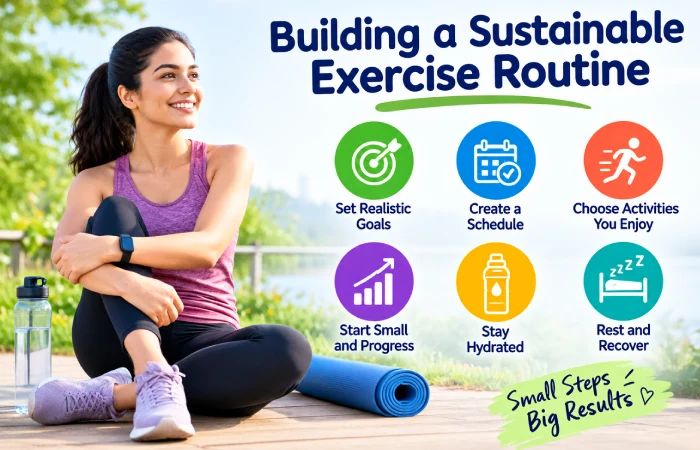
The ideal fitness plan is the one that you can stick with and live with.
First, think about how active you are now, how much time you have to devote, what you enjoy doing and how physically capable you are.
A simple weekly structure could include:
| Day | Example Activity |
| Monday | Walking + short strength session |
| Tuesday | Walking or cycling |
| Wednesday | Strength training + mobility |
| Thursday | Brisk walking |
| Friday | Strength training |
| Saturday | Active hobby or recreational sport |
| Sunday | Gentle walking and recovery |
This is merely an illustration of the principles. Your routine may be modified to meet your requirements. An active lifestyle supports overall health by encouraging regular movement and reducing prolonged sedentary time. The World Health Organization recommends regular physical activity as an important part of maintaining physical and mental well-being.
Tips for Staying Consistent
- Keep it simple: A small scheme is easier than a challenging one that is hard to follow.
- Have realistic goals: Pick goals that are going to be effective in your time.
- Keep a log: Document walks, exercise or any other active day if it encourages you to keep going.
- Select activities that you enjoy: You will be more likely to keep doing activities you enjoy.
- Ramp up: Slowly build up time or intensity.
- Rest and recovery: Recovery is a key component of an exercise program.
- Be flexible: If you are unable to exercise one day, resume exercise on another day.
Final Takeaway
It is important to have an active lifestyle, that is, to make movement a habit. A more active lifestyle can be achieved through walking, cardio exercise, strength training, stretching, active hobbies and movement breaks.
To get more active, you don’t have to be active all the time. Make small changes, limit screen time, and work up to a healthy lifestyle routine.
Those with a medical condition, injury or concerns about exercising, should consult with a suitable healthcare professional for suitable exercise activities.
Dr. Khizrana Begum is a qualified medical professional with MBBS and MD qualifications and 5+ years of experience in the medical field. She works as a General Physician and Dermatologist, with knowledge spanning general medicine, dermatology, preventive healthcare and skin health.
As a medical reviewer, Dr. Khizrana Begum reviews health and wellness content for medical accuracy, clarity and authenticity.
Sameena Begum reviews content for clarity, accuracy and reader usefulness. Her review process helps ensure that published information is clearly presented, relevant and easy for readers to understand.
Syeda Yasmeen is a Health & Wellness Writer at InHumanBeing.com. She creates clear and reader-focused content across health, nutrition, wellness, women’s health, men’s health and babies’ health.