

 Syeda Yasmeen
Health & Wellness Writer Syeda Yasmeen creates clear and
reader-focused content covering health,
nutrition, wellness, women’s health,
men’s health and babies’ health.
Read Full Bio of Author →
 Sameena Begum
Health, Technology & Digital Content Reviewer Sameena Begum reviews selected content
for clarity, factual presentation,
consistency and reader usefulness.
Read Full Bio of Reviewer →
 Dr. Khizrana Begum
General Physician and Dermatologist Dr. Khizrana Begum is a qualified medical
professional with MBBS and MD qualifications
and 5+ years of experience. She reviews health
and wellness content for medical accuracy,
clarity and responsible presentation.
Read Full Bio of Medical Reviewer →
The first step in making a better skin care routine is to know your skin type. You might experience an oily, dry, sensitive or somewhere in between skin sensation. Heat, humidity, strong sunlight, air conditioning and pollution are also conditions that can impact skin throughout the day in Mexico.
With this knowledge you will be able to make it a lot easier to select your cleansers, moisturizers, sunscreens, and other products based on your skin type. It’s not about the most expensive product. It is to discover products that meet your skin’s requirements and apply them regularly.
❝
This article is part of
Womens SKin Care Hub
What Are the Different Skin Types?
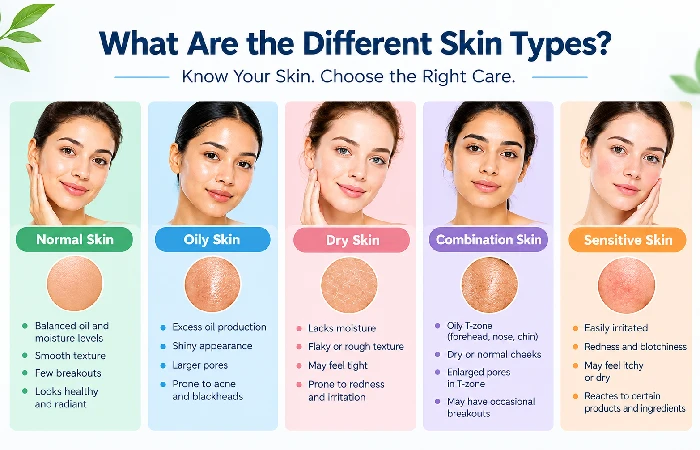
Most individuals have one of five common skin types: normal, dry, oily, combination, or sensitive skin.
| Skin Type | Common Characteristics |
| Normal | Balanced oil and moisture, few noticeable problems |
| Dry | Tightness, roughness, flaking, or dull appearance |
| Oily | Excess shine, enlarged pores, frequent breakouts |
| Combination | Oily areas with some dry or normal areas |
| Sensitive | Easily irritated, red, itchy, burning, or uncomfortable |
Your skin type is not continuously lasting. It can change because of age, weather, hormones, stress, medications, and variations in skin care routine.
For example, your skin may feel more oily during a hot Mexican summer. But become drier when you spend more time in air-conditioned environments.
Understanding your skin type is an important part of choosing suitable skincare products and building a routine that fits your individual needs. Explore our complete skin care guide for practical information.
How to Identify Your Skin Type
You do not have to go under a expert skin analysis to get an idea of your skin type. There’s an easy test you can do at home.
It is finest to wash your face with a mild facial wash first. Do not apply moisturizer, sunscreen, serum or makeup after request. After about 30-60 minutes, check on how your skin feels.
- Normal skin: Your face feels contented without excessive oil or dryness.
- Dry skin: Your skin feels tight, rough, or uncomfortable.
- Oily skin: Your face becomes shiny, particularly around the forehead, nose, and chin.
- Combination skin: Your T-zone becomes oily while your cheeks may feel normal or dry.
- Sensitive skin: Your skin may feel annoyed, itchy, warm, or red easily.
You can also use a clean tissue or blotting paper on different areas of your face. If you notice oil across most areas, you may have oily skin. If oil mostly appears around your T-zone, mixture skin may be more likely.
Remember that dehydration is diverse from dry skin. Any skin type can become dehydrated when it lacks water.
Skin Care for Normal Skin
Normal skin usually has a good balance of oil and moisture. It may have relatively small pores and fewer problems with excessive dryness or oiliness.
However, normal skin still needs daily care. A simple routine can help protect the skin barrier and prevent future problems.
Once you know your skin type, creating a consistent daily routine can become easier and more personalized. Explore our complete skincare routine guide for helpful tips.
A basic routine can include:
Gentle cleanser
Lightweight moisturizer
Sunscreen during the day
At night, wash your face and apply moisturizer.
If you want to add a serum, select one based on your exact concern rather than adding numerous products at once.
Individuals with normal skin should also avoid over-cleansing or continually altering products. Healthy-looking skin does not need a difficult routine.
Skin Care for Dry Skin
Dry skin does not secrete sufficient amounts of natural oil to maintain comfort and protection of the skin. Can feel tight after washing and may occasionally be rough and flaky.
Different skin types may respond differently to skincare products, making product selection an important part of daily care. Explore our skincare products guide for practical ideas.Try to discovery gentle cleansers and moisturizers. That have ingredients that help to support hydration and skin barrier.
A change of elements work well, such as:
- Ceramides
- Glycerin
- Hyaluronic acid
- Squalane
- Petrolatum
- Shea butter
If your skin is very dry, moisturizer in cream form can be more real than a light gel.
Dryness may be aggravated by hot showers. So try to use lukewarm water instead. Do not energetically scrub your face, mainly if skin is already irritated.
For hotter areas in Mexico, use a lighter moisturizer in the daytime and richer product at night.
Skin Care for Oily Skin
Oily skin secretes extreme sebum that makes the facial skin seem shiny. Too much oil can also reason clogged pores and acne breakouts.
The worst thing you can do is to get free of all the oil from the skin. Harsh cleansers and over-washing may cause skin irritation, and make it firmer to stick to your routine.
Use a mild cleanser and a light, non-comedogenic moisturiser. Even though skin seems oily, sunscreen leftovers a must.
People with acne-prone skin may have specific skincare needs when choosing products and developing daily habits. Explore our skincare guide for acne-prone skin for useful information.
Check for products that contain:
- Lightweight
- Oil-free
- Non-comedogenic
- Gel-based
- Ideal for oily and acne-prone skin.
If you wear make-up, use nonporous and contented cosmetics.
Skin Care for Combination Skin
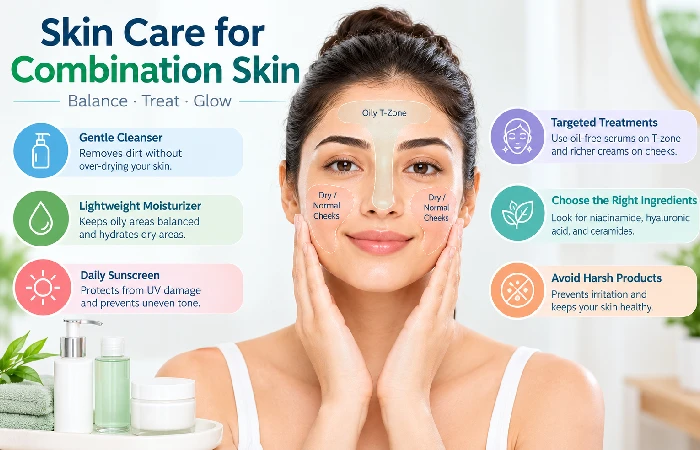
Combination skin types are impacted by both dry or normal areas and oily areas. Oilier forehead, nose and chin (T zone) and normal or dry cheeks.
This skin type can be tricky as a single product may not work on every area of the skin.
One way to do this is to wash your face with a mild cleanser all over and moisturize as needed. May be used on oily skin with a lighter moisturizer and on dry skin with a slightly richer one.
Do not reflect an entire face oily when only the T-zone is shiny.
Sunscreen should be practical all over bare skin. If the breakouts or irritation continue, consult a dermatologist.
People with acne-prone skin may have specific skincare needs when choosing products and developing daily habits. Explore our skincare guide for acne-prone skin for useful information.
Skin Care for Sensitive Skin
Sensitive skin can be highly delicate to new products, fragrances, weather conditions or even the use of cruel ingredients. Symptoms may be a redness, burning, itching, hurtful, or discomfort.
For sensitive skin, a simple skin care regimen is often a good place to start.
Choose:
- Gentle cleansers
- Fragrance-free products
- Simple moisturizers
- Broad-spectrum sunscreen
- Formulations made with sensitive skin in mind.
Introduce only one new product at a time. If you are using a new product, apply it to a small area in an inconspicuous place first.
Best Skin Care Routine by Skin Type
There is no universal workout that everyone can do. Your routine should be suitable to your skin type and your own concerns.
| Skin Type | Cleanser | Moisturizer | Main Focus |
| Normal | Gentle cleanser | Lightweight moisturizer | Maintain balance |
| Dry | Creamy, gentle cleanser | Rich moisturizer | Hydration and barrier support |
| Oily | Gentle foaming cleanser | Lightweight gel or lotion | Control excess oil |
| Combination | Gentle cleanser | Light moisturizer | Balance different areas |
| Sensitive | Very gentle cleanser | Fragrance-free moisturizer | Reduce irritation |
Sunscreens are essential in the daytime, regardless of skin type. Select a broad-spectrum sunscreen that you like and use on a regular basis.
You don’t need 10 products in your routine. A good base is created by a cleanser, moisturizer and sunscreen.
How Skin Type Affects Product Selection
The kind of skin will aid you control what type of products will feel relaxed.
When pick moisturizing products for dry skin, select those that have moisturizing ingredients and creamy consistency. Light and non-comedogenic skincare products can aid reduce the itchy, oily texture of the skin. Combination skin might need a change of textures in diverse areas of the face.
For sensitive skin, it is vital to take special care when presenting new products. A good place to start with fragrance-free and mild formulas.
But skin type is not the only issue to consider when selecting products. It is also essential to take into account your age, skin problems, climate, lifestyle, allergies, and skin response to specific substances.
For instance, a Mexican resident in a hot and humid region of the country. People might be looking for a lighter moisturizer to wear during the day. And a individual who spends a lot of time in air conditioning might need extra moisture during the day.
Avoid picking item just because it’s trendy on-line. Ideas that succeed for someone else may not be successful for you.
Skin type can also influence how you approach concerns such as uneven pigmentation and visible spots. Explore our skincare guide for pigmentation and spots for helpful tips.
Common Skin Type Mistakes to Avoid
A very common error is thinking that oily skin doesn’t require moisturizing. Correct moisturization is beneficial for all skin types.
Other mistakes include:
- Washing your face too frequently throughout the day.
- Roughing up the skin to get rid of oil
- Skipping sunscreen
- Taking more than a few new products all at once
- Decisions on products made solely based on popularity
- Applying hot water very hot on the face
- Failing to treat the symptoms of irritation
- Using strong acne product that is not recommended for dry skin.
- Taking the assumption that all shiny faces are oily skin.
- To stop a simple routine from taking enough time to change products
A second big error is mixing up temporary skin changes for the permanent skin type. Any of the above issues can briefly modify. Skin’s texture such as weather, stress, hormones, travel, or dehydration.
The most effective way is to carefully monitor your skin over time, and make changes as essential. If you do not know your skin type or have a determined rash, redness, itchy skin or other skin problems, a dermatologist will be able to give you a exact diagnosis and information.
Once you know your skin type, skin care is easier! Rather than purchasing every new product available, you can concentrate on the needs your skin may have. Use a mild cleansing product, an appropriate moisturizer and daily sun block as a starter, and then use other products when it makes a clear sense to do so.
Dr. Khizrana Begum is a qualified medical professional with MBBS and MD qualifications and 5+ years of experience in the medical field. She works as a General Physician and Dermatologist, with knowledge spanning general medicine, dermatology, preventive healthcare and skin health.
As a medical reviewer, Dr. Khizrana Begum reviews health and wellness content for medical accuracy, clarity and authenticity.
Sameena Begum reviews content for clarity, accuracy and reader usefulness. Her review process helps ensure that published information is clearly presented, relevant and easy for readers to understand.
Syeda Yasmeen is a Health & Wellness Writer at InHumanBeing.com. She creates clear and reader-focused content across health, nutrition, wellness, women’s health, men’s health and babies’ health.