
 Syeda Yasmeen
Health & Wellness Writer Syeda Yasmeen creates clear and
reader-focused content covering health,
nutrition, wellness, women’s health,
men’s health and babies’ health.
Read Full Bio of Author →
Syeda Yasmeen
Health & Wellness Writer Syeda Yasmeen creates clear and
reader-focused content covering health,
nutrition, wellness, women’s health,
men’s health and babies’ health.
Read Full Bio of Author →
 Sameena Begum
Health, Technology & Digital Content Reviewer Sameena Begum reviews selected content
for clarity, factual presentation,
consistency and reader usefulness.
Read Full Bio of Reviewer →
Sameena Begum
Health, Technology & Digital Content Reviewer Sameena Begum reviews selected content
for clarity, factual presentation,
consistency and reader usefulness.
Read Full Bio of Reviewer →
 Dr. Khizrana Begum
General Physician and Dermatologist Dr. Khizrana Begum is a qualified medical
professional with MBBS and MD qualifications
and 5+ years of experience. She reviews health
and wellness content for medical accuracy,
clarity and responsible presentation.
Read Full Bio of Medical Reviewer →
Dr. Khizrana Begum
General Physician and Dermatologist Dr. Khizrana Begum is a qualified medical
professional with MBBS and MD qualifications
and 5+ years of experience. She reviews health
and wellness content for medical accuracy,
clarity and responsible presentation.
Read Full Bio of Medical Reviewer →
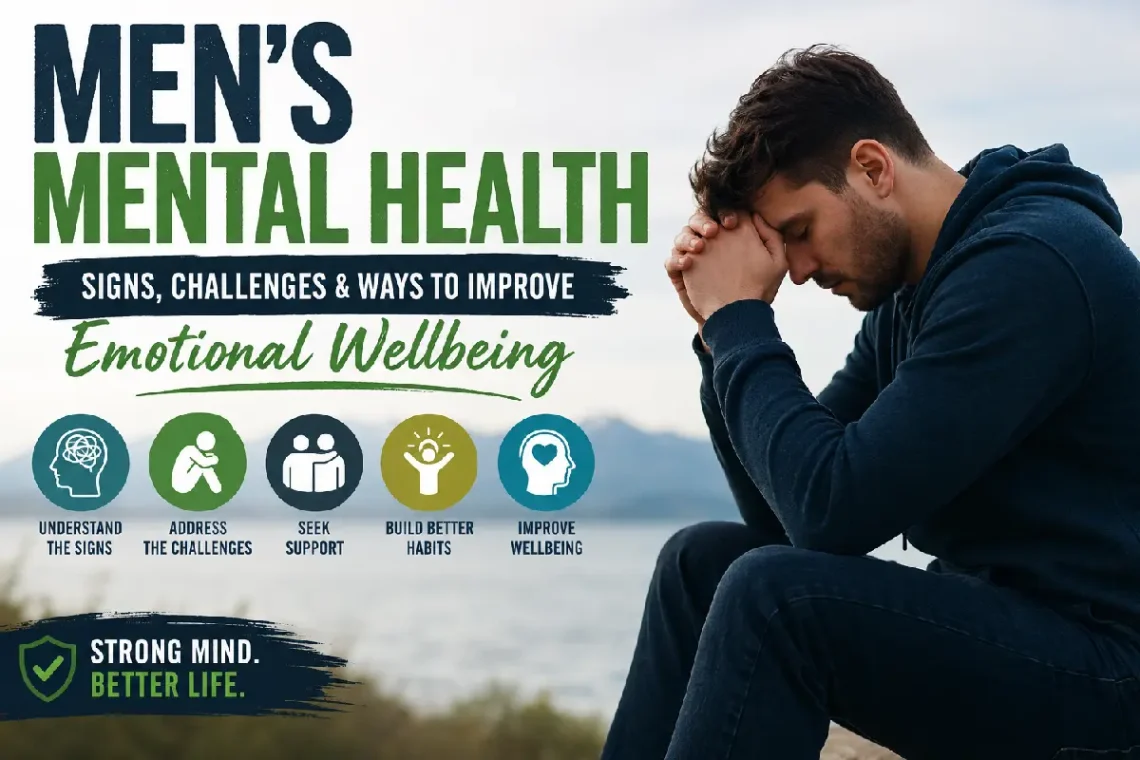
Mental health plays a important role in all aspects of life, in many households, workplaces and social groups, mental health is one of the most least discussed health subjects in many families. Men are raised up by hearing statements like “don’t cry,” “stay strong,” or “handle it yourself. Resilience is necessary but continuously hiding feelings can gradually affect confidence, sleep, physical health, relationships, and happiness over time.
While the discussion surrounding emotional wellbeing is improving in 2026, several men continue to endure stress, anxiety, and depression in silence. There are some who don’t pay attention to emotional symptoms as they may feel normal and others who don’t feel good asking for help.
The simple fact is that mental and physical health are equally important. Understanding the signs of depression in men is an important step toward recognizing symptoms early and seeking appropriate support.
A healthy mind helps you think clearly, to manage your feelings, to improve your relationships. Moreover, to do better at work and to enjoy life more. Also, we are lucky that mental health issues are treatable and controlled, and in many cases preventable. When we adopt healthy lifestyles and are given the right coping strategies.
This guide gives men a basic intro to mental health which includes signs, emotional issues, treatments, healthy living tips, and stress management. It also guide many effective steps to improve emotional well being.
❝
This article is part of
Men’s Mental Health Hub
Men’s Mental Health Challenges in 2026
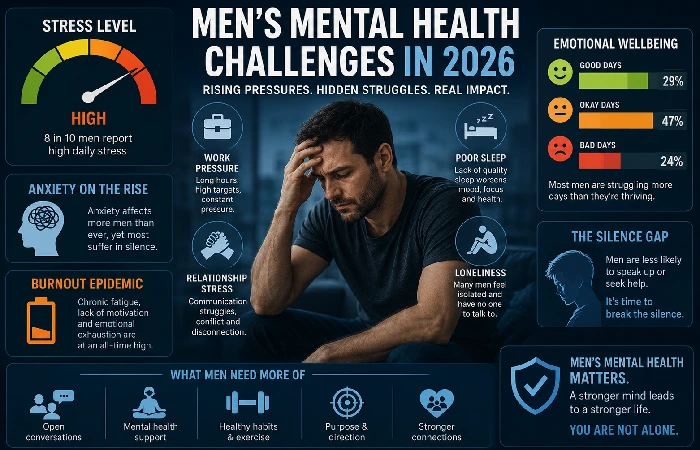
Quick Overview: Men’s Mental Health in 2026
| Area | What It Means |
| Depression | It means low mood. sometimes feel anger. |
| Anxiety | rapid thoughts, excessive rumination |
| Burnout | Emotional and physical tiredness due to stress |
| Loneliness | Feeling alone even in the presence of others |
| Emotional Suppression | Hiding emotions |
| Therapy Support | Professional emotional guidance and coping help |
Long-term pressure from work, finances, and relationships can increase emotional exhaustion. Learning about managing stress in men may help reduce mental fatigue and improve resilience.
Why Men’s Mental Health Matters
The consequences of men’s mental health cannot be understated easily.
It is not easy to understand men’s mental health.
As emotional wellbeing worsens, minor issues can transform into significant challenges. Work-related stress can become increasingly. It leads to difficult to handle, relationships. One may practice the following issues when affected by situations and stress, sleep problems, anxiety, and lowered self-esteem.
Additionally, physical issues such as tiredness, stomach pain, and headaches may develop. Some men select physical fitness, financial status, and responsibilities over their emotional health. They often neglect the final until it becomes too difficult to handle.
Healthy relationships play an important role in emotional well-being. Explore our guide to men’s mental health and relationships to build stronger personal connections.
It reflects the similarity of operating a car without regular engine upkeep. Over time, its performance worsens.
Mental wellbeing purposes in a similar manner. The absence of attention toward emotional challenges creates a void of resolution. The challenges continue to fester, often more insidiously and irritably, in the absence of action.
How Mental Health Affects Everyday Life
Mental health affects much added than emotions.
When emotional wellbeing failures, everyday procedures often become firmer without a person fully understanding why.
For example, many men notice:
- Reduced motivation
- Poor sleeping
- Increased frustration or anger
- Feeling emotionally detached
- Trouble focused at work
- More arguments in relationships
At first, these difficulties may seem unconnected.
Someone might think:
“I’m just tired.”
or
“Work is stressful right now.”
But emotional wellbeing frequently influences energy, focus, assurance, patience and decision-making.
It also affects physical health.
Chronic emotional stress may contribute to:
| Mental Health Effect | Possible Physical Impact |
| Anxiety | Muscle tension, headaches |
| Burnout | Poor sleep, less energy |
| Depression | Appetite changes, fatigue |
| Chronic stress | High stress hormones |
Many men ignore emotional symptoms because they appear slowly.
Unlike a broken arm, mental health struggles usually build gradually.
That is why mindfulness matters.
The previous somebody notices emotional changes, the calmer it often becomes to recover emotional balance.
Real-Life Instance: Silent Stress
Imagine a man balancing work pressure, family responsibilities, financial concerns, and little sleep.
He may continue functioning daily while silently becoming emotionally exhausted.
Instead of recognizing stress, he becomes:
- Easily irritated
- Emotionally distant
- Constantly tired
- Less motivated
This is frequently how mental health fights begin.
Regular exercise can significantly improve mental wellness. Learn how physical activity supports fitness for mental health. Identifying minor emotional changes first can avoid larger problems in the future.
Why This Topic Is More Important Than Ever in 2026
Modern life puts pressure on men from many directions:
- Career competition
- Financial stress
- Relationship expectations
- Parenting responsibilities
- Social media comparison
- Loneliness
- Pressure to “stay strong”
Men are predictable to deliver, succeed, protect maintain emotional and control simultaneously. This leads to rise stress, a lack of care, burnout, and emotional repression a for mental health.
Common Signs Mental Health Might Need Attention
Sometimes sensitive struggles appear in clear ways. Other times, symptoms are subtle.
Here are collective warning signs:
| Emotional | Physical | Behavioral |
| Sadness | Low energy | Isolation |
| Irritability | Sometimes poor sleep | Anger outbursts |
| Hopelessness | Fatigue | Avoiding loved ones |
| Anxiety | It results in muscle tension | Overworking |
| Low confidence | Headaches | Alcohol overuse |
| Emotional numbness | Appetite changes | Sometimes there is a lack of motivation |
Many men do not realize these are emotional health symptoms because they often appear as “stress,” tiredness, or frustration. Many men silently struggle with emotional exhaustion and low motivation. Recognizing the early signs of depression in men can help improve emotional well-being and daily functioning.
2026 Mental Health Challenges Men Generally Face
Every man will not experiences mental health struggles in the same way.
Some men sense emotionally numb. Others feel stressed, angry , anxious, exhausted or disconnected.
Mental health tasks also look differently across age groups.
Common Mental Health Challenges in Men
| Challenge | Why It Happens | Common Symptoms |
| Burnout | It happens due to chronic stress | Exhaustion, low energy |
| Low Self-Esteem | When Social comparison is done | Self-doubt |
| Anxiety | It happens due to work pressure, uncertainty | Overthinking, panic, worry |
| Anger Issues | When Emotional suppression is done | Irritability, frustration |
| Loneliness | It happens due to a lack of emotional support | Withdrawal, sadness |
| Depression | Trauma, Isolation, and Stress. | Low motivation, anger, sadness |
1. Depression in Men
Unhappiness does not always look like sadness.
- Expressive numbness
- Fatigue
- Feeling separated
- Not interested in hobbies
- Anger
- Irritability
A man struggling emotionally may still smile socially, go to work every day, and appear “fine.” Inside, however, he may feel emotionally drained.
2. Anxiety in Men
Anxiety often appears as:
- Restlessness
- Overthinking future problems
- Muscle tension
- Constant worrying
- Unable to focusing
- Poor sleeping
Men with anxiety sometimes work excessively or become perfectionists because staying busy feels safer than slowing down.
3. Burnout and Chronic Stress
Burnout occurs when stress stays for long time without recovery.
Common signs include:
- Brain fog
- Feeling mentally “checked out”
- No motivation
- Feeling expressively exhausted
- Poor sleep
Burnout is especially common among fathers, caregivers, working professionals, and business owners.
4. Loneliness in Men
- Many men have unplanned friendships but absence of expressive talks.
- Emotional isolation rise as a result.
- Loneliness is one of the main mental health challenges in 2026.
- Some avoid susceptibility because they fear being judged.
- You can feel lonely even when surrounded by people.
2026 Comparison Table: Healthy vs Unhealthy Coping Habits
| Healthy Coping Habits | Unhealthy Coping Habits |
| Journaling | Emotional suppression |
| Walking outdoors | Overworking |
| Therapy | Doom-scrolling |
| Sleep routine | Isolation |
| Exercise | Avoiding emotions |
| Talking to friends | Anger outbursts |
| Meditation | Excess alcohol |
Recognizing and expressing emotions is essential for long-term well-being. Read more about emotional health for men.
Example: Two Different Responses to Stress
| Situation | Healthy Response | Unhealthy Response |
| Relationship conflict | Honest communication | Emotional shutdown |
| Burnout | Rest and boundaries | Working harder |
| Work stress | Talk, exercise, plan | Drinking, anger |
| Anxiety | Deep breathing, therapy | Avoidance |
Recognizing and expressing emotions is essential for long-term well-being. Read more about emotional health for men.
Most Common Mental Health Challenges Men Face in 2026
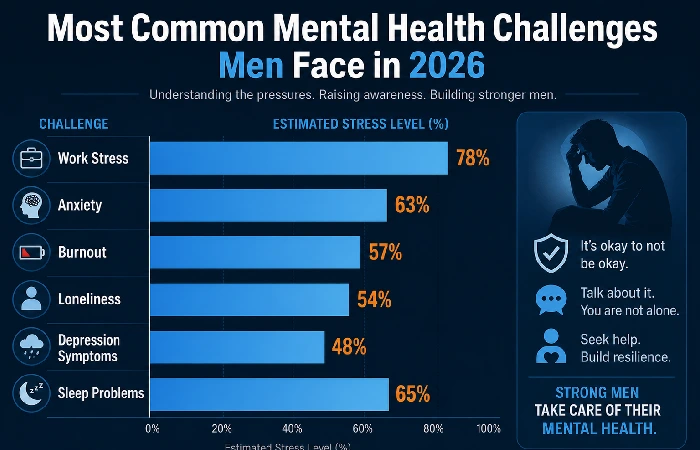
| Challenge | Estimated Stress Level (%) |
| Work Stress | 78% |
| Anxiety | 63% |
| Burnout | 57% |
| Loneliness | 54% |
| Depression Symptoms | 48% |
| Sleep Problems | 65% |
If you or someone you know needs immediate help, our guide to mental health crisis support provides valuable resources and guidance.
How Mental Health Challenges Change by Age
Mental health struggles can look different depending on life stage.
Young Men (18–30)
Common struggles:
- Career uncertainty
- Financial pressure
- Dating stress
- Social comparison online
- Confidence issues
Many younger men also experience anxiety related to social media prospects and terror of failure.
Middle-Aged Men (30–50)
Common struggles:
- Work stress
- Parenting responsibilities
- Marriage or relationship pressure
- Burnout
- Financial responsibilities
This age group often experiences “high-functioning stress,” where everything appears normal externally while emotional tiredness grows internally.
Older Men (50+)
Common struggles:
- Loneliness
- Retirement changes
- Grief and life transitions
- Physical health worries
When social circles become smaller. Emotional isolation becomes more common later in life.
Daily habits have a major impact on mental wellness. Discover practical tips for a mental health lifestyle.
Comparison Table: Mental Health Challenges by Age
| Age Group | Common Mental Health Challenge |
| 18–30 | Anxiety, self-esteem issues |
| 30–50 | Burnout, stress, depression |
| 50+ | Loneliness, grief, anxiety |
Expressive struggles are common, and it’s not individual failures. Empathetic life-stage challenges benefits men identify them.
Mental health challenges can vary throughout life. Learn more with our age-based mental health guide.
Why Men Often Ignore Mental Health Symptoms
Many men are trained to overcome problems independently.
Because of this, emotional struggles are frequently unnoticed until they become severe.
Common reasons include:
“I Should Handle It Myself”
- Several men think requesting for help means weakness.
- In truth, emotional awareness displays maturity and self-responsibility.
- Terror of Judgment
Some worry:
- “Individuals will think I am weak.”
- “I must be stronger.”
- “Others have bigger problems.”
These thoughts often delay treatment.
Misunderstanding Symptoms
Mental health symptoms may look like:
- Anger
- Poor sleep
- Tiredness
- Headaches
- No motivation
Many men will never realize that emotional well-being is the actual issue.
Being Too Busy
- Self-care is difficult in modern schedules.
- Many men place responsibilities, work, or family, above emotional wellbeing.
- When avoiding mental health support makes recovery tougher later.
Expert Insight: Why Early Action Matters
Mental health issues usually recover faster when it taken care early.
Ignoring symptoms often increases:
- Relationship issues
- Sleep problems
- Stress levels
- Exhaustion
- Anxiety
- Physical symptoms
- Depression severity
Small daily habits like sleep, emotional openness, movement, and support can make a big difference over time.
Signs of Depression and Anxiety in Men
Mental health signs in men are often misinterpreted.Many persons imagine depression as endless sadness or crying. In truth, emotional struggles in men can look very changed.
Some men become silent and withdrawn. Others become angry, annoyed , emotionally distant, or overly intensive on work. Because symptoms appear differently, mental health struggles occasionally go unnoticed for months or even years.
Learning to identify early signs is one of the most important steps toward emotional wellbeing.
Help reduce stigma and encourage open conversations by exploring our men’s mental health awareness resources.
Signs of Depression in Men
Depression is more than feeling sad after a difficult day.
It is a lasting emotional struggle that affects energy, thinking, sleep, motivation, and daily functioning.
Some men describe depression as:
- “Feeling numb.”
- “Feeling empty.”
Common symptoms include:
| Emotional Signs | Physical Signs | Behavioral Signs |
| Low mood | Fatigue | Isolation |
| Hopelessness | Sleep problems | Avoiding friends |
| Irritability | Appetite changes | Working excessively |
| Less motivation | Body pain | Anger mood |
| Emotional numbness | Less energy | Alcohol misuse |
Depression in Men Often Looks Different
Many men express emotional pain through:
- Anger
- Increased work focus
- Emotional shutdown
- Risk-taking behavior
- Irritability
- Substance use
Instead of saying, “I feel depressed,” some men simply say:
- “I am tired of the stage.”
- “Everything feels bad.”
- “I do not enjoy anything anymore.”
Signs of Anxiety in Men
It is one of the most common emotional health problems men face.
It frequently feels like the attention refuses to slow down.
Common anxiety symptoms include:
- Continuous disturbing
- Racing thoughts
- Overthinking worst-case situations
- Restlessness
- Trouble sleeping
- Difficulty focusing
- Muscle tension
- Feeling overwhelmed
Men with anxiety sometimes become extremely productive because remaining busy provisionally reduces worry.
But over time, mental exhaustion builds.
Quick Self-Check Table
| Question | Possible Concern |
| Do you feel mentally exhausted most days? | Stress or burnout |
| Do you overthink constantly? | Anxiety |
| Have you lost interest in hobbies? | Depression |
| Are you emotionally disconnected? | Emotional suppression |
| Do anger or irritation happen more often? | Hidden emotional distress |
| Is sleep becoming worse? | Anxiety, stress, depression |
If several symptoms last for more than a few weeks, emotional support may help.
Stress, Anger & Emotional Suppression
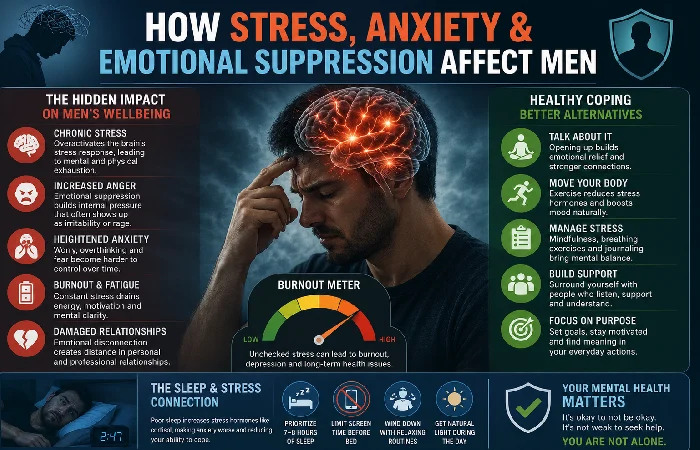
Healthy Coping Strategies for Menonal Suppression
- Many men are not taught how to process difficult emotions.
- As a result, stress often turns into anger.
- Sadness becomes silence.
- Fear becomes frustration.
- Anxiety becomes overworking.
This process is called emotional suppression.
Professional support can provide healthy coping strategies and emotional guidance. Exploring the benefits of therapy for men may help individuals manage anxiety, stress, and emotional challenges more effectively.
What Is Emotional Suppression?
Emotional suppression means repeatedly hiding or ignoring emotions.
Examples include:
- Imagining everything is fine
- Avoiding emotional talks
- Keeping fears inside
- Busy yourself with work
- While this may feel obliging briefly, emotional pressure gradually builds.
- Imagine shaking a bottle continually and never opening it.
- Eventually, pressure explodes.
That explosion may look like:
- Anger
- No Emotional
- Panic symptoms
- Relationship conflicts
- Burnout
Common Signs of Emotional Suppression
| Sign | Example |
| Irritability | Breaking over small issues |
| Emotional numbness | Feeling alone |
| Avoidance | Refusing difficult conversations |
| Overworking | Staying busy constantly |
| Withdrawal | Pulling away from relationships |
Anger Is Often a Secondary Emotion
Anger sometimes fleeces deeper emotions such as:
- Fear
- Anxiety
- Shame
- Sadness
- Stress
- Loneliness
Accepting this can change how men approach emotional wellbeing.
Instead of asking:
- “Why am I angry?”
- Try asking:
- “What emotion is underneath this?”
That small mindset shift can improve self-awareness.
Emotional Suppression vs Healthy Expression
| Emotional Suppression | Healthy Emotional Expression |
| Bottling emotions | Talking openly |
| Anger outbursts | Calm communication |
| Isolation | Seeking support |
| Avoidance | Problem-solving |
Healthy emotional look does not mean oversharing. It means identifying emotions relatively than ignoring them.
Healthy Coping Strategies for Men
Mental wellbeing recovers when healthy managing becomes part of daily life.
- The goal is not excellence.
- The goal is emotional stability.
- Minor habits recurrent reliably matter more than affected changes.
1. Physical Activity
Exercise benefits emotional wellbeing because drive lowers stress hormones and recovers mood.
Good beginner options:
- Walking
- Strength training
- Cycling
- Swimming
- Yoga
- Stretching
- Even 20–30 minutes helps.
2. Talk to Someone You Trust
You do not need perfect words.
Simple conversations matter.
Try saying:
“I’ve been struggling lately.”
or
“I feel mentally exhausted.”
Opening up reduces emotional pressure.
3. Improve Sleep
Poor sleep affects:
- Mood
- Anxiety levels
- Stress tolerance
- Emotional control
Simple sleep habits:
- Sleep at consistent times
- Decrease late-night scrolling
- Avoid heavy caffeine late in the day
- Keep the room dark and silent
4. Reduce Isolation
Loneliness causes emotional distress.
Healthy ways to reconnect:
- Join any hobby group
- Exercise with your friends
- Schedule regular calls
- Spend your time outdoors
5. Learn Emotional Awareness
Pause occasionally and ask:
“What am I actually feeling?”
You may notice:
- Stress
- Fear
- Frustration
- Disappointment
- Sadness
Naming emotions reduces mental overwhelm.
Therapy and Mental Health Support
One of the major myths about therapy is that it only happens for severe glitches.
That is not true.
Therapy can help with:
- Stress
- Anxiety
- Burnout
- Relationship issues
- Anger management
- Emotional overwhelm
- Life transitions
Think of therapy like coaching for emotional health.
Mental Health Support Options
| Option | Best For | Pros | Cons |
| Therapy/Counseling | Long-term emotional support | Personalized help | Cost/time |
| Online Therapy | Convenience | Flexible | Less personal for some |
| Support Groups | Shared experiences | Community feeling | Not private |
| Self-help Books | Learning coping skills | Affordable | Limited personalization |
| Mental Health Apps | Daily support | Easy access | Limited depth |
Online vs In-Person
| Feature | Online Therapy | In-Person Therapy |
| Convenience | High | Medium |
| Flexibility | High | Medium |
| Face-to-face interaction | Low | High |
| Accessibility | Excellent | Depends on location |
| Comfort level | Home setting | Office setting |
The top choice depends on ease, lifestyle and budget.
Seeking provision initial is frequently easier than waiting till burnout becomes severe.
Habits That Improve Emotional Wellbeing in Men
| Habit | Estimated Positive Impact |
| Better Sleep | 72% |
| Exercise | 69% |
| Therapy/Counseling | 66% |
| Social Support | 61% |
| Stress Reduction | 59% |
| Mindfulness | 52% |
Lifestyle Habits That Improve Mental Health
Improving men’s mental health is not only about treatment or therapy. Daily lifestyle habits play a main function in stress control, emotional balance, and long-term health.
Marginal, reliable changes in sequence can significantly improve focus, mood and emotional flexibility over time.
1. Arrange Quality Sleep
Sleep is one of the greatest powerful tools for mental health retrieval.
Poor sleep increases:
- Irritability
- Anxiety
- Overthinking
- Emotional insecurity
- No motivation
Healthy sleep habits:
- Avoid screens before bed
- Keep a fixed sleep schedule
- Keep the room dark and cool
- Avoid caffeine late at night
Even refining sleep by 1–2 hours can help recover emotional stability.
2, Eat for Brain and Mood Health
Food directly affects energy, mood, and mental clarity.
A stable diet supports brain function and decreases stress impact.
Helpful foods:
- Protein-rich meals
- Nuts and seeds
- Whole grains
- Fresh fruits and vegetables
- Omega-3-rich foods (fish, flaxseed)
Foods to limit:
- Alcohol
- Excess sugar
- Ultra-processed snacks
- Excess caffeine
3. Regular Physical Activity
Exercise is one of the greatest real natural antidepressants.
It helps:
- Release endorphins
- Decrease stress hormones
- Improve sleep
- Boost self-confidence
Simple options:
- Walking
- Gym
- Running
- Yoga
- Even 20–30 minutes daily makes a change.
4. Reduce Digital Overload
Too much screen time increases:
- Contrast anxiety
- Mental fatigue
- Sleep disturbance
- Reduced care span
Healthy digital habits:
- Set screen time
- Take short breaks during work
- Avoid social media
- Spend some time outdoors daily
5. Build a Healthy Routine
Structure creates emotional stability.
A simple daily routine:
- Morning walk
- Balanced meals
- Social interaction
- Relaxation time
- Work breaks
- Fixed schedule sleep time
Routine decreases mental chaos and recovers control over stress.
How Friends and Family Can Help
Support from close persons plays a main role in recovery.
Many men silently struggle, but do not express their emotional needs obviously. A supportive environment can make a vast difference.
What Friends and Family Can Do
- Listen without judgment
- Avoid phrases like “just be strong”
- Encourage open conversations
- Check in regularly
- Respect emotional space
- Encourage professional help if needed
NOT to Do
- Ignoring emotional signals
- Minimizing feelings
- Giving unsolicited advice only
- Forcing someone to “move on quickly”
What If Things Don’t Improve?
Sometimes, even after trying lifestyle changes, stress and emotional struggles continue.
- That is totally normal.
- Mental health retrieval is not linear.
- If You Still Feel Struggles After Weeks
Try this step-by-step approach:
Step 1: Recheck Basic Habits
Ask yourself:
- Am I sleeping fulltime?
- Am I eating properly?
- Am I exercising?
- Am I isolating myself?
Step 2: Talk to Someone Trusted
A friend, family member, or mentor can help reduce emotional pressure.
Step 3: Consider Professional Help
If symptoms persist:
- Therapy can help identify root causes
- Counseling provides coping strategies
- Mental health professionals offer structured support
Step 4: Avoid Self-Blame
- Mental health struggles are not personal failures.
- They are signals that support is needed.
Main Reasons Men Avoid Mental Health Support (2026)
| Reason | Percentage |
| Fear of judgment | 68% |
| “I should handle it myself” mindset | 62% |
| Lack of awareness | 55% |
| Cost concerns | 48% |
| Time constraints | 44% |
How to Know When It Is Time to Seek Support
Many men delay until stress becomes severe before asking for assistance.
But emotional care works greatest when problems are addressed early.
Signs it may be time to seek help include:
- Feeling mentally exhausted
- Sleep problems lasting weeks
- Anxiety affecting daily life
- Anger becoming harder to control
- Losing motivation or enjoyment
- Feeling emotionally disconnected
- Support does not always mean therapy immediately.
- Sometimes improvement begins with:
- Talking to trusted friends
- Joining a support group
- Stress management techniques
- Lifestyle improvements
However, professional help becomes important if symptoms continue.
What Happens During Therapy?
Many men evade therapy because they are hesitant about what to expect.
A main therapy session often includes:
- Talking about current stressors
- Identifying emotional patterns
- Discussing goals
- Learning management strategies
- Therapy is not judgment.
It is an organized talk designed to improve emotional wellbeing.
Beginner-Friendly Therapy Comparison
| Support Option | Best For |
| Therapy | Long-term emotional struggles |
| Coaching | Goal-setting and accountability |
| Support groups | Shared experiences |
| Self-help resources | Mild stress management |
Looking for support initially frequently prevents emotional issues from becoming harder to manage later.
FAQs
- What are the initial signs of mental health matters in men?
Some of the initial signs of mental health difficulties with men include:
- Irritability and fatigue
- Sleep Issues
- No motivation
- Removal from family and friends
- Rise in stress
- Rise in anger
2. Why do men hide their emotions?
Study indicates that many men hide their emotions and fight in silence because they have been trained to a young age that stating emotions and being sensitive is not suitable and that they always be strong all the time.
3. Is anger a sign of depression in men?
Yes. For men depression is frequently existing as anger, prevention or irritability as opposed to sadness.
4. Can exercise recover mental health?
Yes. It can decrease the stress hormones in your body, recover your mood and rise your emotional stability.
5. When should a man seek therapy?
If stress, sadness, emotional struggles, and anxiety are affecting a man in ways that are not provisional (more than a few weeks) and interfere with his daily activities then a man can pursue therapy.
Final Conclusion
Men’s mental health is not about weakness or strength. It is about balance, awareness, and support.
Every man practises periods of pressure ,stress, and emotional challenge in his life but with initial recognition and suitable minor steps to address these problems, they can be overcome and recover his wellbeing in the long term.
Quality sleep, exercise, being more open about your emotions, a support network of friends and family, and then therapy if necessary can really transform a person’s mental health for the better in the long run.
You do not need to handle everything alone.
Support exists, and recovery is always possible.
Dr. Khizrana Begum is a qualified medical professional with MBBS and MD qualifications and 5+ years of experience in the medical field. She works as a General Physician and Dermatologist, with knowledge spanning general medicine, dermatology, preventive healthcare and skin health.
As a medical reviewer, Dr. Khizrana Begum reviews health and wellness content for medical accuracy, clarity and authenticity.
Sameena Begum reviews content for clarity, accuracy and reader usefulness. Her review process helps ensure that published information is clearly presented, relevant and easy for readers to understand.
Syeda Yasmeen is a Health & Wellness Writer at InHumanBeing.com. She creates clear and reader-focused content across health, nutrition, wellness, women’s health, men’s health and babies’ health.