
 Syeda Yasmeen
Health & Wellness Writer Syeda Yasmeen creates clear and
reader-focused content covering health,
nutrition, wellness, women’s health,
men’s health and babies’ health.
Read Full Bio of Author →
Syeda Yasmeen
Health & Wellness Writer Syeda Yasmeen creates clear and
reader-focused content covering health,
nutrition, wellness, women’s health,
men’s health and babies’ health.
Read Full Bio of Author →
 Sameena Begum
Health, Technology & Digital Content Reviewer Sameena Begum reviews selected content
for clarity, factual presentation,
consistency and reader usefulness.
Read Full Bio of Reviewer →
Sameena Begum
Health, Technology & Digital Content Reviewer Sameena Begum reviews selected content
for clarity, factual presentation,
consistency and reader usefulness.
Read Full Bio of Reviewer →
 Dr. Khizrana Begum
General Physician and Dermatologist Dr. Khizrana Begum is a qualified medical
professional with MBBS and MD qualifications
and 5+ years of experience. She reviews health
and wellness content for medical accuracy,
clarity and responsible presentation.
Read Full Bio of Medical Reviewer →
Dr. Khizrana Begum
General Physician and Dermatologist Dr. Khizrana Begum is a qualified medical
professional with MBBS and MD qualifications
and 5+ years of experience. She reviews health
and wellness content for medical accuracy,
clarity and responsible presentation.
Read Full Bio of Medical Reviewer →
The application of sun protection measures is a crucial skin care step. Sunlight is good, but it can cause damage to the skin. If it is for the long term because of ultraviolet (UV) radiation. Over time, regular experience will lead to an uneven skin tone, dark spots, sunburn and early skin aging and skin cancer.
In Mexico, sun protection would be mainly essential for individuals. Who live in areas that get strong sunlight all year long. Caring exposed skin is a top, easy-to-follow safety tip when you are outside, on the job, traveling, or on a beach.
Sunscreen is most effective when used with shade, protective clothing, hats and other sun safe behaviors.
❝
This article is part of
Womens SKin Care Hub
Why Is Sunscreen Important for Skin Care?
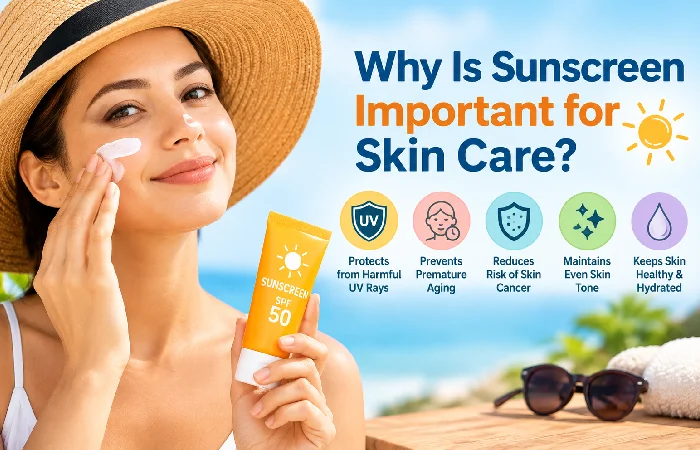
Sunscreen is used to protect skin from ultraviolet radiation. Two types of UV radiations are definite to skin health, UVA and UVB.
UVB is powerfully linked to sunburn. Whereas UVA is linked to longer term skin damage and early skin ageing. They can both reason skin problems.
Sun protection is an essential part of maintaining healthy-looking skin and should be included in your overall skincare approach. Explore our complete skin care guide for practical information.
Regular use of sunscreen can help:
- Minimize risk of sunburn.
- Ward off UV skin damage.
- Minimize the appearance of premature signs of skin aging.
- Keep some sun-induced discolorations from occurring
- Provide (overall) skin protection
Sunscreen is not just for summer vacations or journeys to the beach. Individuals can be exposed to UV while they are walking, working outdoors, driving or sitting by a window.
Sunscreen does not, however, provide 100% protection. It also aids to seek shade, wear protection and avoid lengthy direct exposure to high levels of sunlight.
How to Choose the Right Sunscreen
There are many types of sunscreens available and selecting a sunscreen can seem like a challenge. First check the label for a couple of important features.
Look for:
- Broad-spectrum protection
- SPF 30 or higher
- Water resistance (as needed)
- A texture that you will be using throughout the course.A texture you will consistently use.
The best texture can also vary depending on your skin type.
Lighter gels or fluids may be better for the oily skin type. Some dry skin may choose a moisturizing sun cream. Fragrance free formula may be preferable for individuals with sensitive skin.
For lengthy periods outside the house, choice a sun cream that is labelled for outdoor practise and re-apply the sun cream as directed.
The most effective sun screen is one that offers adequate protection, and is tolerable for you to use frequently.
Adding sun protection to a consistent daily routine can make skincare habits easier to maintain throughout the year. Explore our complete skincare routine guide for helpful tips.
SPF and Broad-Spectrum Protection Explained
It stand for Sun Protection Factor and it is a measure of the efficiency of a sun cream in stopping the sunburn caused by the UVB rays.
However, SPF does not suggest that you can spend an unlimited amount of time in the sun.
The American Academy of Dermatology and various other dermatology societies generally mention applying a sun protection factor (SPF) of 30 or higher for everyday use.https://www.aad.org/public/everyday-care/sun-protection/
Broad-spectrum sunscreen is effective against both UVA and UVB radiation.
A simple way to remember it is:
| Label | What It Means |
| SPF | Indicates the level of protection against UVB-related sunburn |
| Broad-spectrum | Provides UVA and UVB protection |
| Water-resistant | Maintains its labeled protection for a specified time during swimming or sweating |
None of sunscreens are 100% effective at blocking UV rays. The technique in which to apply the product and how often it is re-application is as relevant as the number on the bottle.
Different skin types may have different preferences when choosing sunscreens and other skincare products. Explore our different skin types guide for useful information.
Sun protection according to skin type.
In general, certain skin types are better suited to certain skin types of sun cream.
| Skin Type | Sunscreen Features to Consider |
| Oily | Lightweight, non-comedogenic, gel or fluid |
| Dry | Moisturizing cream or lotion |
| Combination | Lightweight lotion or fluid |
| Sensitive | Fragrance-free, gentle formula |
| Normal | Any comfortable broad-spectrum formula |
Hypperpigmentation can affect individuals of darker skin tone, but everyone can suffer from UV damage to their skin. Sunscreen is therefore beneficial for any skin color.
A sunscreen that does leave a white layer on the skin is an option that doesn’t work for everyone, or you should consider using a different sun protection.
Sunscreen for Acne-Prone Skin
Some individuals with acne-prone skin do not use sunscreen out of fear of greasy or acne-causing effects.
Rather, seek out non-comedogenic products, which are made in order that they’re less inclined to block pores.
A lightweight gel, fluid or lotion could be more comfortable on oily or acne skin.
Sunscreen can also be especially helpful when you’ve acne spots. Some kinds of post inflammatory discolorations may be more obvious or permanent due to sun exposure.
Choosing suitable skincare products can help you create a simple routine that includes effective sun protection. Explore our skincare products guide for practical ideas.
A basic task might be:
Acne Treatment → Sunscreen → Moisturizer → Cleanser
If you’ve already applied an adequate moisturizer, you might not need to use a special heavy moisturizer under your sunscreen.
Do not take a one-size-fits-all approach to which products to use; opt for the ones that work for your skin.
Sunscreen for Dry and Sensitive Skin
Sunscreens with moisturizing properties are effective for dry skin. Search for formulas that are comfortable but will not make skin tight after application.
Glycerin and other moisturizing ingredients can be used to give a more comfortable finish.
Extra attention is needed for sensitive skin. Sunscreen that often burns or redness, use one that is designed for sensitive skin and does not contain a fragrance.
Some sensitive skinned individuals might want to try mineral sunscreens with zinc oxide or other inorganic ingredients but tolerance to this ingredient will vary from person to person.
If you wish to use a new sunscreen on your entire face, you can first try it on a small area.
Do not use sunscreen on visibly irritated or damaged skin unless advised to do so by a health care provider.
Sun protection is also an important consideration when caring for acne-prone skin and choosing suitable daily skincare products. Explore our skincare guide for acne-prone skin for helpful information.
How Much Sunscreen Should You Apply?
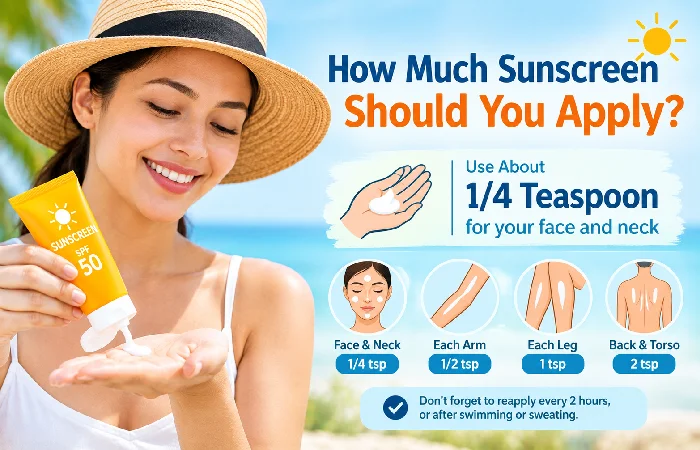
If you don’t put enough sun cream on, you will not be as protected.
A good rule of thumb for face, neck and other uncovered parts is to apply copiously enough so as to cover the skin evenly. The two-finger technique is the most common method, which is to apply sunscreen along the length of two fingers on the face and neck, but the amount will depend on the size of the area being covered.
The recommended dosage of dermatology products for the entire body of an adult is around 1 ounce, or the amount that will fill a shot glass, per application.
Be sure to include spaces that are easily overlooked, including:
- Ears
- Neck
- Hairline
- Tops of feet
- Hands
Areas of the body, such as the chest that are exposed.
Use sunscreen before leaving home, following product instructions, allowing enough time to create an even layer, if necessary.
When should you reapply the sunscreen?
Sun protection isn’t continuous, meaning that sun cream won’t protect you all day long after the initial application.
Sunscreen is typically recommended to be reapplied approximately every two hours while outdoors, and more frequently if the product says it should be if you have been swimming, sweating or towel-drying.
Consistent sun protection can be an important part of caring for skin affected by uneven pigmentation and visible spots. Explore our skincare guide for pigmentation and spots for practical guidance.
Re-application is particularly recommended in the following seasons:
- Beach days
- Outdoor sports
- Hiking
- Swimming
- Long walks
- Outdoor work
- Extended travel
Your requirements may be different if you spend more of your time inside than outside, away from intense sunlight.
Sunscreen that is water resistant helps when swimming or sweating, but it isn’t waterproof. It is still important to reapply.
Common Sunscreen Mistakes
People who use sun protection daily may make mistakes that decrease their protection.
Common mistakes include:
- When the sun protection factor is too low.
- Not considering the spectrum and forgetting the neck and the ears.
- Only applying the sunscreen when it is sunny outside
- Failure to reapply when the exposure time is prolonged outside.
- Using only sunscreen.
- Using expired sunscreen
- Restricting coverage to just the ultraviolet range of the spectrum.
- Applying only UVA sunscreen.
- If a high SPF is assumed, then they should be able to sunbathe for as long as they want.
- Sunscreen is not taken when exercising outdoors.
- Applying sunscreen unevenly
Another frequent error is only using sunscreen while on vacation. Exposure to UV can also occur in everyday activities.
Keep in attention that clouds are not 100% real at blocking out the sun’s UV rays. Sun defence can still be essential when the weather appears cloudy.
How Sun Exposure Affects Skin Aging
Regular exposure to the sun can be a cause of early ageing. UV radiation can cause harm to the construction of your skin and lead to fine lines, wrinkles, uneven pigmentation and loss of elasticity.
This process can be referred to as photoaging.
Another factor that can cause changes in the arrival of the skin is the sun.
Natural aging cannot be evaded, but the use of good sun protection can help minimise those UV-related alterations which may be prevented.
The simple daily approach is practical:
Protect your skin: apply sun cream, seek shade, wear protective clothing and re-apply as necessary.
Whether you’re in a big city, working outside, commuting a lot, or just spending time outdoors during the day, this routine can help.
Sun protection does not need to be clear. Use a sunscreen with an SPF of 30 or more. Apply it to any skin that is exposed, reapply as wanted and practice other sun protection measures along with using the sunscreen. One of the easiest steps you can take to protect your skin in the long run is to establish them into your regular skin care routine.
Dr. Khizrana Begum is a qualified medical professional with MBBS and MD qualifications and 5+ years of experience in the medical field. She works as a General Physician and Dermatologist, with knowledge spanning general medicine, dermatology, preventive healthcare and skin health.
As a medical reviewer, Dr. Khizrana Begum reviews health and wellness content for medical accuracy, clarity and authenticity.
Sameena Begum reviews content for clarity, accuracy and reader usefulness. Her review process helps ensure that published information is clearly presented, relevant and easy for readers to understand.
Syeda Yasmeen is a Health & Wellness Writer at InHumanBeing.com. She creates clear and reader-focused content across health, nutrition, wellness, women’s health, men’s health and babies’ health.