

Last Updated: September 14, 2026
Formula feeding is one of the ways to feed babies. Some babies feed solely on formula, and some on both breast milk and formula. There are different reasons why parents choose formula feeding.
There may be lots of questions about formula feeding for first-time parents. How much formula does the baby need? What is the appropriate frequency of bottle feedings? What kind of formula is appropriate? How should the formula be prepared?
Knowing some basics will help a lot and ensure the baby gets all the necessary nourishment.
This guide includes all the information you need to know about formula feeding, including frequencies of feedings, amounts of formula, formulas, preparations, methods of bottle feeding, when the baby is full, and what challenges may occur.
What Is Formula Feeding?
Formula feeding is the way to feed the baby with commercially produced formula instead of or together with breast milk.
The formula is developed to include all the necessary nourishment for proper development of babies. It can be found in different forms, such as:
- Powdered formula
- Concentrated liquid formula
- Ready-to-feed formula
Each type has specific preparation and storage instructions.
How Much Formula Does a Baby Need?
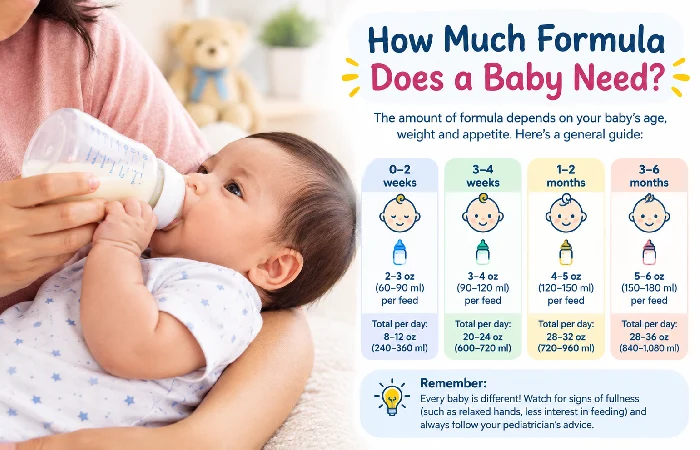
The amount of formula needed by the infant varies depending on certain factors.
Some of these factors include:
- Age
- Weight
- Rate of growth
- Individual appetite
- State of health
- Frequency of feeding
The amount of formula taken usually varies with age. Infants usually start by taking small amounts of formula and gradually build up to take larger amounts of the formula.
Formulas in the Newborn Stage
Infants are born with small stomach capacity and require frequent feeding.
At the initial stages, they tend to take small quantities during feeding but increase gradually as they grow.
Parents should concentrate on the hunger signs displayed by their infants rather than expecting that they should take a fixed quantity of food in each bottle.
An individual feed can be large, while another can be small.
Amount of Formula in Growing Babies
In growing babies, they usually:
- Take larger amounts of formula in each feed
- Are fed at a lower frequency compared to newborn babies
- Have regular schedules
- Sleep for long hours
- Begin to eat complementary foods
The process is gradual.
When complementary foods begin, formula or breastfeeding is likely to continue to form part of the baby’s diet in the first year.
Avoid Overfeeding
Avoid putting unnecessary pressure on the infant to finish all his food.
Infants are capable of letting parents know when they are hungry or have been fed enough.
Feeding an infant beyond their appetite may be harmful.
It is advisable to adopt responsive feeding, which entails responding to the infant’s hunger and fullness cues.
When Should You Formula Feed?
There is no fixed number for formula feeding.
The rate at which one feeds the infant with formula decreases as the child grows.
Formula Feeding for Babies
Most babies require more frequent feeding than older infants.
This is because babies have a small stomach capacity.
Formula Feeding for Infants
The feeding patterns of newborn babies can be erratic.
On one day, babies tend to feed more frequently. On another day, the time between feeds may be longer.
Formula Feeding for Older Infants
The feeding pattern of infants changes as they grow.
Some of the patterns of feedings for infants include:
- Morning feed
- Midday feed
- Afternoon feed
- Evening feed
- Bedtime feed
Some infants may still need night feeding, especially in the early months.
Feed According to Hunger Cues
Apart from following a rigid schedule, one should take cues from the signs of hunger.
Hunger cues could be:
- Rooting
- Puckering mouth
- Hand sucking
- Licking lips
- Elevated alertness
- Turning towards bottle
Crying usually serves as a last cue of hunger after other cues.
Early hunger cues will help in making feeding easy.
Choosing Appropriate Baby Formula
Various types of formula products are available in the market, making it difficult to choose a formula.
When it comes to a healthy baby, one can go for regular formula. But there may be some infants who have special nutritional needs.
It is always important to get in touch with a physician before opting for a special formula.
Regular Types of Baby Formulas
Formulas include:
- Traditional milk formulas
- Soy formulas
- Hydrolyzed formulas
- Formulas that are specific to particular medical issues
Not all babies need a special formula.
Changing formula without any consultation could complicate things in figuring out if a formula product is good or bad for your baby.
Powdered Formula
Powdered formula is commonly used and usually requires adding water to it.
Concentrated Liquid Formula
The concentrated liquid formula should be diluted following the instructions provided on the product label.
The proper amount of water is essential.
Ready-to-Feed Formula
Ready-to-feed formula does not require dilution with water.
It may come handy while traveling or if there are any problems with preparing powder formula.
When Should You Consult a Pediatrician about Formula?
Speak to a pediatrician in case your child suffers from:
- Frequent vomiting
- Failure to gain weight
- Breastfeeding difficulties
- Blood in stools
- Diarrhea
- Consequences of severe constipation
- Allergies
The physician will determine whether it is necessary to change the formula.
Tips for Preparing Safe Formulas
It is extremely important to prepare safe formulas in order to provide your child with maximum safety.
Read the instructions for use for the specific product and your healthcare professional’s recommendations.
Step 1: Hand Washing
Wash your hands with soap and water before preparing formulas and handling bottles.
Step 2: Cleaning Feeding Utensils
You need to clean the bottles, nipples, caps, and other equipment used by your baby to drink the formula.
Step 3: Use Safe Water
Use the proper water to mix the baby formula in accordance with the health department guidelines in the locality and the physician’s advice.
Step 4: Use Proper Directions to Mix the Formula
Use the proper mixing ratio as indicated in the manufacturer’s packaging instructions.
Avoid:
- Adding excess formula powder.
- Using extra water.
- Concluding the amounts needed.
- Measuring the formula powder using household utensils.
It is very important that the formula be mixed properly.
Too much water or formula powder can change the concentration of the formula.
Step 5: Mix Thoroughly
Stir thoroughly after mixing all the ingredients of the formula.
Step 6: Check for Proper Temperature
In the process of warming the bottle, ensure that the formula is not hot when offering it to the baby.
The bottle should never be warmed using a microwave due to uneven heating.
Storage of Prepared Formula
Proper storage of the prepared formula should be followed in accordance with the manufacturer’s instructions.
Proper disposal of unused formula should be done if needed.
Leftover formula from the bottle should never be reused.
Bottle Feeding Tips
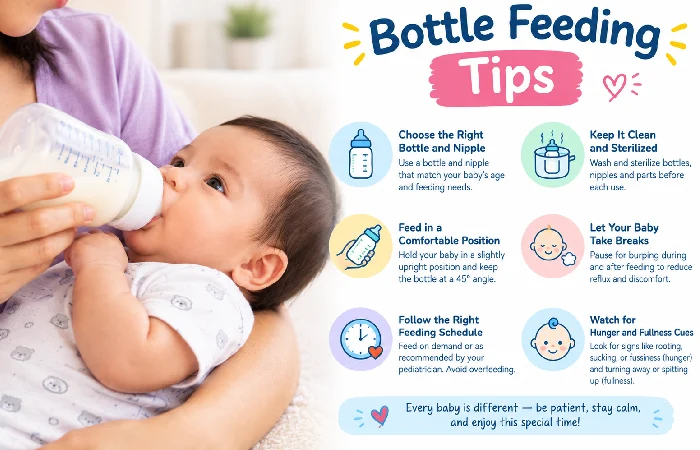
But in some instances, bottle feeding your baby is a good experience in terms of bonding.
The right posture and the right way of feeding will make your work easy.
Hold Your Baby Correctly
It is vital to hold your baby in a comfortable semi-sitting posture while bottle feeding.
You should not bottle-feed your baby in a lying position.
Holding your baby makes you observe your baby while bottle feeding and ensure that your baby feels comfortable.
Right Nipple Flow
There are different kinds of nipple flow that are available in the market.
A nipple that enables milk to flow fast might cause:
- Coughing
- Gagging
- Choking
- Milk flowing out of the mouth
A nipple that flows slowly might cause:
- Frustration
- Long time for feeding
- Feeding effort
Choose a nipple based on the age of your baby.
Paced Bottle Feeding
Paced bottle feeding includes:
- Holding the baby comfortably
- Right posture of the baby
- Intervals in feeding
- Looking for signs of fullness
It helps you avoid hurried bottle feeding.
Burp Your Baby
Burping your baby after bottle feeding may be very helpful.
Burping enables your baby to release the air swallowed during bottle feeding.
How to Know Your Baby Is Full
A baby can communicate if it has had enough food.
It is crucial to learn these signs in order to prevent overfeeding your baby.
Signs Your Baby Is Full
If your baby:
- Turns its head from the bottle,
- Closes its mouth,
- Stops sucking,
- Pushes the bottle,
- Becomes calm,
- Sleeps,
- Is no longer interested in feeding,
There is no need to force your baby to eat all the volume of formula left.
Each feeding should be unique for your baby.
The Baby’s Hunger and Fullness Are Different
Each feeding will be different due to changes in the baby’s appetite.
The reasons could be a growth spurt, illness, sleeping problems, development, and so on.
Common Formula Feeding Problems
A lot of infants experience irregular feeding issues.
There are issues that will go away on their own once the infant gets older; there are others that will require professional guidance.
Vomiting
This issue is very common among infants.
It may happen due to:
- Taking air in
- Taking food too fast
- Taking more food than what their bodies can manage
- Their developing digestive systems
Keeping the baby upright after feeding is helpful.
Health professionals should see forceful and regular vomiting.
Gas
Babies may experience problems with gas in their stomachs.
Some of the symptoms could include:
- Babies being fussy
- Lifting their legs
- Crying
- Having a hard time relaxing
Here are some solutions to the problem:
- Burping the baby after feeding
- Inspecting the flow of nipples in the bottle
- Ensuring proper position of the baby while feeding
- Taking your time while feeding
Constipation
Parents usually get worried when their baby’s stool is different.
However, not all differences in the stools are constipation issues.
Consult the doctor when you notice your baby is having difficulties defecating or is uncomfortable.
Do not switch formulas or try any home remedies.
Refusing the Bottle
There might be some occasions when some babies refuse to take their bottle.
The possible causes might be:
- Fatigue
- Illness
- Discomfort
- Distracted
- Change of routine
- Flow of nipple is different
If bottle refusal persists or the baby is not taking much milk, then contact the healthcare provider.
Feeding Too Fast
If a baby feeds too fast, then they might swallow some extra air or experience discomfort.
The possible signs might be:
- Coughing
- Gulping
- Milk coming out of the mouth
- Fussy while feeding
Try checking the flow of the nipple and feed slowly.
Crying After Bottle Feeding
Crying of babies after bottles does not necessarily mean that they are hungry.
There are various other reasons, like:
- Gas
- Fatigue
- Discomfort
- The need for physical touch
- Wet diaper
- Illness
Don’t assume you need to give them more formula immediately.
Final Thoughts
Bottle feeding is a safe and proper option for most parents. Whether you choose exclusively bottle feeding or both types, information about safe formula preparation and responsive feeding will help you provide your baby with food.
Every child has specific requirements regarding feeding because it depends on their age. Babies require more frequent feeding than newborns because they eat larger quantities of the bottle as they get older.
Safety of formula preparation, observation of hunger and fullness signs, and development of the baby are the aspects you should be paying attention to at all times.
All children are unique, and the same rules do not apply to everyone. There is no universal quantity and schedule for feeding a baby, and the size of the bottle depends on the individual.
If you have any doubts concerning the type of formula, feeding schedule, and development of your baby, always consult with a pediatrician.