
Last Updated: September 14, 2026
Knowing how to read your baby’s feeding cues may make caring for your baby a bit easier. Infants don’t understand whether they are hungry, satisfied, drowsy, or uncomfortable; thus, babies use their body language to tell us something.
Knowing baby feeding cues may help you, as they will help you take care of the infant’s needs without making the baby irritable. Baby feeding cues are extremely vital because babies have no feeding schedules.
All babies are unique because some of them give clear signs of hunger while others give very subtle signs. These baby feeding cues change as the babies grow older.
In this article, we will learn about baby feeding cues including early hunger cues, late hunger cues, fullness cues, age-specific feeding cues, and the appropriate responses to baby feeding cues.
What are Baby Feeding Cues?
Baby feeding cues are the cues used by babies to indicate whether they are hungry or full.
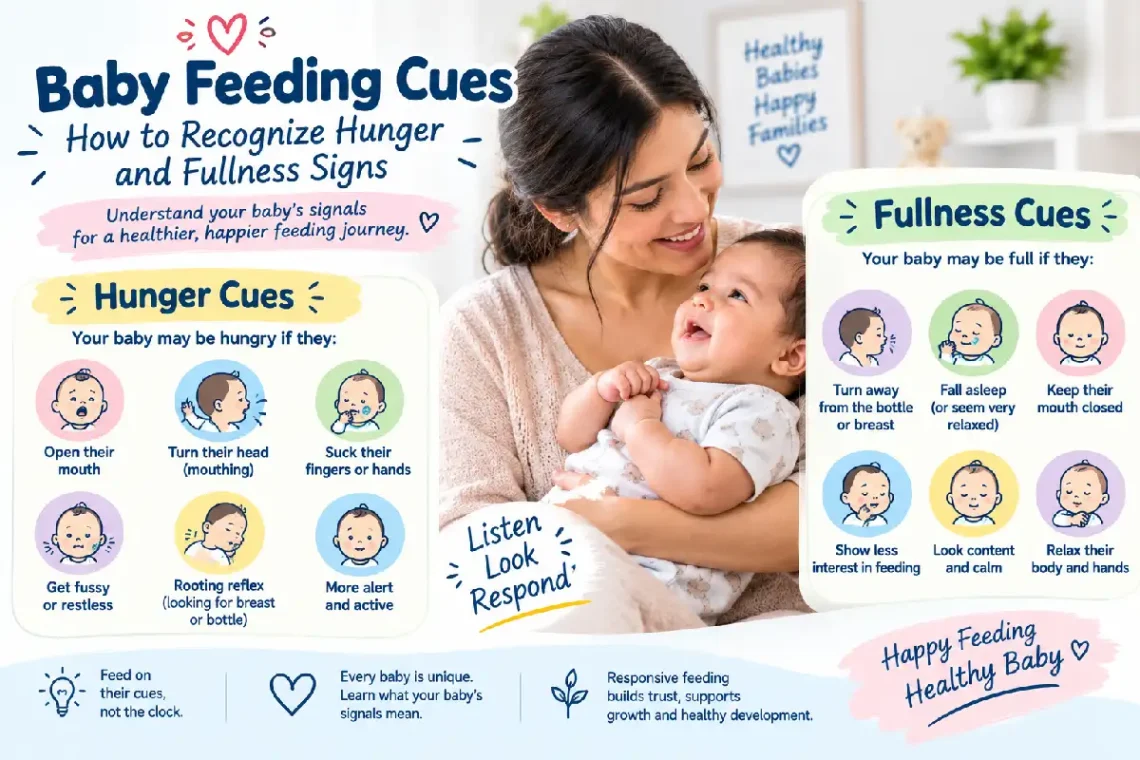
Babies show numerous signs before crying to indicate that they need to be fed. Equally, babies show various signs after they are fed to indicate that they are full. Some of the baby feeding cues are:
- Moving the head
- Opening the mouth
- Rooting
- Sucking on hands
- Smacking lips
- Reaching for food
- Turning away from food
- Slowing down while feeding
Therefore, for example, your baby might want to eat before the designated time or show a lack of appetite, although it is time to feed them.
In this way, once you notice these signs, you can react accordingly.
Early Signs of Hunger

The initial signs of hunger suggest that a baby is hungry and needs to eat.
Considering the initial hunger signs will assist in making the feeding easier because a calm baby is more likely to eat.
- Rooting
Rooting is one of the most distinctive hunger signs of infants.
Touching the baby’s cheeks leads to turning their head in the direction of the touch and opening the mouth.
This reflex is helpful for locating the breast or bottle.
- Open Mouth
Another sign of hunger is the baby’s open mouth.
Infants can open their mouths several times or move their lips to indicate that they need to feed.
- Turning the Head from One Side to Another
Infants tend to turn their heads from one side to another when searching for food.
It is a typical feature of infants.
- Bringing Hands to Mouth and Start Sucking
Infants bring their hands close to their mouth and start sucking.
Sucking is an indication of hunger, but not every time it indicates that the baby is hungry.
Old babies generally perform this activity as a soothing behavior.
Think about other cues alongside sucking of hands.
- Lip Smacking
Some babies show certain signs of sucking or lip smacking when hungry.
These cues may remain unnoticed when the baby is sleeping.
- Becoming More Alert
Even the most drowsy babies become suddenly more alert when it comes to being fed.
Babies will start moving their body parts or looking here and there.
- Going towards Breast/Bottle
When babies understand that they are going to be fed, they go towards breast/bottle.
Old babies become very excited during food preparation process.
Late Signs of Hunger
When these initial signs of hunger are ignored, the child will get even more agitated.
A cry is indicative of a late hunger sign.
Very hungry children will not eat easily because they will already be agitated.
Late Hunger Signs
The late hunger signs include:
- Being cranky
- The baby’s body will move a lot
- Face redness
- The baby will cry
- The baby screams
- Will have difficulty being calmed down
At this stage, babies need to be calmed before eating.
Calming Very Hungry Babies
If your baby is screaming, soothe the baby first before it eats.
You can:
- Hold your baby
- Soothe your baby
- Rock your baby gently
- Lower the noise levels.
- Soften your baby first before you let the baby eat.
Once you have calmed your baby, look for signs that indicate the baby is ready to eat.
Signs Your Baby Is Full
Babies also communicate when they have eaten enough.
The identification of satiety cues is as important as hunger cues.
It is necessary to avoid stimulating the continuation of feeding by the baby once they indicate they are satisfied.
Signs of Satiety
The signs that your baby may be satisfied are:
- Turning the head away from you.
- Closing their mouth.
- Stopping sucking.
- Feeding at a slower rate.
- Pushing the breast or bottle away.
- Looking relaxed.
- Releasing the nipple.
- Losing interest in feeding.
More advanced babies also might:
- Push food away from themselves.
- Throw food.
- Turn away from the spoon.
- Have their mouth closed.
Importance of Satiety Cues
In this way, babies learn to react to their body cues of being hungry or sated.
Providing an opportunity for the babies to stop feeding themselves when they are full may lead to responsive feeding.
It is natural that babies take different amounts of food during each feed.
For instance, your baby will drink a lot of milk in the morning but then will take less during another feed.
Feeding Cues in Newborns
Feeding cues will be more common for newborns since they need regular meals.
It is due to their small stomachs and rapid growth in the early weeks.
Common Hunger Cues of Newborns
Newborns may:
- Root
- Open their mouths
- Head turning
- Sucking their hands
- Show sucking movements
- Lip smacking
- Greater activity
- Moving towards the breast
These cues could appear before crying occurs.
Newborn Feeding Patterns
Newborns might not have a predictable schedule.
On some days they could feed very often, but on others the intervals between feedings might be longer.
Increases in feeding could happen during growth spurts.
Some babies also practice cluster feeding, meaning they desire many feeds within a short period.
Cluster feeding might be normal in newborns.
Why It Is Important to Watch the Cues in Newborns
As newborns have an unpredictable schedule, hunger cues will be more helpful than strict adherence to the clock.
However, the medical recommendations for feeding frequency should be considered, especially in cases of:
- Weight gain problems
- Health problems
- Being born prematurely
- Feeding problems
Feeding Cues by Age
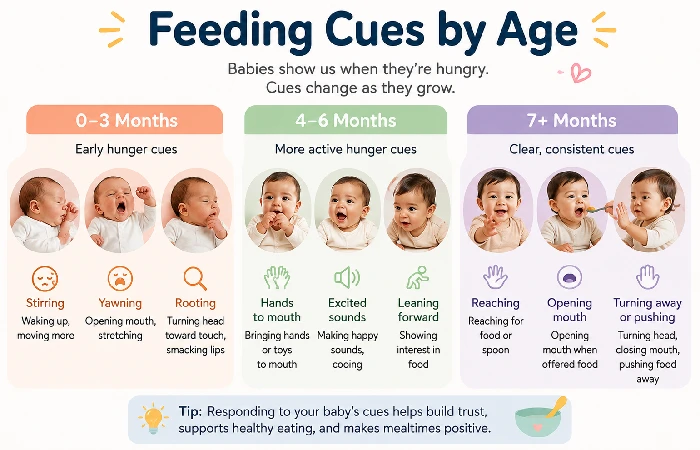
Baby feeding cues change as babies develop.
Newborns do not use the same cues as a baby who has started eating solids.
It is important to know this in order to provide an adequate response to your child’s needs.
Feeding Cues Between Birth and 3 Months
Young babies use non-verbal signs of hunger such as movements and reflexes.
Typical feeding cues include:
- Rooting
- Head turning
- Opening the mouth
- Suckling
- Hand-mouth movements
Crying is usually a late hunger cue at this age.
Feeding Cues Between 4 to 6 Months
With time, babies become aware of their environment, and the way they feed may change.
Babies might:
- Be easily distracted during feeding time
- Remember regular feeding patterns
- Express excitement when seeing the bottle
- Learn from watching other people eat
There might also be an increase in interest in food as babies get closer to being ready for complementary food introduction.
However, interest in food alone is not always an indicator of developmental readiness for solid foods.
Feeding Cues Between 6 and 9 Months
Babies who have started eating complementary foods have new ways of communicating hunger.
They may:
- Reach toward food.
- Open their mouths when a spoon approaches.
- Lean forward.
- Become excited at mealtimes.
- Try to grab food.
Signals of satiety might be pulling away, closing one’s mouth, or loss of interest.
Feeding Signals Between 9 and 12 Months
Babies tend to be clearer at this age.
For instance, they can:
- Point at the food.
- Lunge at the food.
- Signal through sounds when they want to be fed.
- Be interested in their high chair.
- Express excitement when food is being prepared.
In addition, babies might show independence through self-feeding.
At this age, babies can clearly signal when they are satiated.
How to Respond to Your Baby’s Hunger Cues
Recognizing feeding cues is essential in taking care of a child.
Try to feed your baby based on early signs of hunger, and not after they become too frustrated.
- Watch out for Signs Instead of Following a Timetable
Timed feeding is effective, but not applicable for all infants.
Your baby’s appetite may be determined by different factors, including:
- Growth spurts
- Level of activity
- Changes in sleeping habits
- Illnesses
- Developmental milestones
Use the feeding timetable as a guide only.
- Recognize Early Hunger Signs
If your baby shows early signs such as rooting reflex, opening their mouth, or sucking on hands, get ready to feed them.
A calm baby will eat better.
- Feeding your Baby in a Quiet Setting
A quiet and peaceful place may distract your baby from anything else.
It may be particularly helpful in the case of older babies, who get easily distracted during feeding.
- Let Your Baby be in Control
Do not force your baby to eat.
Whichever it is – breast milk or formula, let them have necessary pauses in between.
Observe signs that your baby wants to continue feeding or stop eating.
- Do Not Force Your Baby to Eat
Do not pressure the baby to take the whole bottle or food.
Let the baby stop taking food in case they signal that they have enough.
Why Crying is Not Always Indicative of Hunger
Parents assume that the child cries because it is hungry.
Although the child may be hungry, there are various reasons for crying in babies.
Crying is a mode of communication, and it is important to think about other possibilities.
Other Reasons for Babies’ Crying
Babies may cry because of the following:
- Tiredness
- Uncomfortability
- Being too hot or too cold
- Being wet or having a dirty diaper
- Baby is feeling gassy
- Feeling over-stimulated
- Crying for comfort
- Feeling uncomfortable
Check for Other Signs of Hunger
When you want to give your baby a feed, ensure that you first look for the hunger signs.
It includes the baby:
- Rooting
- Mouthing
- Hand sucking
- Drawing toward the breast or the bottle
If the baby has just taken a meal and shows no other sign of hunger, then they need something else.
Do Not Always Feed the Baby When It Begins to Cry
Think about how you would place yourself in that position.
Consider the following questions:
- Have I fed my baby recently?
- Does my baby show any signs of hunger?
- Does my baby need to change diapers?
- Might my baby be feeling sleepy?
- Is my baby in discomfort?
Eventually, many parents manage to figure out their baby’s individual way of communicating.
Conclusion
Baby feeding cues constitute an important part of baby feeding communication. Not being able to verbally express what they need, infants rely on physical cues.
Among others, baby hunger cues are rooting, mouth opening, turning their heads and hands toward the mouth, and crying (crying may not necessarily indicate hunger). Also, equally important are baby fullness cues, which include turning heads away from food, slowing down feeding rate, keeping their mouths closed, and lack of interest in food intake.
The cues indicating baby hunger get more complex as the baby gets older. Baby hunger cues include primarily reflexes and physical movements at first, yet as the baby grows up, they begin pointing at food and reaching for it.