
 Syeda Yasmeen
Health & Wellness Writer Syeda Yasmeen creates clear and
reader-focused content covering health,
nutrition, wellness, women’s health,
men’s health and babies’ health.
Read Full Bio of Author →
Syeda Yasmeen
Health & Wellness Writer Syeda Yasmeen creates clear and
reader-focused content covering health,
nutrition, wellness, women’s health,
men’s health and babies’ health.
Read Full Bio of Author →
 Sameena Begum
Health, Technology & Digital Content Reviewer Sameena Begum reviews selected content
for clarity, factual presentation,
consistency and reader usefulness.
Read Full Bio of Reviewer →
Sameena Begum
Health, Technology & Digital Content Reviewer Sameena Begum reviews selected content
for clarity, factual presentation,
consistency and reader usefulness.
Read Full Bio of Reviewer →
 Dr. Khizrana Begum
General Physician and Dermatologist Dr. Khizrana Begum is a qualified medical
professional with MBBS and MD qualifications
and 5+ years of experience. She reviews health
and wellness content for medical accuracy,
clarity and responsible presentation.
Read Full Bio of Medical Reviewer →
Dr. Khizrana Begum
General Physician and Dermatologist Dr. Khizrana Begum is a qualified medical
professional with MBBS and MD qualifications
and 5+ years of experience. She reviews health
and wellness content for medical accuracy,
clarity and responsible presentation.
Read Full Bio of Medical Reviewer →
Dietary fiber intake is, without a doubt, one of the significant factors affecting various aspects of the health of the digestive system. Overall, since most carbohydrates are completely digested and absorbed in the small bowel, various fiber types escape with undigested material to the large bowel and consequently are responsible for the changes in stool consistency, regulation, and composition of gut microflora.
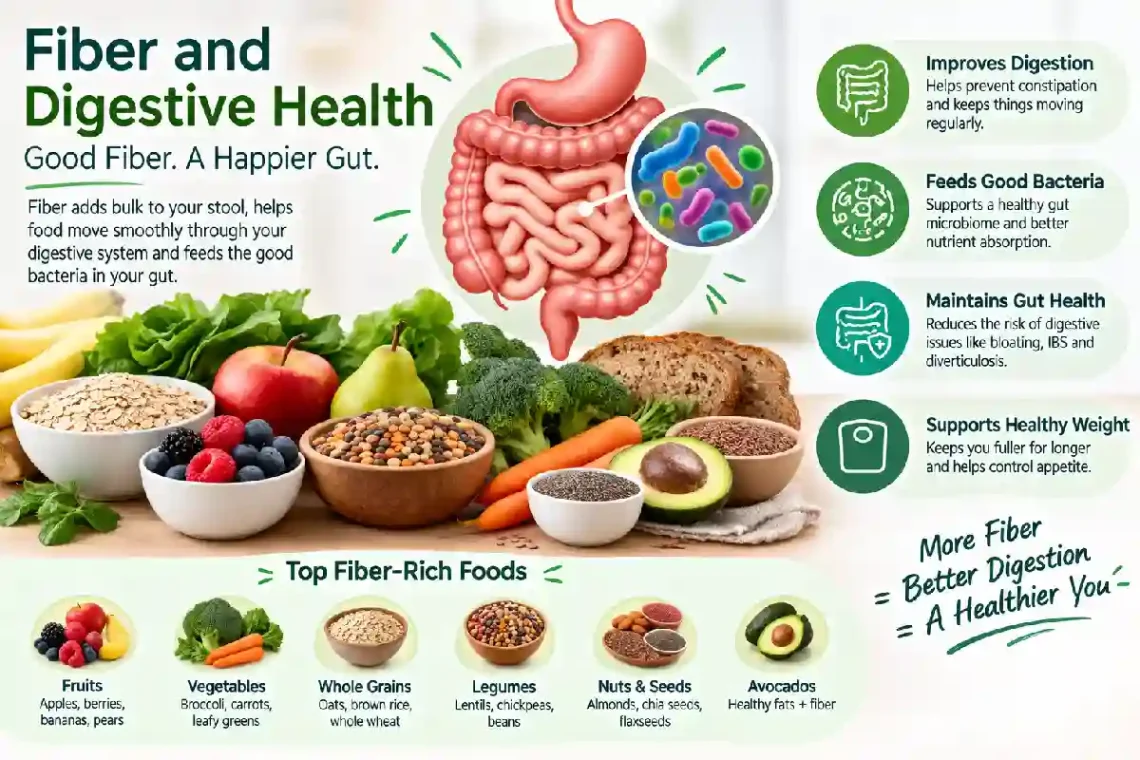
Foods which naturally contain the fiber in the diet are found to be: fruit and vegetables; whole grains, pulses, nuts and seeds. The higher the consumption of these foods, the higher the dietary fiber intake, also accompanied by high levels of nutrients and other plant chemicals associated with these foods.
But a sudden increase in fiber may increase Gas production, bloating, or abdominal discomfort. A fast increase in fiber in the diet should be avoided, and sufficient fluid intake should be maintained.
❝
This article is part of
Digestive Health Hub
What Is Dietary Fiber?
Dietary fiber refers to carbohydrates naturally present in plants. They are cereal foods that cannot be digested normally by the body.
In general, fiber can be divided based upon its physiological effect in the gut. Some fibers are water-soluble, and some are not. Some fibers are also fermentation products of bacteria within the large intestine.
Common sources include:
- Fruits such as apples, pears, berries, and oranges
- Vegetables such as broccoli, carrots, peas, and leafy greens
- Whole grains such as oats, barley, and brown rice
- Legumes such as beans, lentils, and chickpeas
- Nuts and seeds
- Certain fortified foods
Fiber is not a single substance. Different fibers have different properties, which is one reason eating a variety of plant foods is useful.
How Fiber Supports Digestion
Fiber assists digestion through many mechanisms, one of which is its well-known role in maintaining the normal functioning of the bowel.
Certain fibers absorb water and can assist in softening stool. Other types of fiber bulk up the stool, which can aid in normal peristalsis.
Gut micro-organisms can also ferment some fibers. Fermentation by micro-organisms can produce substances to react with the gut milieu.
Fiber can therefore contribute to digestive health through several mechanisms:
| Fiber Function | Potential Digestive Role |
| Adds bulk | Supports normal stool formation |
| Holds water | Can help maintain softer stool |
| Ferments in the colon | Provides fuel for certain gut micro-organisms |
| Supports regularity | Helps maintain consistent bowel movements |
| Found in plant foods | Adds nutrients and dietary variety |
The effects depend on the type of fiber, the amount consumed, hydration, and individual digestive tolerance.
Soluble vs. Insoluble Fiber
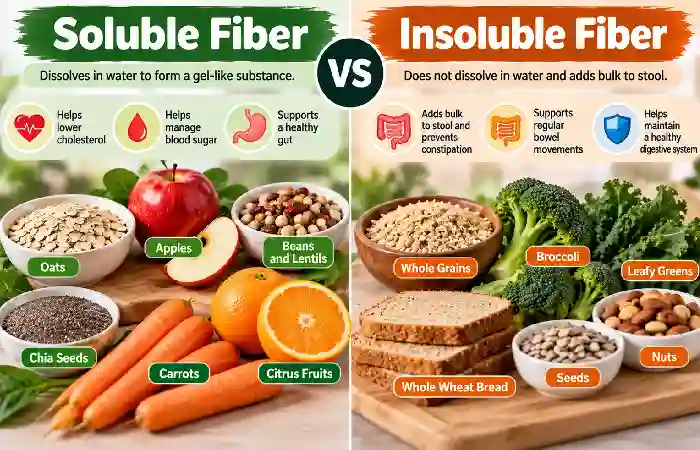
Usually, people differentiate fiber as being soluble or insoluble depending on whether it is soluble in water.
Soluble fiber is soluble in water and forms a gel-like substance. It is present in some foods like oats, barley, beans, fresh peas, apples, and citrus fruits.
Insoluble fiber is insoluble in water, so it passes through the digestive system intact to increase the bulk of the stool. Whole grains, nuts, seeds, and virtually all vegetables are a good source of this.
Many plant foods are sources of various types of fibers.
| Type | General Characteristics | Examples |
| Soluble fiber | Dissolves or disperses in water | Oats, barley, beans, apples |
| Insoluble fiber | Adds bulk to stool | Whole grains, vegetables, nuts |
| Fermentable fiber | Can be used by certain gut micro-organisms | Some fruits, legumes, oats, vegetables |
High-Fiber Foods
Adding more fiber to the diet is probably best achieved by simply increasing consumption of high-fiber foods, most of which are plant-based.
Good sources include:
Fruits
Apples, pears, raspberries, blackberries, oranges, and other whole fruits are sources of fiber. Generally, there is more fiber in eating whole fruit than drinking the juice.
Vegetables
Adding fiber to your diet. Broccoli, carrots, green peas, Brussels sprouts, sweet potato, and greens are all fantastic sources of fiber, for example.
Whole Grains
Oats, barley, brown rice, and whole-wheat foods, among other whole grains, can contribute even more fiber.
Legumes
Beans, lentils, chickpeas, and peas are helpful to lungs because they are sources of both fiber and plant protein.
Nuts and Seeds
Eating nuts and seeds: Almonds and other nuts and seeds are great sources of fiber, as well as healthy fats and other nutrients.
A mixture of these foods would be ideal in ensuring an adequate amount of fiber is obtained with little dependence on one particular food.
Fiber and Bowel Regularity
The most well-known benefit of dietary fiber is undoubtedly the effect it has on bowel regularity.
It also affects stool weight. It contributes to stool weight and consistency. Soluble fibers can retain water and consequently influence stool texture.
Those who do not consume an adequate amount of fiber may consider gradually increasing the intake of fiber-containing foods to induce regular bowel movements.
But fiber isn’t an answer to all types of bowel problems. Bowel problems such as constipation have a number of causes, including: a low fluid intake, medication use, a change in activity levels, or an underlying medical disorder.
Seek medical attention if you have persistent constipation or other concerning symptoms.
Fiber and Gut Microbiome
The gut microbiome refers to the micro-organisms that reside in the gut. The abundance and activity of the gut micro-organisms are partly affected by the diet.
Bacteria ferment some dietary fibers in the large intestine. They act as substrates for some bacteria.
That is one of the reasons why fiber is sometimes spoken of as feeding the bacteria in the gut.
Various plant foods contain different fibers that support different microbes, so limiting oneself to the plant foods eaten could limit the range of fermentable materials.
Examples of foods containing fermentable fibers include:
- Oats
- Barley
- Beans
- Lentils
- Chickpeas
- Certain fruits
- Onions and other vegetables
The relationship between dietary fiber and the microbiome is complex, and individual responses can vary.
How Much Fiber Do You Need?
Fiber requirements are dependent on factors including age, sex, and other dietary requirements. Typical dietary guidelines tend to recommend an intake of somewhere around 25 38grams per day, although requirements may be outside this range.
Alternatively, rather than targeting a certain number, it might be worth considering the diet in its entirety.
The bay example: food from the group should include the following: oats, fruits, vegetables, breads and crackers with grains, and the beans can provide a mix of fiber source.
If your present consumption is fairly low, you do not want to go all out to a lofty claim; you want to add in fiber very gradually.
People who have some digestive disorder will have more specific dietary needs, and advice should always be sought from a trained health professional.
Increasing Fiber Gradually
A sudden increase in fiber can overwhelm the digestive system, especially if a person has been eating very little fiber.
Instead, increase fiber step by step.
For example:
- Add one serving of fruit each day.
- Include vegetables with lunch or dinner.
- Replace some refined grains with whole grains.
- Add beans or lentils to meals in moderate portions.
- Include nuts or seeds as appropriate.
- Gradually increase portions as your body adjusts.
A gradual approach allows the digestive system and gut micro-organisms time to adapt.
Fiber and Hydration
Fluid intake should be increased when using more fiber.
Water-absorbing fibers. If you increase fiber intake significantly and do not increase fluid, stool can become harder, or you may feel bloated or uncomfortable.
In the majority of cases, water is the easiest to consume to help hydrate the body. Fluid requirements differ depending on body size, physical activity, climate, diet, and health.
One potential approach, considering practical needs, would be to increase fiber and fluids together, rather than dramatically increasing fiber while minimizing fluid intake.
Guidance for hydration should be obtained from their health care professional in people with medically prescribed fluid restriction.
Common Problems From Increasing Fiber Too Quickly

While fiber can be part of a healthy diet, an instant boost in intake may cause momentary digestive discomfort.
Gas
Other gut micro-organisms ferment some fibers, giving rise to gas (flatulence). Rapid introduction may thus give rise to more flatus.
Bloating
An abrupt increase in fiber can lead to an increased volume of intestinal contents and fermentation and can lead to a sensation of abdominal distension or bloating.
Abdominal Discomfort
For some individuals, a major dietary switch can cause cramps and discomfort.
Changes in Stool
Adding fiber can modify the size and form of stool. These effects can potentially occur with continued adaptation of the gastrointestinal tract.
How to Reduce These Problems
| Problem | Helpful Approach |
| Gas | Increase fiber slowly |
| Bloating | Reduce portion size temporarily. |
| Hard stools | Review fiber and fluid intake. |
| Abdominal discomfort | Introduce new foods gradually. |
| Sudden stool changes | Avoid making several major diet changes at once |
Persistent, severe, or unexplained digestive symptoms should not automatically be attributed to fiber. A healthcare professional can help determine whether another cause is involved.
Frequently Asked Questions About Fiber
Is fiber good to digest?
Yes. The inclusion of fiber in the diet is able to help maintain normal bowel function, stool formation, and some activity of intestinal micro-organisms.
What foods have the highest fiber content?
The following foods are good sources of dietary fiber: Legumes, whole grains, fruits, vegetables, nuts, and seeds. Amounts of fiber can vary by food and by prepared serving size.
Is there an excessive fiber intake?
Yes. A fast or very high dose increase can lead to bloating, farting, stomach fullness, or alterations in bowel movements.
What if I am constipated? Do I have to increase the amount of fiber rapidly?
Slow and steady with a gradual increase in fiber whilst ensuring adequate fluid intake, as persistent constipation may need to be investigated.
How do you feed gut bacteria?
Micro-organisms ferment some fibers within the large intestine, and may act as substrates for certain intestinal bacteria.
Final Thoughts
This is another key element to a digestive-friendly diet. Various forms of fiber are contained within fruits, vegetables, whole grains, legumes, nuts and seeds, along with a multitude of other nutrients.
The important thing is to keep a steady and slow pace. If you are quite low in fiber, build up slowly, drink plenty, and give your system a chance to adapt.
With a varied diet including a range of Plant foods, any amount of fiber can be supplied, ensuring normal bowel function and a diverse gut environment.
Dr. Khizrana Begum is a qualified medical professional with MBBS and MD qualifications and 5+ years of experience in the medical field. She works as a General Physician and Dermatologist, with knowledge spanning general medicine, dermatology, preventive healthcare and skin health.
As a medical reviewer, Dr. Khizrana Begum reviews health and wellness content for medical accuracy, clarity and authenticity.
Sameena Begum reviews content for clarity, accuracy and reader usefulness. Her review process helps ensure that published information is clearly presented, relevant and easy for readers to understand.
Syeda Yasmeen is a Health & Wellness Writer at InHumanBeing.com. She creates clear and reader-focused content across health, nutrition, wellness, women’s health, men’s health and babies’ health.