
 Syeda Yasmeen
Health & Wellness Writer Syeda Yasmeen creates clear and
reader-focused content covering health,
nutrition, wellness, women’s health,
men’s health and babies’ health.
Read Full Bio of Author →
Syeda Yasmeen
Health & Wellness Writer Syeda Yasmeen creates clear and
reader-focused content covering health,
nutrition, wellness, women’s health,
men’s health and babies’ health.
Read Full Bio of Author →
 Sameena Begum
Health, Technology & Digital Content Reviewer Sameena Begum reviews selected content
for clarity, factual presentation,
consistency and reader usefulness.
Read Full Bio of Reviewer →
Sameena Begum
Health, Technology & Digital Content Reviewer Sameena Begum reviews selected content
for clarity, factual presentation,
consistency and reader usefulness.
Read Full Bio of Reviewer →
 Dr. Khizrana Begum
General Physician and Dermatologist Dr. Khizrana Begum is a qualified medical
professional with MBBS and MD qualifications
and 5+ years of experience. She reviews health
and wellness content for medical accuracy,
clarity and responsible presentation.
Read Full Bio of Medical Reviewer →
Dr. Khizrana Begum
General Physician and Dermatologist Dr. Khizrana Begum is a qualified medical
professional with MBBS and MD qualifications
and 5+ years of experience. She reviews health
and wellness content for medical accuracy,
clarity and responsible presentation.
Read Full Bio of Medical Reviewer →
Stretching Exercises for Women can be beneficial for almost any fitness program. It can help you get around more easily with greater flexibility, whether you are doing home exercises, strength training or walking, running or spending long hours at a desk.
Stretching does not have to be lengthy and complicated. To establish a regular mobility time, a few minutes before or after exercise may suffice. It all comes down to selecting the correct type of stretching for the appropriate time.
Dynamic movements are typically better for pre-exercise, and static for post-exercise or separate flexibility sessions.
Stretching can be a useful part of a beginner workout routine, helping you include mobility and flexibility work alongside your regular exercises. For a broader starting point, explore our beginner workout plan for women.
❝
This article is part of
Womens Fitness Hub
Importance of Stretching
Flexibility refers to the kind of joint and muscle movement that can be accomplished throughout an available range of motion. When performed regularly, that range can be maintained or improved through regular stretching.
Why Stretching Matters
| Benefit | How It Can Help |
| Flexibility | Helps maintain joint range of motion |
| Mobility | Supports comfortable movement |
| Warm-up | Dynamic movement prepares the body for exercise |
| Cool-down | Helps transition from exercise to rest |
| Muscle comfort | Gentle movement may reduce feelings of stiffness |
| Posture | Mobility work can support better movement habits |
If you have a job that involves a lot of sitting, stretching can be very helpful.
If, for instance, you work at a table, you will probably repeat gentle movements to the hips, chest, shoulders and upper back.
Stretching can be a useful part of a beginner workout routine, helping you include mobility and flexibility work alongside your regular exercises. For a broader starting point, explore our beginner workout plan for women.
Stretching and Exercise
When it comes to stretching, it’s not an alternative to strength training or cardio.
Rather, consider it to be a component of a balanced fitness plan.
Here’s a sample of a balanced week…
- Strength training
- Cardiovascular activity
- Mobility work
- Stretching
- Rest and recovery
Is Stretching the Key to Avoiding ALL injuries?
No.
The following does not imply that stretching will prevent injuries. The risk of injury depends on numerous factors such as training load, technique, recovery, previous injuries, fitness and type of activity being undertaken.
Appropriate mobility and preparing the body for activity however, can be helpful components of an overall exercise plan.
Dynamic Warm-Up
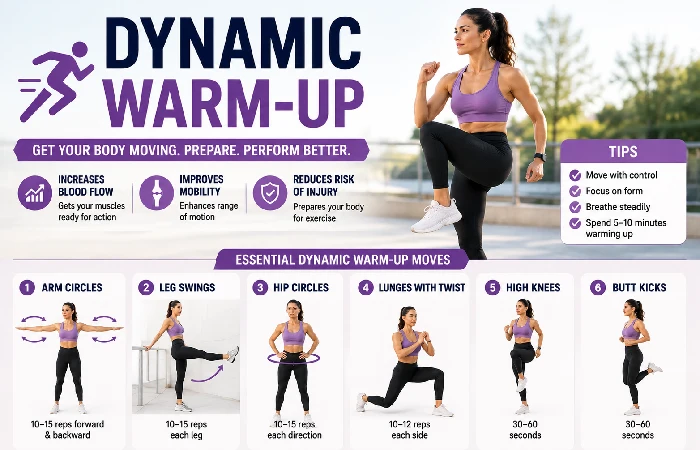
Dynamic stretching – movement that is controlled and does not require holding in position for extended periods.
It’s a good option before exercise, as it slows down your body to prepare it for activity.
Dynamic Movements are illustrated with the following examples:
| Movement | Duration/Reps | Main Area |
| Arm Circles | 10–15 each direction | Shoulders |
| Walking Lunges | 6–10 each side | Hips and legs |
| Leg Swings | 8–12 each side | Hips |
| Torso Rotations | 8–10 each side | Torso |
| Hip Circles | 8–10 each direction | Hips |
| Marching | 30–60 sec | Whole body |
| Bodyweight Squats | 8–10 reps | Legs |
Arm Circles
Stand comfortably and move arms in small circles.
Make the circles larger and move them progressively but not too large.
Leg Swings
Use a firm surface to hold on to if necessary.
Move the leg slowly forwards and backwards, allowing the movement.
Switch sides.
Walking Lunges
Step carefully forward with a controlled movement and lower your body to a comfortable lunge.
Use smaller steps or stationary reverse lunges for regular lunges if they’re difficult.
Stretching can also complement gym-based training by adding mobility work around your regular sessions. Our beginner gym workout plan for women provides another structured approach to getting started.
Dynamic Warm-Up Example
Try: Before strength training:
1 minute marching, 10 squats, 10 arm circles, 8 leg swings on each side, 8 reverse lunges on each side.
The aim isn’t to feel tired, but warm and more mobile.
Static Cool-Down
Static stretching consists of going into a comfortable stretch and holding that stretch.
Often used following exercise or during different flexibility sessions.
Basic Static Stretches
| Stretch | Hold | Target Area |
| Hamstring Stretch | 20–30 sec | Back of thighs |
| Quad Stretch | 20–30 sec | Front of thighs |
| Calf Stretch | 20–30 sec | Calves |
| Hip Flexor Stretch | 20–30 sec | Front of hips |
| Chest Stretch | 20–30 sec | Chest |
| Shoulder Stretch | 20–30 sec | Shoulders |
| Child’s Pose | 20–30 sec | Back and hips |
Hamstring Stretch
- Sit or stand comfortably and stretch out one leg.
- Gently lean forward from the hips until you feel a stretch in the back of your thigh.
- Don’t force yourself to touch your toes.
Quadriceps Stretch
- Put yourself close to a wall or other firm support.
- Tuck in one knee and slowly draw the heel towards the buttocks.
- Hold knees fairly close together.
Calf Stretch
- Clasp hands together and step one foot behind yourself.
- Maintain back heel on floor with a slight bend at front knee.
Hip Flexor Stretch
- Get into a crouch that is comfortable.
- With body upright, move hips forward slightly.
- The stretch should be felt in front of the hip.
Stretching Rules
Static stretches should be like a nice stretch, not a painful one.
Avoid:
- Bouncing
- Forcing the joint
- Holding your breath
- Zipping through the sharp pain
If a stretch is uncomfortable, STOP and adjust the stretch.
Bodyweight workouts can be paired with stretching to create a simple routine that requires minimal equipment. Explore our beginner bodyweight workout plan for women for practical exercise ideas.
Flexibility Routine
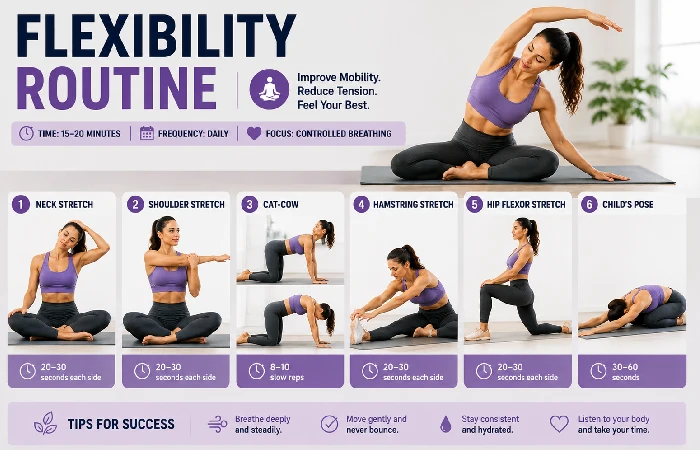
Do not require to stretch for an hour.
There are several key points that can be addressed with a basic flexibility exercise in just 10 minutes.
10-Minute Routine
| Exercise | Time |
| Cat-Cow | 60 sec |
| Hip Flexor Stretch | 30 sec/side |
| Hamstring Stretch | 30 sec/side |
| Quad Stretch | 30 sec/side |
| Calf Stretch | 30 sec/side |
| Chest Stretch | 30 sec/side |
| Shoulder Stretch | 30 sec/side |
| Child’s Pose | 60 sec |
Slowly and naturally breathe during the sequence.
If you are a novice at stretching, begin with brief holds and with your range of motion at a comfortable level.
Don’t push flexibility.
- With practice, it may become easier to go through your available range over time.
- Rest Days are extended during the day.
- Stretching can take place at rest times as well.
- On a rest day, a short mobility session can be a great way to get some movement without an additional training session.
For example:
- Afternoon: 5-minute mobility routine
- 20 minutes of dynamic warm up and a cool down (optional)
- Evening: GENTLE, Stretching.
- The best schedule is a schedule you will stick to.
Injury Prevention
Stretching Exercises for Women may be included in a good training program for fitness and mobility, but stretching alone will not stop all injuries.
Warm Up Before Intense Exercise
- Avoid going from sitting with computer work to weight lifting or aerobic activity.
- Begin at low intensity and progress to higher intensity.<Strength training and flexibility work can both have a place in a balanced beginner routine. Learn more about building resistance-based workouts with our beginner strength training plan for women./li>
Increase Training Gradually
- A lot of exercise related issues can arise when people have a sudden increase in their training.
- Slowly increase your workout schedule rather than starting with nothing and then doing seven grueling workouts each week.
Strength Matters Too
Flexibility is only one part of physical fitness.
Flexibility is just one component of fitness.
Getting stronger at the joints means supporting the movement and stability.
A good lower-body workout might consist of:
- Squats
- Lunges
- Glute bridges
- Calf raises
- Hip-hinge exercises
Don’t Stretch Through Pain
Normal stretch should not be sharp, burning, or painful.
Stop if you experience:
- Sharp pain
- Numbness
- Tingling
- Significant joint pain
Sudden weakness
- If symptoms continue, you may want to talk to a qualified health-care provider.
- Choose the right amount of stretch for the activity.
- A runner can use different mobility exercises than a person who strength trains.
- Similarly, a person who works at a desk during the day might wish to take extra time to move their hips and shoulders and upper back.
- There isn’t one perfect stretching routine for every woman.<If you want to combine stretching with resistance exercises, dumbbells can add another dimension to your beginner workouts. Explore our beginner dumbbell workout plan for women for ideas on incorporating dumbbell exercises./li>
Final Takeaway
Stretching Exercises for Women are some simple exercises that could help support flexibility, mobility and comfortable movement. Prior to training or exercise, perform dynamic stretching and after training or as part of a separate flexibility session, perform gentle static stretching.
Maintain controlled movements, don’t force a stretch and use flexibility with strength, cardiovascular activity and recovery.
There’s no need for a complex routine. The regular mobility and stretching activity can be a practical time for a healthy fitness regime even if it’s only for 5-10 mins.
Dr. Khizrana Begum is a qualified medical professional with MBBS and MD qualifications and 5+ years of experience in the medical field. She works as a General Physician and Dermatologist, with knowledge spanning general medicine, dermatology, preventive healthcare and skin health.
As a medical reviewer, Dr. Khizrana Begum reviews health and wellness content for medical accuracy, clarity and authenticity.
Sameena Begum reviews content for clarity, accuracy and reader usefulness. Her review process helps ensure that published information is clearly presented, relevant and easy for readers to understand.
Syeda Yasmeen is a Health & Wellness Writer at InHumanBeing.com. She creates clear and reader-focused content across health, nutrition, wellness, women’s health, men’s health and babies’ health.