
 Syeda Yasmeen
Health & Wellness Writer Syeda Yasmeen creates clear and
reader-focused content covering health,
nutrition, wellness, women’s health,
men’s health and babies’ health.
Read Full Bio of Author →
Syeda Yasmeen
Health & Wellness Writer Syeda Yasmeen creates clear and
reader-focused content covering health,
nutrition, wellness, women’s health,
men’s health and babies’ health.
Read Full Bio of Author →
 Sameena Begum
Health, Technology & Digital Content Reviewer Sameena Begum reviews selected content
for clarity, factual presentation,
consistency and reader usefulness.
Read Full Bio of Reviewer →
Sameena Begum
Health, Technology & Digital Content Reviewer Sameena Begum reviews selected content
for clarity, factual presentation,
consistency and reader usefulness.
Read Full Bio of Reviewer →
 Dr. Khizrana Begum
General Physician and Dermatologist Dr. Khizrana Begum is a qualified medical
professional with MBBS and MD qualifications
and 5+ years of experience. She reviews health
and wellness content for medical accuracy,
clarity and responsible presentation.
Read Full Bio of Medical Reviewer →
Dr. Khizrana Begum
General Physician and Dermatologist Dr. Khizrana Begum is a qualified medical
professional with MBBS and MD qualifications
and 5+ years of experience. She reviews health
and wellness content for medical accuracy,
clarity and responsible presentation.
Read Full Bio of Medical Reviewer →
A Bodyweight Workout for Women is a simple formula to achieve strength, fitness and comfort with exercising without the need for a gym and costly equipment. You can use many of the exercises at home, outdoors and even when traveling as your body is the resistance.
Bodyweight training is suitable for a complete beginner as well as the woman who is already a regular exerciser. The important thing to consider is to select movements that are appropriate to your level of fitness and progressively increase the difficulty.
You don’t have to push yourself to the fullest during all your exercises. That’s what provides the steady improvement that you need over time: A steady routine, good technique, adequate recovery, and gradual progression.
❝
This article is part of
Womens Fitness Hub
Benefits of Bodyweight Training
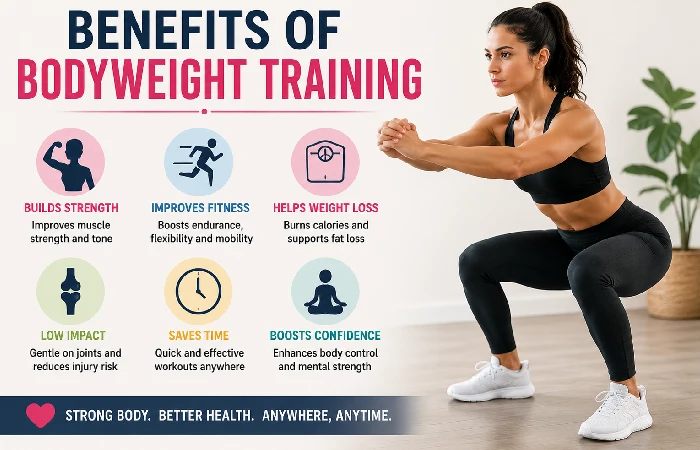
Accessibility is one of the best qualities of a Bodyweight Workout for Women. You can get fit just about anywhere and require little preparation.
Bodyweight exercises are a simple way to build a consistent workout routine without relying on gym equipment. For a broader overview of beginner-friendly training options, explore our beginner workout plan for women.
No Equipment Required
Squats, lunges, glute bridges and push-ups are examples of exercises that involve using your body against itself.
This is where bodyweight training can come in handy if:
- You don’t have access to a gym!
- You’re traveling
- You’ve never trained before
- You don’t have enough room to work out.
- You would like to have a home routine that is simple
Builds Functional Strength
Bodyweight exercises tend to engage more than one muscle group.
A squat involves working the leg and glute muscles as well as stabilizing the trunk and core muscles.
Supports Balance and Coordination
Control and balance is needed when performing exercises like lunges and bird dogs. These skills can make things easier when it comes to doing daily activities.
Easy to Modify
Many of the exercises used for body weight training can be adapted to be easier or more difficult.
For example:
- Standard push-up is the starting position for the next three push-up exercises.
- This makes body weight training an option for various fitness levels.
- Make use of cardiovascular exercises to support cardiovascular fitness
- Some of the body weight exercises can also elevate your heart rate.
Examples include:
- Marching
- Step-ups
- Mountain climbers
- Jumping jacks
- High knees
If jumping is not comfortable, select low impact versions.
If you prefer exercising in the comfort of your own space, many bodyweight movements can easily be included in a home routine. Explore our beginner home workout plan for women for additional ideas.
Beginner Exercises
When starting out, do simple exercises and concentrate on form.
Beginner Exercise Guide
| Exercise | Main Focus | Beginner Target |
| Bodyweight Squat | Legs and glutes | 8–12 reps |
| Glute Bridge | Glutes and hips | 10–15 reps |
| Wall Push-Up | Chest and arms | 8–12 reps |
| Reverse Lunge | Legs and balance | 6–10/side |
| Bird Dog | Core and stability | 6–10/side |
| Standing March | Cardio and coordination | 30–60 sec |
| Modified Plank | Core | 15–30 sec |
Bodyweight Squat
Feet should be approximately shoulder-width apart. Move hips back and bend knees without using too much strength.
Squats may be hard – try sitting and standing up from a firm chair.
Glute Bridge
While lying on your back with your knees bent and your feet flat on the floor.
Stand up with your hips lifted up as you squeeze your buttocks, then slowly lower yourself.
Avoid using momentum.
Wall Push-Up
Set hands on wall and maintain a comfortable straight alignment of body.
Bend elbows and push chest to wall, pushing back.
Progress to an incline push up with a stable elevated surface as you increase strength.
Reverse Lunge
Take one step back and slowly lower yourself.
Tilt through the front foot and back up to starting position.
If you have problems with balance, cling onto a firm surface.
Bird Dog
Begin on all fours.
Extend opposite arm and opposite leg, keeping torso stable.
Go back to starting position and cross sides.
Full-Body Circuit
Full body circuit is a circuit that includes multiple exercises for the entire body.
If you are new, 1 or 2 rounds might suffice.
Bodyweight training can also complement gym workouts, particularly when you want to practice basic movement patterns before adding equipment. Our beginner gym workout plan for women provides another approach to structured training.
Beginner Bodyweight Circuit
| Exercise | Reps/Time |
| Bodyweight Squats | 10 reps |
| Wall Push-Ups | 10 reps |
| Glute Bridges | 12 reps |
| Reverse Lunges | 6 each side |
| Bird Dogs | 8 each side |
| Standing March | 45 seconds |
| Modified Plank | 20 seconds |
| Rest | 60–90 seconds |
Do 1–2 rounds (or as many as you can).
Warm-Up First
Allow about 5 minutes to prepare your body.
Try:
- Marching in place
- Arm circles
- Shoulder rolls
- Gentle side steps
- Hip movements
The warm up should be comfortable, NOT strenuous.
How Hard Should the Workout Feel?
It is not necessary to make yourself work to the maximum.
A beginner workout should feel like it’s a challenge but not so hard that you lose your good form.
If your form fails, abort the set or select a simpler one.
Progression Tips
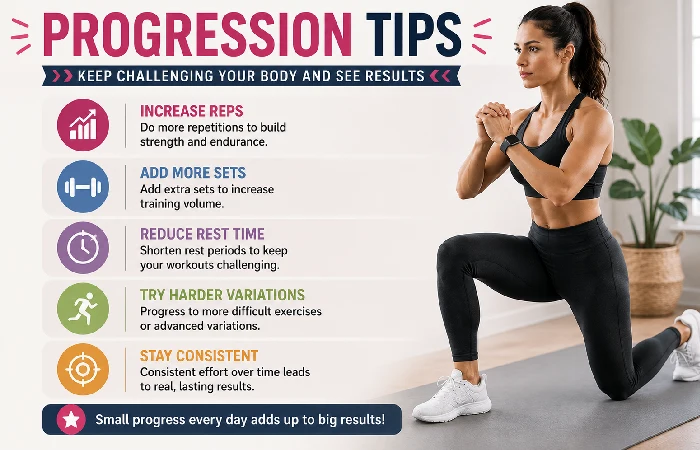
Once your workouts become easier, it’s time to gradually increase the challenge.
This is called progressive overload.
You can work on the same level without loading up weights.
As your fitness routine develops, adding resistance can provide another way to challenge your muscles. Explore our beginner strength training plan for women for guidance on getting started with resistance exercises.
1. Add Repetitions
Once you can comfortably do 8 squats, aim to do 10 or 12.
2. Add Another Round
Do one circuit and gradually increase to two or three.
3. Slow Down
Do repetitions in a controlled manner rather than quickly.
For instance, squat to the ground for three seconds and then stand.
Apply More Difficult Variations to increase the difficulty of the exercise.
Can perform variations of the exercises.
4. Use More Difficult Variations
You can progress through exercise variations.
| Beginner | Progression |
| Wall push-up | Incline push-up |
| Chair squat | Bodyweight squat |
| Supported lunge | Reverse lunge |
| Glute bridge | Single-leg bridge |
| Modified plank | Standard plank |
| Marching | High knees |
5. Improve Your Technique
Not all progress is the same as more.
Improved control, balance, posture and range of motion are other meaning improvements.
6. Add Resistance Later
Once bodyweight exercises become easy, you can introduce:
- Resistance bands
- Dumbbells
- Ankle weights
You don’t need to purchase equipment right away.
Weekly Routine
It is easier to be consistent if you have a structure plan for your week.
Don’t work out very hard each day.
Mobility and flexibility work can be a useful complement to bodyweight workouts. Our stretching exercises for women offers simple ideas for adding stretching to your routine.
Beginner Weekly Plan
| Day | Workout | Duration |
| Monday | Full-body bodyweight circuit | 20–25 min |
| Tuesday | Walking or light cardio | 20–30 min |
| Wednesday | Rest/mobility | 10–15 min |
| Thursday | Full-body bodyweight circuit | 20–25 min |
| Friday | Walking or low-impact cardio | 20–30 min |
| Saturday | Optional bodyweight workout | 15–25 min |
| Sunday | Rest | — |
If you’re completely new to exercise, begin with two bodyweight workouts per week and gradually build from there.
Example Beginner Week
Tuesday: Mountain climbers, plank jacks, crab kicks and side plank jacks
Tuesday: Easy walk
Wednesday: Rest
Thursday: Fully complete the full-body circuit.
Friday: Light cardio
Saturday: Mobility/short walk optional.
Sunday: Rest
This will allow your body to rest and recover, and helps build a regular exercise routine.
Listen to Your Body
A little muscle soreness is a common experience when beginning an exercise program.
If there is sharp pain and significant swelling, dizziness, chest pain or unusual symptoms, however, this should not be ignored. Stop exercising and seek appropriate medical advice when necessary.
If you are unable to exercise due to medical reasons, injury or restrictions talk to a qualified health care practitioner before starting a new exercise program.
If you want to progress beyond bodyweight movements, dumbbells can provide a convenient way to introduce additional resistance. Explore our beginner dumbbell workout plan for women for practical exercise ideas.
Final Takeaway
A Bodyweight Workout for Women can be a great beginning to strength training and fitness with no fancy equipment. Squats, lunges, push-ups, glute bridges, planks, and other basic exercises can activate the big muscles, while also working to enhance coordination and control of the body.
Do exercises which are comfortable for you, pace yourself and continue with your workouts, adding reps, rounds and/or complexity as you improve.
It’s not necessary to have an all-new routine to get going. Consistency beats complexity. The simplicity of a body weight program can be the basis for more advanced strength training exercises later on.
Dr. Khizrana Begum is a qualified medical professional with MBBS and MD qualifications and 5+ years of experience in the medical field. She works as a General Physician and Dermatologist, with knowledge spanning general medicine, dermatology, preventive healthcare and skin health.
As a medical reviewer, Dr. Khizrana Begum reviews health and wellness content for medical accuracy, clarity and authenticity.
Sameena Begum reviews content for clarity, accuracy and reader usefulness. Her review process helps ensure that published information is clearly presented, relevant and easy for readers to understand.
Syeda Yasmeen is a Health & Wellness Writer at InHumanBeing.com. She creates clear and reader-focused content across health, nutrition, wellness, women’s health, men’s health and babies’ health.