 Syeda Yasmeen
Health & Wellness Writer Syeda Yasmeen creates clear and
reader-focused content covering health,
nutrition, wellness, women’s health,
men’s health and babies’ health.
Read Full Bio of Author →
Syeda Yasmeen
Health & Wellness Writer Syeda Yasmeen creates clear and
reader-focused content covering health,
nutrition, wellness, women’s health,
men’s health and babies’ health.
Read Full Bio of Author →
 Sameena Begum
Health, Technology & Digital Content Reviewer Sameena Begum reviews selected content
for clarity, factual presentation,
consistency and reader usefulness.
Read Full Bio of Reviewer →
Sameena Begum
Health, Technology & Digital Content Reviewer Sameena Begum reviews selected content
for clarity, factual presentation,
consistency and reader usefulness.
Read Full Bio of Reviewer →
 Dr. Khizrana Begum
General Physician and Dermatologist Dr. Khizrana Begum is a qualified medical
professional with MBBS and MD qualifications
and 5+ years of experience. She reviews health
and wellness content for medical accuracy,
clarity and responsible presentation.
Read Full Bio of Medical Reviewer →
Dr. Khizrana Begum
General Physician and Dermatologist Dr. Khizrana Begum is a qualified medical
professional with MBBS and MD qualifications
and 5+ years of experience. She reviews health
and wellness content for medical accuracy,
clarity and responsible presentation.
Read Full Bio of Medical Reviewer →
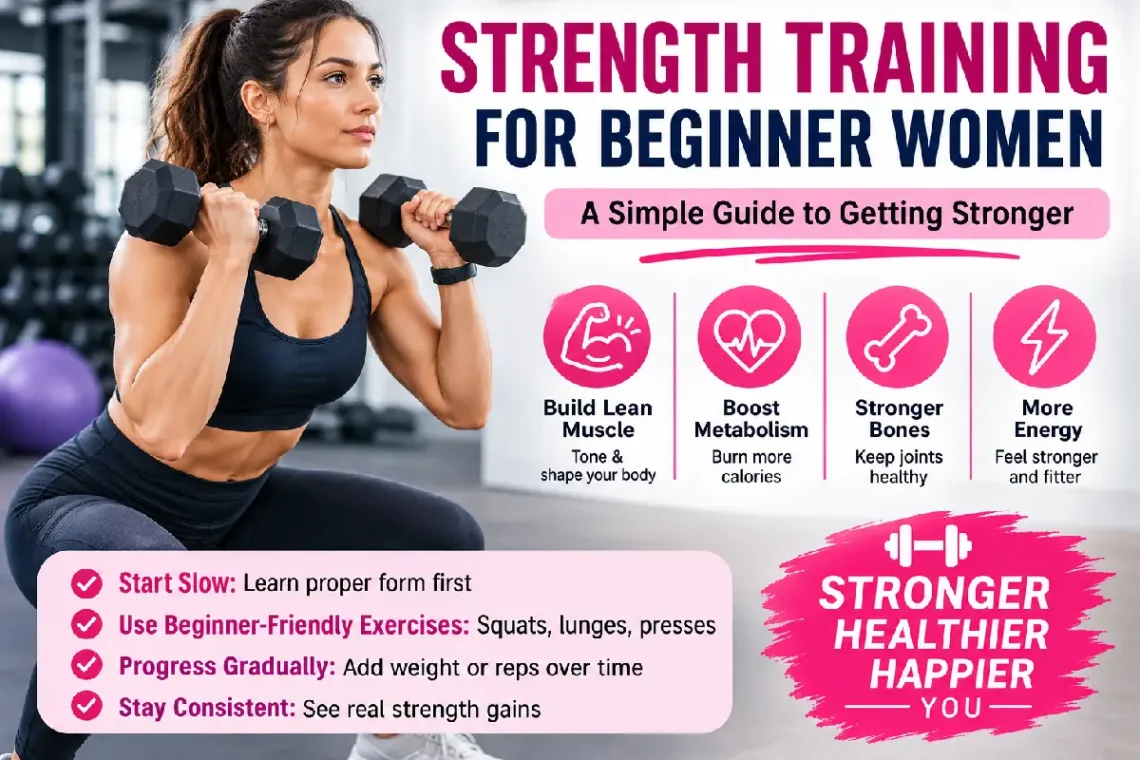
Strength Training for Beginner Women isn’t an exercise of lifting extremely heavy weights, or spending hours in a gym. If you are new to training, strength work is all about getting comfortable. With movement, developing confidence and incrementally increasing strength.
Resistance training can be a great complement to your workout plan. If you are looking for ways to improvement more strength, support healthy bones, build muscle, enhance body arrangement or simply feel better.
The secret is to start slowly and gradually! There is no need to compare your weights, reps, or body. The starting point is the personal one and improvement is important.
Strength training can be a useful part of a beginner fitness routine when exercises are introduced gradually and performed with proper form. For a broader starting point, explore our beginner workout plan for women.
❝
This article is part of
Womens Fitness Hub
Why Women Should Lift Weights
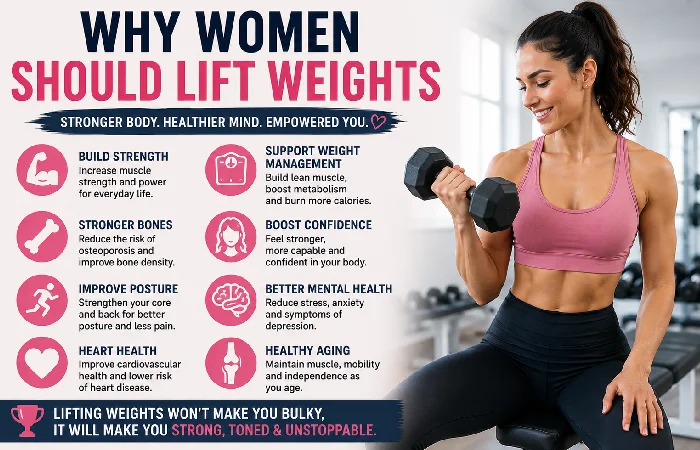
But there is another myth that women will bulk up from lifting weights. The truth is it takes discipline in resistance training, proper nutrition, patience, and individual factors like genetics to build much muscle.
Strength training is more likely to strengthen and build muscle for most beginners.
Benefits of Strength Training
| Benefit | How Strength Training Helps |
| Muscle strength | Makes daily movements easier |
| Muscle development | Encourages healthy muscle growth |
| Bone health | Provides mechanical loading |
| Balance | Strengthens muscles involved in stability |
| Body composition | Helps maintain and develop lean mass |
| Functional fitness | Supports lifting, carrying, climbing and other activities |
| Confidence | Helps you see measurable progress |
Supports Everyday Activities
Strength isn’t only about the gym.
It can help with everyday activities such as:
- Carrying groceries
- Climbing stairs
- Picking up children
- Moving household items
- Standing up from a chair
- Carrying luggage
Supports Healthy Aging
It is significant to keep muscles strong and healthy as individuals become older.
Early confrontation training may aid to form habits that will support long-term physical function.
You Don’t Need Heavy Weights
Heavy weights are not required. Maintaining muscle and strength becomes increasingly valuable as people get older.
Initial resistance training earlier can help found habits that support long-term physical function.
If you prefer to build your fitness routine at home, you can start with simple movements that require little or no equipment. Explore our beginner home workout plan for women for additional ideas.
If you are just preliminary out, you should begin with:
- Bodyweight exercises
- Resistance bands
- Light dumbbells
- Machines
- Household movements
Resistance can be gradually increased as you get stronger.
Best Beginner Strength Exercises
The basic movements should be taught in a good beginner program and not just the one muscle group.
Beginner Exercise Guide
| Exercise | Primary Focus | Beginner Target |
| Goblet Squat | Legs and glutes | 8–12 reps |
| Glute Bridge | Glutes and hips | 10–15 reps |
| Dumbbell Row | Back and arms | 8–12 reps |
| Chest Press | Chest and arms | 8–12 reps |
| Romanian Deadlift | Hamstrings and glutes | 8–12 reps |
| Shoulder Press | Shoulders and arms | 8–12 reps |
| Reverse Lunge | Legs and balance | 6–10/side |
| Plank | Core | 15–30 sec |
Squats
- Squats are a great lower-body exercise and one of the most practical exercises for beginners.
- Begin with body weight squats. When you feel comfortable, you can hold a light dumbbell near to your chest.
- Practice controlled movement and not depth or weight.
Glute Bridges
- It target the glutes and hips and are an informal exercise to do.
- With your feet flat on the floor and knees bent, raise your hips, squeeze your buttocks and lie on your back.
Dumbbell Rows
- Rows develop upper back and arm strength.
- Hold the dumbbell in a comfortable weight and have a nice stable torso as you pull towards your body.
Chest Press
- Chest Press can be done using dumbbells or a gym machine.
- Control movement and don’t use too much weight for your body.
Romanian Deadlifts
- This exercise will activate the glutes and hamstrings and it will help teach the hip-hinge movement.
- Begin at VERY light weights until you have learned how to move it.
Shoulder Press
- A dumbbell shoulder press can be complete sitting or standing to help build shoulder and arm strength.
- If overhead motion is painful, opt for a different exercise or ask for information from a professional.
Sets and Repetitions
A common question among beginners is:
How many sets and reps do I need to do?
There is no one best number.
For most strength training exercises, 1-3 sets of 8-12 reps will be a good starting point.
Not every strength workout requires weights. Bodyweight exercises can help beginners practice fundamental movement patterns before progressing to additional resistance. Our beginner bodyweight workout plan for women provides practical examples.
Beginner Strength Guide
| Experience | Sets | Repetitions |
| Complete beginner | 1–2 | 8–12 |
| Early beginner | 2 | 8–12 |
| Comfortable with routine | 2–3 | 8–15 |
| More experienced | 3+ | Depends on goal |
The correct range can vary depending on the exercise and your goals.
Choosing the Right Weight
- The range may be different for each exercise and individual depending on training goals.
- Select a weight that’s challenging but still allows for proper technique.
- The weight should not be swung or held for too long and the body position should not change dramatically to finish the last reps.
- If you have no problem doing many more than your intended repetitions, the load could be too easy.
- If you are unable to achieve the desired number of reps with proper form, decrease the weight.
Rest Between Sets
- Many strength training sets can be done around a 1-2 minute rest for the beginner.
- The amount of rest required may vary depending on the intensity of the activity and the type of activity.
- There’s no point in rushing to whole your workout simply to get it complete sooner.
How Often Should Beginners Strength Train?
Two to three total-body strength workouts a week is a realistic place to begin for many novices.
For women who prefer using gym equipment, a structured routine can make it easier to learn different exercises and organize training sessions. Explore our beginner gym workout plan for women.
For example:
| Day | Activity |
| Monday | Full-body strength |
| Tuesday | Walking/light cardio |
| Wednesday | Rest |
| Thursday | Full-body strength |
| Friday | Light activity |
| Saturday | Optional strength/cardio |
| Sunday | Rest |
Building Muscle Safely
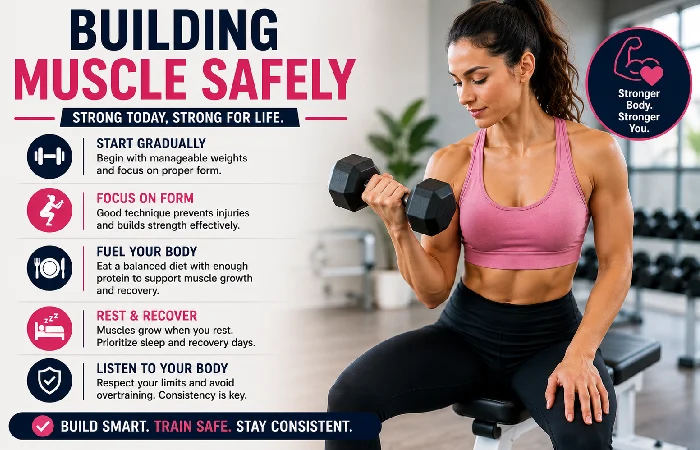
The goal of Strength Training for Beginner Women is to gradually incorporate more weight, not to lift as heavy of weight as possible.
Start Light
- The first step is to learn the exercise.
- Once you’re comfortable with the technique, start to make it more challenging.
Use Progressive Overload
Progressive overload is the gradual increase of the load on the muscles.
The following options enable you to advance:
- Increasing weight
- Adding repetitions
- Adding a set
- Improving technique
Using a more challenging exercise variation
For example:
- Week 1: Bodyweight squat × 10
- Week 2: Bodyweight squat × 12
- Week 3: Goblet squat × 10
- Week 4: Goblet squat × 12
The sequence does not necessarily need to be followed each week. Take the next step when you have a workload that is manageable.
Increasing the weight is not as important as good technique.
Stretching and mobility work can complement strength training by giving you dedicated time to work on flexibility and movement. Our stretching exercises for women can help you add simple flexibility exercises to your routine.
For beginners:
- Control > weight
- Consistency > intensity
- Progress > perfection
Allow Recovery
- Rest is important for the body to recover after resistance training.
- Don’t train the same muscles with heavy workouts every day.
- Rest, sleep, nutrition and hydration all play a role in recovery.
Eat Enough Protein
Protein supplies amino acids that are necessary for muscle repair and adaption.
Good sources include:
- Eggs
- Greek yogurt
- Milk
- Chicken
- Fish
- Lean meat
- Tofu
- Tempeh
- Beans
- Lentils
Protein supplements can be handy, but they’re not necessary if you’re getting enough protein from food.
Dumbbells are a versatile way to introduce resistance into a beginner strength routine. Explore our beginner dumbbell workout plan for women for practical ways to incorporate dumbbell exercises.
Common Strength Training Mistakes
The following are common Strength Training Mistakes:
By steering clear of common pitfalls, Strength Training for Beginner Women can be safer, easier, and more comfortable to follow.
1. Lifting Too Much Weight
Trying to impress others can lead to poor technique.
Choose a weight that you can control.
2. Skipping the Warm-Up
A brief warm up can “get you ready” to move.
Do try 5–10 minutes of simple aerobic activity, followed by 5 minutes of simple activity related to the activity that you are doing.
Too Much Too Soon is
3. Too Much is Too Soon
It’s not necessary to train seven days a week to make progress.
Begin by starting small and gradually increase your activities.
4. Copying Advanced Workouts
- What is suitable for an experienced lifter might not be suitable for a beginner.
- Begin with simple exercises and gradually build up over time.
5. Ignoring Technique
- Bad form decreases the quality of exercise and increases the risk of injury.
- Don’t know how to do a certain exercise – have a qualified trainer show you.
6. The Lower Body Only is a workout that targets the lower half of the body.
- While squats and glute workouts are popular, there should be a balance of pushing, pulling, and core activity as well.
- Balanced exercise involves training the entire body.
7. Frequently changing the program constant.
- Don’t require a new workout each week.
- The same fundamental movements used over and over can be used to develop technique and track progress.
8. Comparing yourself with others
- Each person is at a different point of origin.
- Try to be more aware of your progress, improvement, and consistency.
Frequently Asked Questions
Is strength training an activity that can be performed by novice women?
Most healthy adults can safely do well-designed resistance training and it can be an effective exercise program. Rushing is not advised for beginners; they need to learn the techniques rather.
Will women get bulky from lifting weights?
Not automatically. Muscles take time and dedication to build and effort to diet along with genetic makeup. Strength training is not necessarily done to make muscles grow, but rather for enhancing muscle strength and body composition.
If you’re a beginner, how many days per week would you recommend that you lift weights?
For most new people the 2-3 full body strength training sessions per week is a healthy choice.
Which is better for the woman, machines or free weights?
Both can work. It’s easier to learn how to use the machines at the start, and free weights such as dumbbells offer a greater range of movement.
Is it possible to gain weight without going to the gym?
Yes. Strength exercises can be done with body weight, resistance bands or home exercises that are challenging enough when using resistance.
Final Takeaway
Strength Training for Beginner Women is not about heavy weights or complicated workouts. It’s about laying the groundwork. Begin with simple exercises to aid you get used to using the gear, build up right form, work at a relaxed level of fight and progress the trouble as you get stronger.
Strength training is not for the athletes only! If you exercise at home or the gym, you can develop stronger. Learn how to do daily actions and form habits that will aid you stay that way for years.
The ideal exercise is not the one that is the most problematic, but the one that you can do securely, recover from and stick with!
The best exercise is not the hardest. It’s the one you can do safely, recover from and do continually.
Dr. Khizrana Begum is a qualified medical professional with MBBS and MD qualifications and 5+ years of experience in the medical field. She works as a General Physician and Dermatologist, with knowledge spanning general medicine, dermatology, preventive healthcare and skin health.
As a medical reviewer, Dr. Khizrana Begum reviews health and wellness content for medical accuracy, clarity and authenticity.
Sameena Begum reviews content for clarity, accuracy and reader usefulness. Her review process helps ensure that published information is clearly presented, relevant and easy for readers to understand.
Syeda Yasmeen is a Health & Wellness Writer at InHumanBeing.com. She creates clear and reader-focused content across health, nutrition, wellness, women’s health, men’s health and babies’ health.