
 Syeda Yasmeen
Health & Wellness Writer Syeda Yasmeen creates clear and
reader-focused content covering health,
nutrition, wellness, women’s health,
men’s health and babies’ health.
Read Full Bio of Author →
Syeda Yasmeen
Health & Wellness Writer Syeda Yasmeen creates clear and
reader-focused content covering health,
nutrition, wellness, women’s health,
men’s health and babies’ health.
Read Full Bio of Author →
 Sameena Begum
Health, Technology & Digital Content Reviewer Sameena Begum reviews selected content
for clarity, factual presentation,
consistency and reader usefulness.
Read Full Bio of Reviewer →
Sameena Begum
Health, Technology & Digital Content Reviewer Sameena Begum reviews selected content
for clarity, factual presentation,
consistency and reader usefulness.
Read Full Bio of Reviewer →
 Dr. Khizrana Begum
General Physician and Dermatologist Dr. Khizrana Begum is a qualified medical
professional with MBBS and MD qualifications
and 5+ years of experience. She reviews health
and wellness content for medical accuracy,
clarity and responsible presentation.
Read Full Bio of Medical Reviewer →
Dr. Khizrana Begum
General Physician and Dermatologist Dr. Khizrana Begum is a qualified medical
professional with MBBS and MD qualifications
and 5+ years of experience. She reviews health
and wellness content for medical accuracy,
clarity and responsible presentation.
Read Full Bio of Medical Reviewer →
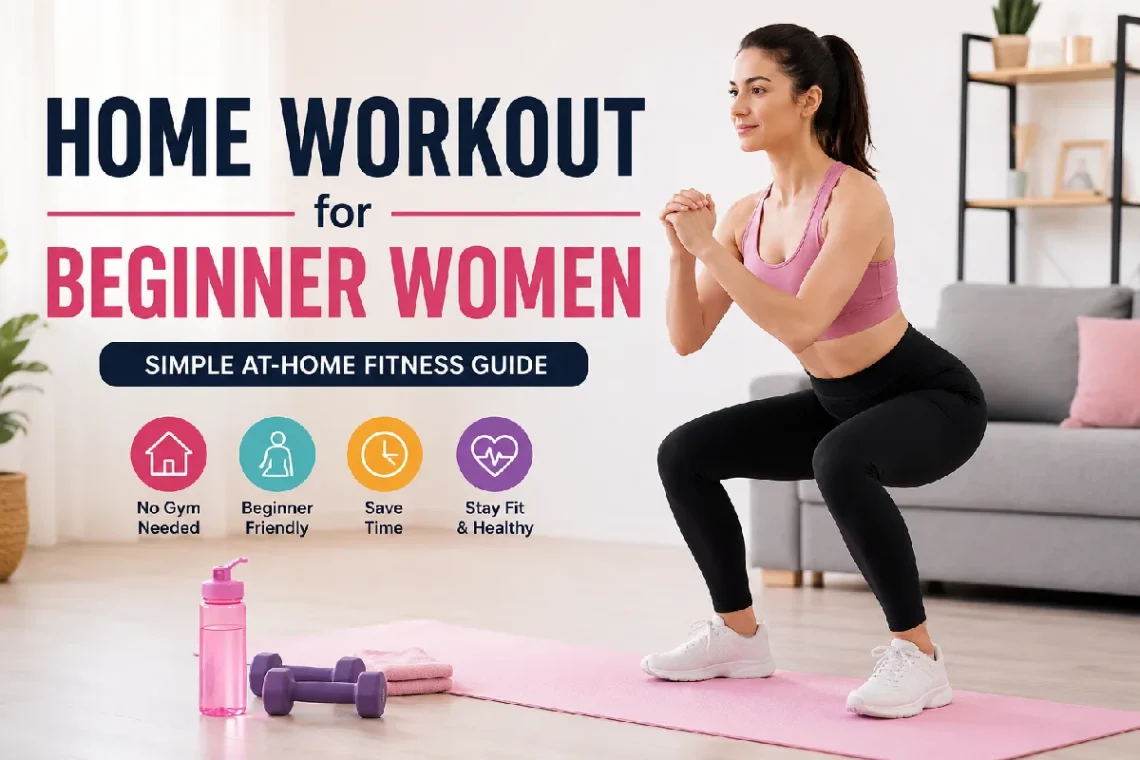
It can be hard to get started with exercise, particularly if you’ve never been to the gym or don’t know where to start. A Home Workout for Beginner Women can be easy and useful, an opportunity to get active, strong, fit and to create a workout schedule that fits their daily lives.
You don’t have to spend a lot of cash or lots of time. Even a small period (minutes) of steady activity in a small space with relaxed clothing is sufficient to begin. The vital thing is to select exercises that are suitable for you and then start to make them more stimulating as you get righter.
When work, family, weather, transportation, or gym fees make it hard for women in the USA to work out, it may also be suitable to do it at home. The idea is not to make a flawless routine. The idea is to make one that you can sensibly maintain.
It explains the advantages of home workouts, equipment-free exercises for newbies, a basic whole-body exercise plan, creating a week-by-week workout schedule, and how to stay motivated.
❝
This article is part of
Womens Fitness Hub
Benefits of Home Workouts
Convenience is one of the greatest home workout for beginners women has. No gym, no equipment, and no need to wait for anyone else to get ready to exercise.
1. Convenient and Flexible
You can work out:
- Before work
- At lunch time
- Giving children to school after drop off
- In the evening
- On weekends
When you are first starting out, even a 15-30 minute session can be beneficial.
2. Builds Strength
Body weight exercises can target big muscle groups such as the:
- Legs
- Glutes
- Core
- Chest
- Shoulders
- Back
3. Supports Cardiovascular Fitness
Strength training is not the only activity you need to do in the comfort of your home. To make your heart rate go up, march in place, step ups, dance, jumping jacks or brisk walking.
4. Can Conduct Self.
Exercise can also boost your energy use and can complement good nutrition practices. But, weight management is not just about the specific workout; it’s about overall nutrition, exercise, sleep and more.
5. Supports Development of a Sustainable Habit
A 20-minute home exercise can be easier to stick with than a hour long exercise that involves an hour of travel and an hour in the gym.
Starting a workout routine at home can be a convenient way to build consistency without needing a gym membership. For a complete overview of beginner-friendly training, explore our beginner workout plan for women.
No-Equipment Exercises
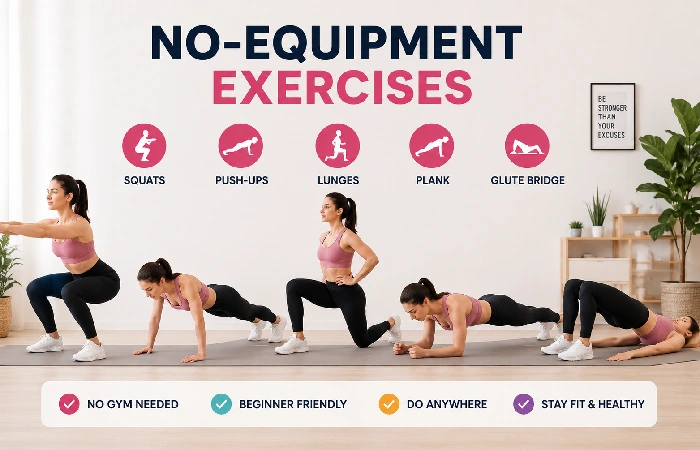
- Even though a full home gym is nice, the beginner doesn’t have to have a full gym to get started.
- The following movements can be done with little or no equipment.
Bodyweight Exercise Guide
| Exercise | Main Muscles | Beginner Target |
| Bodyweight Squat | Legs, glutes | 8–12 reps |
| Glute Bridge | Glutes, hamstrings | 10–15 reps |
| Wall Push-Up | Chest, shoulders, arms | 8–12 reps |
| Reverse Lunge | Legs, glutes | 6–10 each side |
| Bird Dog | Core, back | 6–10 each side |
| Standing March | Legs, core | 30–60 seconds |
| Modified Plank | Core, shoulders | 15–30 seconds |
Bodyweight Squats
- Have your feet about shoulder-width apart. Move hips back and stay in a squat position as if sitting down into a chair.
- Maintain a comfortable chest and knees moving in the same direction as your toes.
- Use a chair to get up in a regular squat if it is challenging.
Wall Push-Ups
- Facing a wall, place hands on wall. Now bend your elbows so that you move your chest towards the wall, and push back.
- Once you are able to do more push ups, you can move on to incline push ups with a sturdy raised surface.
Glute Bridges
- The glute bridge engages the glutes and some of the hip and core muscles.
- While lying on your back with your knees bent and your feet flat on the floor.
- Raise hips slowly and hold at the top for a few seconds then lower them down slowly.
- Try 10–15 repetitions.<If you prefer training with gym equipment or want access to a wider range of machines and weights, our beginner gym workout plan for women provides another approach to getting started.
Beginner Exercise Tips
Focus on:
- Controlled movements
- Comfortable range of motion
- Good posture
- Breathing normally
- Gradual progression
You don’t need to feel exhausted after every workout for it to be effective.
Bird Dogs
- Bird dogs are a great movement for beginners and will test core stability and coordination.
- Kneel and kneepad on the floor. Slowly stretch out one arm and the opposite leg. Go back to starting position and cross to the other side.
- Repeat 6-10 times on each side.
Marching in Place
- Marching is a straightforward technique for including some exercise and increasing your heart rate.
- Maintain a comfortable posture and use your arms in a natural manner.
- Practice for 30-60 seconds at a time.
Beginner Exercise Guide
| Exercise | Main Focus | Beginner Target |
| Bodyweight Squat | Legs & glutes | 8–12 reps |
| Glute Bridge | Glutes & hips | 10–15 reps |
| Wall Push-Up | Chest & arms | 8–12 reps |
| Bird Dog | Core & stability | 6–10/side |
| Marching | Cardio | 30–60 sec |
Start with fewer repetitions if necessary. Chasing a lot of numbers is not the key aspect of good technique.
Full-Body Home Routine
An easy full body workout that works on multiple big muscle groups without equipment.
20–25 Minute Beginner Routine
Warm-up — 5 minutes
- March in place
- Arm circles
- Gentle side steps
- Hip movements
- Easy bodyweight squats
Next, fill in the following:
| Exercise | Repetitions/Time |
| Bodyweight Squats | 10 reps |
| Wall Push-Ups | 10 reps |
| Glute Bridges | 12 reps |
| Bird Dogs | 8/side |
| Marching in Place | 45 sec |
| Rest | 30–60 sec |
You will get started by completing 2 rounds.
After a few sessions, if this is manageable, start to increase the number of rounds to three.
Home workouts do not always require equipment. Bodyweight movements can be adapted to different fitness levels, so explore our beginner bodyweight workout plan for women for additional ideas.
How to Progress
It’s not necessary to push every workout to its maximum level right away.
Progress gradually by:
- Adding a few repetitions
- Adding another round
- Increasing exercise time
- Reducing rest slightly
- From wall push-ups to incline pushup
- Using a more challenging variation
A sharp pain (not normal exercise effort) during an exercise indicates that you should reevaluate your form or select an alternative exercise.
Weekly Home Workout Schedule USA
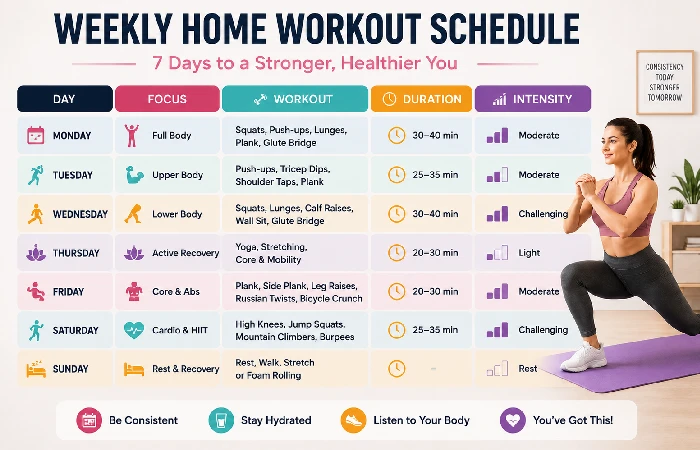
You don’t need to work out all day, every day to get a balanced Home Workout for Beginner Women.
Beginner’s workout schedule may include strength, cardio, light activity, and rest.
As you become more comfortable with exercise, adding resistance can help you develop a more structured training routine. Our beginner strength training plan for women covers the basics of resistance-focused workouts.
Sample Weekly Schedule
| Day | Workout | Duration |
| Monday | Full-body strength routine | 20–25 min |
| Tuesday | Brisk walk or light cardio | 20–30 min |
| Wednesday | Rest or gentle stretching | 10–20 min |
| Thursday | Full-body strength routine | 20–25 min |
| Friday | Walking, dancing, or light cardio | 20–30 min |
| Saturday | Optional beginner workout | 15–25 min |
| Sunday | Rest | — |
This schedule is flexible.
Do not feel like you have to sacrifice the rest of the week if you miss the workout on Monday! Just rearrange the session to another suitable day.
How Much Exercise Should You Aim For?
As a general rule, U.S. physical action guidelines suggest adults aim for 150 minutes of moderate-intensity aerobic exercise weekly and muscle strengthening activities at least two days a week for over-all good health.
If they are lazy, they don’t have to attain that goal right away. Start with handy amounts and slowly build up.
You can contribute to your weekly activity by walking, moving around around the house, dancing, riding a bike and more.
Tips for Staying Consistent
It’s much easier to start a Home Workout for Beginner Women than keep it going.
The key is to make exercise fit into your lifestyle and not your lifestyle fit into exercise.
1. Start Small
- Avoid starting with 1 hour of exercise daily.
- Go for 15-20 minutes and gradually increase.
A brief exercise session that you can truly finish is better than a prolonged exercise session that you’ll continually put off.
2. Select Regular Time
Try exercising at approximately the same time each day.
For example:
- 7:00 AM → 20-minute workout
or
- 6:30 PM → 25-minute workout
3. A routine can help make exercise routine.
Place equipment where you can easily see it.
When you go to resistance bands, dumbbells or yoga mat, have them in a place where you will see them.
What doesn’t happen out of sight, often doesn’t happen.
If you have dumbbells available at home, they can provide an easy way to add resistance to beginner exercises. Our beginner dumbbell workout plan for women offers ideas for incorporating dumbbell exercises into your training.
4. Track Progress
Write down:
- Workout date
- Exercises completed
- Repetitions
- Workout duration
- How you felt
It is encouraging to see that progress is being made.
5. Don’t Chase Perfection
Not going to your workout once doesn’t mean you are a failure.
The aim is to get back to your normal routine as soon as possible.
6. Make It Enjoyable
Experiment with various techniques of movement.
You might enjoy:
- Dance workouts
- Walking
- Strength circuits
- Yoga
- Pilates
- Low-impact cardio
The ideal exercise plan is one you are able to follow long-term.
7. Pay attention to your body
It is normal to experience some muscle discomfort when starting a new workout program, however, if this is severe or continues, it should not be dismissed.
Rest when necessary; take off slowly.
Flexibility and mobility can complement your home workouts, especially when included as part of a warm-up or cool-down. Explore our stretching exercises for women for simple movements to add to your routine.
Frequently Asked Questions
Can a home exercise program work for the beginner female?
Yes. For those new to exercise, body weight exercises and basic cardiovascular activities can help to build strength, mobility, fitness and overall physical activity without the need for gym equipment.
Few points to consider about a beginner workout at home.
A starting time of about 15-30 minutes is reasonable. As fitness improves, length of time can be gradually increased.
Do home exercises help you to lose weight?
Exercise at home can help with weight management, as it can boost activity levels. Other factors also are important, such as nutrition, total calorie consumption, sleep and activity.
Do I need any equipment?
No. Beginners can begin by doing body weight exercises. Later, if desired, resistance bands or dumbbells can be added to increase resistance.
What is the number of days suitable for beginner to exercise per week?
This is a reasonable beginning, with two or three strength sessions a week and regular walking or other moderate activity.
If I’ve never gotten into exercise before, what can I do?
Keep sessions short and start slow with simple movements. Please consult a trained health care provider before starting exercise if you have a medical condition, symptoms or concerns.
Conclusion
If you’re just beginning to exercise, a Home Workout for Beginner Women can be a great and convenient method to start a healthier fitness routine. You do not have to use fancy gear, join gymnasiums or use complicated exercises. Simple exercises like squats, glute bridges, wall push-ups, bird dogs and marching can be a countless foundation.
Uniformity is the most vital thing. Begin with easy workouts, slowly work up to them, and listen to your body. Perform strength training in combination with walking or other aerobic exercise, ensure a balanced diet, drink plenty of fluids and focus on recovery.
Most essential of all, do not get stressed about doing everything right from the get-go! Having a truthful schedule that works for you is more probable to stick with you.
Dr. Khizrana Begum
Dr. Khizrana Begum is a qualified medical professional with MBBS and MD qualifications and 5+ years of experience in the medical field. She works as a General Physician and Dermatologist, with knowledge spanning general medicine, dermatology, preventive healthcare and skin health.
As a medical reviewer, Dr. Khizrana Begum reviews health and wellness content for medical accuracy, clarity and authenticity.
Sameena Begum
Sameena Begum reviews content for clarity, accuracy and reader usefulness. Her review process helps ensure that published information is clearly presented, relevant and easy for readers to understand.
Syeda Yasmeen
Syeda Yasmeen is a Health & Wellness Writer at InHumanBeing.com. She creates clear and reader-focused content across health, nutrition, wellness, women’s health, men’s health and babies’ health.