 Syeda Yasmeen
Health & Wellness Writer Syeda Yasmeen creates clear and
reader-focused content covering health,
nutrition, wellness, women’s health,
men’s health and babies’ health.
Read Full Bio of Author →
Syeda Yasmeen
Health & Wellness Writer Syeda Yasmeen creates clear and
reader-focused content covering health,
nutrition, wellness, women’s health,
men’s health and babies’ health.
Read Full Bio of Author →
 Sameena Begum
Health, Technology & Digital Content Reviewer Sameena Begum reviews selected content
for clarity, factual presentation,
consistency and reader usefulness.
Read Full Bio of Reviewer →
Sameena Begum
Health, Technology & Digital Content Reviewer Sameena Begum reviews selected content
for clarity, factual presentation,
consistency and reader usefulness.
Read Full Bio of Reviewer →
 Dr. Khizrana Begum
General Physician and Dermatologist Dr. Khizrana Begum is a qualified medical
professional with MBBS and MD qualifications
and 5+ years of experience. She reviews health
and wellness content for medical accuracy,
clarity and responsible presentation.
Read Full Bio of Medical Reviewer →
Dr. Khizrana Begum
General Physician and Dermatologist Dr. Khizrana Begum is a qualified medical
professional with MBBS and MD qualifications
and 5+ years of experience. She reviews health
and wellness content for medical accuracy,
clarity and responsible presentation.
Read Full Bio of Medical Reviewer →
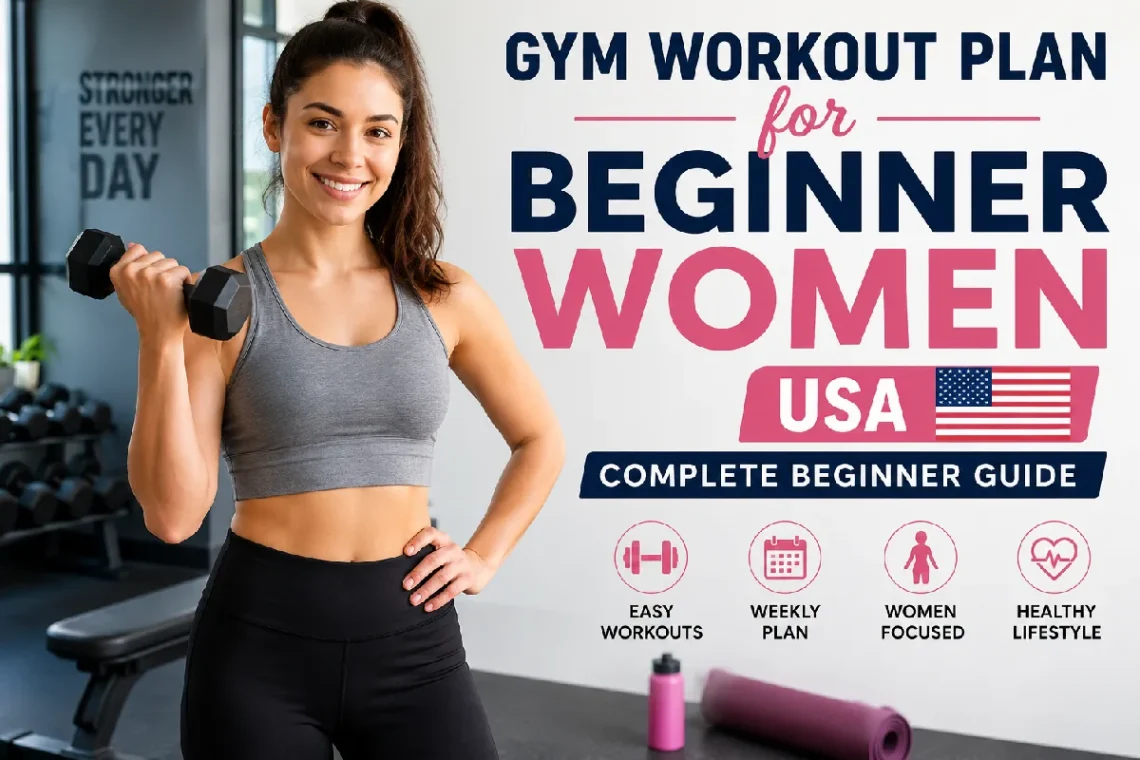
It can be daunting to start working out at a gym. Mainly if you do not know what gear to use or are not certain what exercises you need to do. The Gym Workout Plan for Beginner Women USA will help you to make those first couple of weeks a little bit easier for you, with a simple plan that you can follow.
There’s no need to devote hours in the gym or use all of the machines available. When starting out, it’s essential to focus on getting the basic movement patterns down, slowly emerging strength, and making an exercise routine that is not overwhelming.
In this guide discover, what gym equipment is best for beginners, how to do a fully body workout, how to do progressive overload and how to exercise safely.
❝
This article is part of
Womens Fitness Hub
What to Expect at the Gym

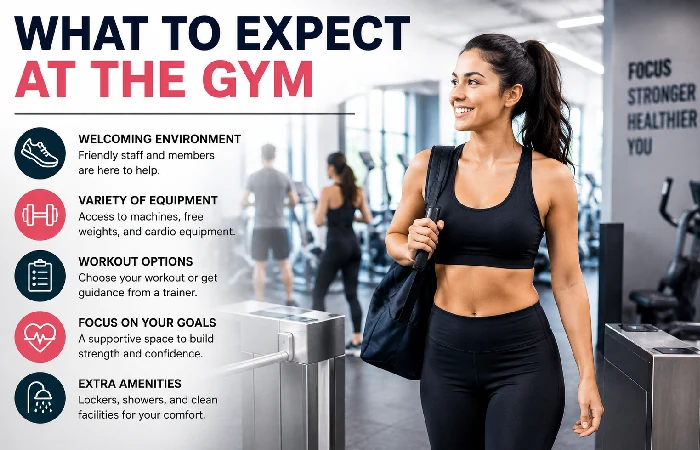
The prospect of starting to use a gym can be daunting the first time. There’s probably dozens of machines, free weights, treadmills, cables, and the people doing exercises that you haven’t seen before.
But don’t fear—you don’t have to use all of these.
The first workout can be quite easy.
Starting at the gym can feel more manageable when you have a structured routine designed for beginners. For a broader overview of beginner-friendly training options, explore our beginner workout plan for women.
Your First Gym Visit
It’s worth spending some time in your initial session getting to know:
- The cardio area
- Weight machines
- Dumbbells
- Cable machines
- Benches
- Changing rooms
- Water stations
However, when the aim is to stretch or allow mobility, these areas are not covered.
Take advantage of any orientation or equipment demonstration that your gym may provide.
What is the ideal length of time for a beginner to train?
There’s no need to workout for two hours.
An easy starting workout might last about 30-45 minutes, and incorporate warm up.
How Long Should Beginners Work Out?
You don’t need a two-hour gym session.
A beginner strength workout can take approximately 30–45 minutes, including a warm-up.
A simple session might look like:
| Part | Approximate Time |
| Warm-up | 5–10 minutes |
| Strength training | 20–30 minutes |
| Cool-down | 5 minutes |
It’s more vital to be reliable than spend too much time at the gym.
If you cannot make it to the gym every day, you can still stay consistent with a home-based routine. Explore our beginner home workout plan for women for convenient alternatives.
What to wear when it comes to the Covid-19 vaccination?
Wear relaxed clothes that will enable you to move around easily.
It’s also supportive to have helpful athletic shoes, particularly when you are doing strength training in addition to walking, using the treadmill or other kinds of cardio exercises.
Beginner-Friendly Equipment
There’s no need for elaborate gear when it comes to building strength.
In fact, machines can be beneficial for learning as they give a controlled movement pattern.
Items to begin with.
| Equipment | Beginner Use | Main Benefit |
| Treadmill | Walking | Cardio |
| Stationary bike | Cycling | Low-impact cardio |
| Leg press | Lower body | Leg strength |
| Lat pulldown | Upper back | Back strength |
| Seated row | Upper back | Pulling strength |
| Chest press | Chest and arms | Upper-body strength |
| Cable machine | Various exercises | Versatility |
| Dumbbells | Free-weight exercises | Balance and strength |
One of the easiest things to do is to walk on a treadmill.
Begin at 5–10 minutes per lap with a relaxed pace and increase the lap time as needed.
Low impact cardiovascular exercise can also be done with a stationary bike or elliptical machine.
Gym workouts can include equipment, but bodyweight exercises are also useful for building movement confidence and learning proper form. Our beginner bodyweight workout plan for women provides additional exercise ideas.
Weight Machines
Some machines, like the leg press, chest press, lat pulldown and seated row, can be helpful when you’re just starting out.
- Begin slowly on the easiest resistance so that you can master the movement.
- Ignore another person’s lifting ability.
- The beginning is the beginning.
Dumbbells
When using dumbbells you can do the following exercises:
- Goblet squats
- Dumbbell rows
- Shoulder presses
- Romanian deadlifts
Biceps curls
If you have never lifted free weights before, you might think of trying to ask someone who knows how to properly demonstrate the movement.
Full-Body Gym Routine
A full-body workout is an efficient option for beginners who don’t want to go to the gym every day and want to work out more than one muscle group.
Two or three strength sessions per week for the whole body is a realistic beginning for many novices.
Once you are comfortable with basic movements, resistance exercises can become an important part of a structured gym routine. Explore our beginner strength training plan for women for guidance on getting started.
Beginner Full-Body Workout
| Exercise | Sets | Reps |
| Leg Press | 2 | 8–12 |
| Lat Pulldown | 2 | 8–12 |
| Chest Press | 2 | 8–12 |
| Seated Cable Row | 2 | 8–12 |
| Dumbbell Romanian Deadlift | 2 | 8–12 |
| Glute Bridge | 2 | 10–15 |
| Plank | 2 | 15–30 sec |
Take a few seconds break between sets, depending on the exercise and fitness level.
Warm-Up
Begin with 5–10 minutes of low-intensity exercise.
For example:
5 minutes walk on the treadmill → move lightly around the house → strength training
Warm-up should have you ready to work out, not weary.
Choosing Your Weight
Choice a confrontation that allows you to comprehensive the target recurrences with controlled technique.
The final few repetitions should feel stimulating, but you shouldn’t need to expense form.
For beginners, technique should come before lifting heavier weights.
Example Workout
Leg Press
Complete 8–12 controlled repetitions.
Lat Pulldown
Keep your torso stable and pull the bar toward your upper chest.
Chest Press
Adjust the machine so the handles are positioned comfortably.
Seated Row
Pull toward your torso while keeping your shoulders controlled.
Dumbbell Romanian Deadlift
Keep the dumbbells close to your legs and emphasis on touching through your hips.
Glute Bridge
Squash the glutes at the top without excessively arching your lower back.
Plank
Keep your body in a relaxed straight line and stop before your form breaks down.
- Select a confrontation that will enable you to perform the desired number of recurrences using a controlled technique.
- The last couple of reps should be just hard enough but not sacrifice form.
- Technique should be emphasized before heavier weights for the beginner.
Progressive Overload Basics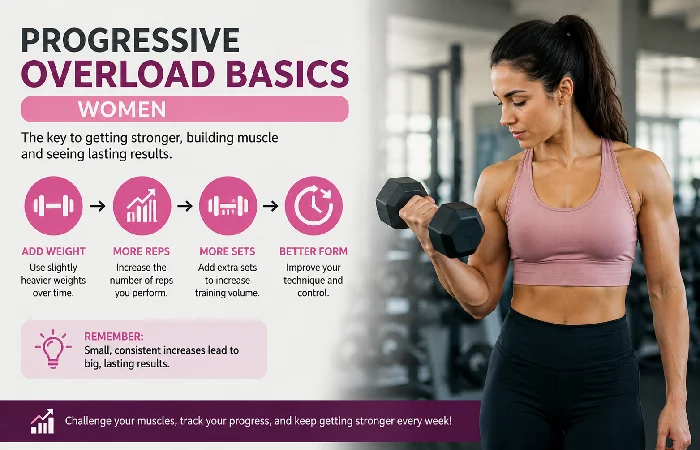 Progressive overload is basically just the progressive increase in training intensity over time.
You don’t have to increase the weight every workout.
Progress can come from:
- Adding repetitions
- Increasing resistance
- Adding a set
- Improving technique
- To increase the range of motion.
Keeping up the same workload but less strain on the body.Doing the same work but in a more comfortable way.
Stretching can complement your workout by giving you time to focus on mobility and flexibility before or after training. Our stretching exercises for women can help you add simple flexibility work to your routine.
Simple Example
Imagine you’re doing the leg press:
| Week | Weight | Reps |
| Week 1 | 40 lb | 10 |
| Week 2 | 40 lb | 12 |
| Week 3 | 45 lb | 10 |
| Week 4 | 45 lb | 12 |
The exact weight will depend on the machine and individual. The point is simply to show how gradual progression can work.
Don’t Rush Progress
One of the most common beginner mistakes is adding weight too quickly.
If your technique becomes poor, the weight is probably too heavy.
A successful Gym Workout Plan for Beginner Women USA should focus on steady improvement rather than trying to achieve maximum lifts.
Dumbbells are a versatile option for adding resistance to many beginner exercises at the gym. Explore our beginner dumbbell workout plan for women for practical exercise ideas.
Keep a Workout Log
Write down:
- Exercise
- Weight
- Repetitions
- Sets
How the workout felt
A modest phone note or fitness app can be enough.
After numerous weeks, you will be able to see your growth more clearly.
Safety Tips
Safety should continuously come before growing weight or intensity.
Start Slowly
If you are totally new to exercise, do not try to copy an progressive gym program.
Begin with handy workouts and give your body time to adapt.
Learn Proper Technique
If you are not sure how to use a machine or perform an exercise, ask gym staff or a fit fitness expert for guidance.
Don’t Ignore Pain
Muscle fatigue and mild exertion are normal.
Sharp, sudden, or unusual pain is different.
Stop the exercise and seek suitable professional information if essential.
Stay Hydrated
Have water while exercising.
Additional fluids are needed when exercise longer or in hot weather.
Use Equipment Properly
Prior to using a machine:
Adjust the seat.
Check the settings.
Begin with a low resistance.
Carry out a controlled test repetition.
Add the resistance only when you feel good.
Rest Between Workouts
You will need rest time for your muscles.
A novice need not train hard on the same muscle groups every day.
A simple weekly structure could look like:
| Day | Activity |
| Monday | Full-body strength |
| Tuesday | Walking/cardio |
| Wednesday | Rest |
| Thursday | Full-body strength |
| Friday | Light cardio |
| Saturday | Optional strength or activity |
| Sunday | Rest |
Final Takeaway
The Gym Workout Plan for Beginner Women USA should be simple, realistic and easy to progress.
Begin with simple machines and exercises, exercise major muscle groups, develop correct technique, and build up the level of difficulty slowly. No need to use the heaviest weights or the most complex exercises to make progress.
Most importantly, allow yourself time to get some comfort in the gym. It’s never too early to learn and the basics can set the stage for lifelong fitness.
Dr. Khizrana Begum is a qualified medical professional with MBBS and MD qualifications and 5+ years of experience in the medical field. She works as a General Physician and Dermatologist, with knowledge spanning general medicine, dermatology, preventive healthcare and skin health.
As a medical reviewer, Dr. Khizrana Begum reviews health and wellness content for medical accuracy, clarity and authenticity.
Sameena Begum reviews content for clarity, accuracy and reader usefulness. Her review process helps ensure that published information is clearly presented, relevant and easy for readers to understand.
Syeda Yasmeen is a Health & Wellness Writer at InHumanBeing.com. She creates clear and reader-focused content across health, nutrition, wellness, women’s health, men’s health and babies’ health.