
 Syeda Yasmeen
Health & Wellness Writer Syeda Yasmeen creates clear and
reader-focused content covering health,
nutrition, wellness, women’s health,
men’s health and babies’ health.
Read Full Bio of Author →
Syeda Yasmeen
Health & Wellness Writer Syeda Yasmeen creates clear and
reader-focused content covering health,
nutrition, wellness, women’s health,
men’s health and babies’ health.
Read Full Bio of Author →
 Sameena Begum
Health, Technology & Digital Content Reviewer Sameena Begum reviews selected content
for clarity, factual presentation,
consistency and reader usefulness.
Read Full Bio of Reviewer →
Sameena Begum
Health, Technology & Digital Content Reviewer Sameena Begum reviews selected content
for clarity, factual presentation,
consistency and reader usefulness.
Read Full Bio of Reviewer →
 Dr. Khizrana Begum
General Physician and Dermatologist Dr. Khizrana Begum is a qualified medical
professional with MBBS and MD qualifications
and 5+ years of experience. She reviews health
and wellness content for medical accuracy,
clarity and responsible presentation.
Read Full Bio of Medical Reviewer →
Dr. Khizrana Begum
General Physician and Dermatologist Dr. Khizrana Begum is a qualified medical
professional with MBBS and MD qualifications
and 5+ years of experience. She reviews health
and wellness content for medical accuracy,
clarity and responsible presentation.
Read Full Bio of Medical Reviewer →
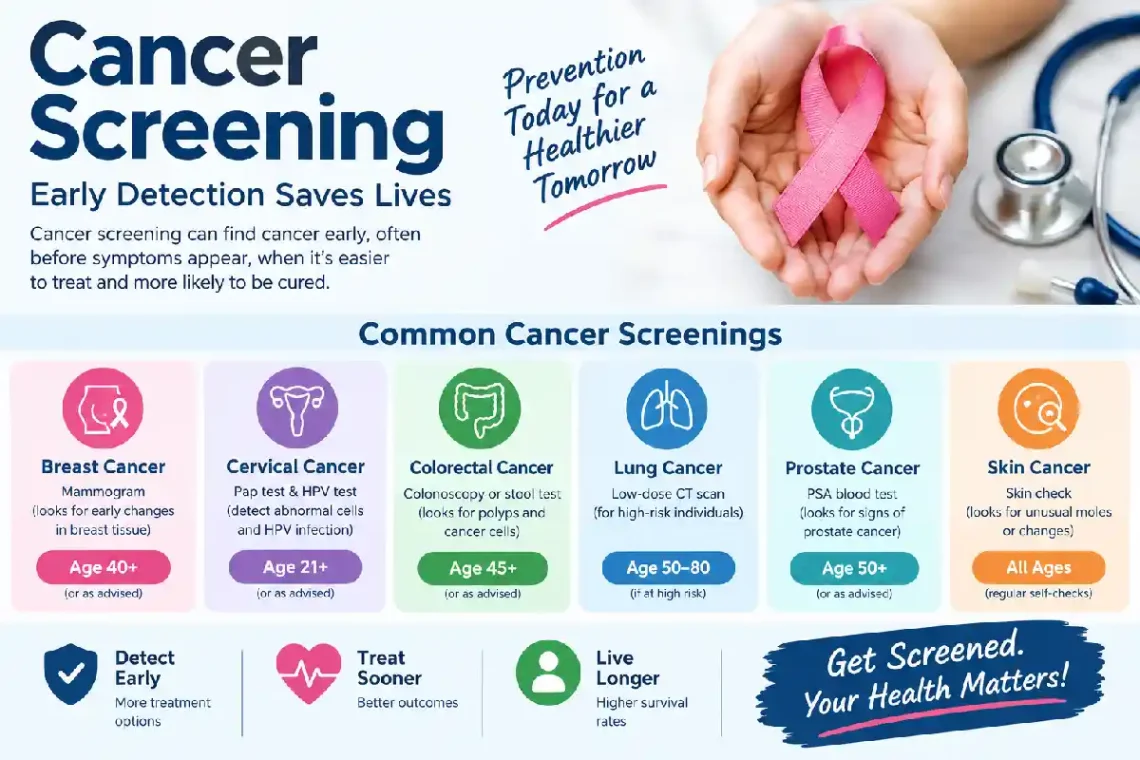
Cancer screening is a valuable component of primary prevention. Screening involves the use of various screening tests for some forms of cancer or for precancerous conditions in apparently asymptomatic individuals. The early detection of certain cancers allows treatment to be less invasive and may contribute toward decreased mortality. Cancer screening, however, is not indicate for all types of cancers in all individuals and varies in its benefits, risks, and limitations.
Based on your age, sex, family history, genetic risk, prior screening results, lifestyle and other health conditions, your suggested screening schedule may vary. Your screening recommendations may also vary by country and change over time as new evidence emerges.
❝
This article is part of
Health Checkups Hub
What Is Cancer Screening?
Cancer screening is the process of examining for cancer and abnormal cells before any symptoms are notice. The aim is to detect some types of cancer or precancerous cells early so treatment can more successful.
Common cancer screening tests include:
- Mammography for breast cancer
- HPV and Pap testing for cervical cancer
- Stool tests and colonoscopy for colorectal cancer
- Low-dose CT scans for certain people at high risk of lung cancer
- PSA testing for prostate cancer in selected individuals
Screening should not confuse with testing individuals for known symptoms of other diseases. Someone who presents with a new lump, unexplain bleeding, ongoing cough, or any other worrying symptom may require diagnostic, rather than screening, services.
Why Cancer Screening Matters
Certain cancers may be asymptomatic (show no symptoms) early on. Screening can detect changes prior to symptoms occurring.
An optimal screening program should achieve benefits in meaningful ways while minimizing harms. Harms may include false-positive, false-negative, excessive diagnostic and/or unnecessary follow-up, anxiety, over-diagnosis, and overtreatment.
This is one of the reasons why more screening does not necessarily mean better.2. Screening is usually advised if ‘sufficient evidence exists of a valuable benefit of a test for a specific population.
Screening, furthermore, does not prevent the recognition of symptoms. In the presence of symptoms, it is imperative that an individual attends for proper medical consultation, even if screening was clear previously.
Breast Cancer Screening
Mammography screening is the most common screening test for breast cancer today. X-ray imaging of breast tissue can identify some cancers before symptoms appear:
According to the National Cancer Institute, mammography has been proven to reduce breast cancer mortality among women aged 40-74, and expert guidelines typically recommend beginning routine screening at age 40, but defined schedules are inconsistent.
Breast screening may be different for people with a higher-than-average risk because of:
- A strong family history of breast cancer
- Certain inherited gene changes
- Previous chest radiation
- A personal history of breast cancer or certain breast conditions
A few high-risk patients are considered candidates for breast MRI as well as mammography.
Screening is guided by the healthcare profession, who can advise on the screening most appropriate to the individual’s risk.
Cervical Cancer Screening
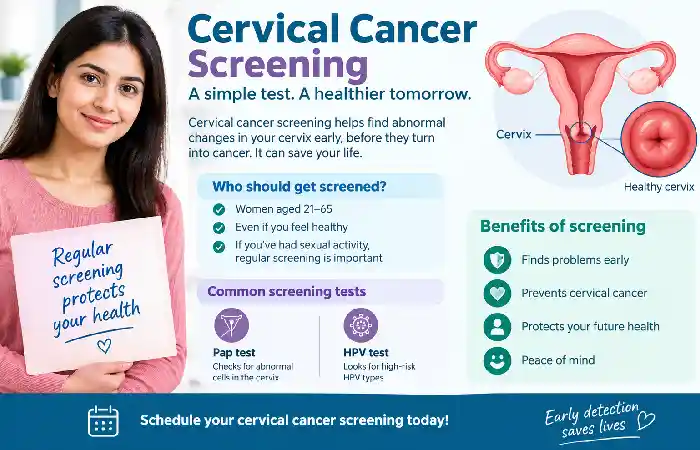
Screening for cervical cancer involves testing for the presence of high-risk HPV infection or abnormal cells that may, in time, progress into cancer.
Common screening methods include:
- HPV testing
- Pap testing
- HPV and Pap testing together in some screening programs
Screening could be capable of detecting abnormal cells at an early stage before they turn malignant, enabling them to be monitored or treated accordingly.
Screening intervals are dependent on age, previous results, test used, and individual risk. In some protocols, routine screening is generally recommended from early adulthood until about age 65 years for individuals with average risk and previous satisfactory screening.
Having an abnormal HPV or Pap result doesn’t necessarily mean that someone has cervical cancer; there might be other tests or follow-up that may be necessary depending on the result.
Colorectal Cancer Screening
Screening for colorectal cancer is used to identify cancerous or precancerous lesions in the colon and rectum.
Screening options can include:
- Stool-based tests
- Colonoscopy
- Flexible sigmoidoscopy
- Other imaging-based approaches in selected circumstances
Some screening options allow for early detection of colorectal cancer, and some are also able to find polyps that can be easily removed before they turn into cancer.
For average-risk individuals, several expert panels recommend starting routine screening for colorectal cancer at age 45 to 75 years and then using individualized decision-making after age 75.
Some individuals may be advised to follow a different screening schedule if they have a family history of bowel cancer, inherit certain conditions, have inflammatory bowel disease, or have had polyps before.
Lung Cancer Screening
Screening for lung cancer is not advised in all cases.
Lung cancer screening with low-dose computed tomography (LDCT) is effective at reducing lung cancer mortality among some moderately to heavily smokers of a certain age. According to the National Cancer Institute, lung cancer screening is recommended for some current or former heavy smokers aged 50–80.
Eligibility depends on factors such as:
- Age
- Current smoking status
- Previous smoking history
- Number of pack-years
- How long ago a person stopped smoking
A routine chest X-ray cannot be said to be an acceptable alternative to low-dose CT screening.
Patients presenting with symptoms such as cough (continual), hemoptysis, unexplained weight loss or persisting symptoms related to the chest may warrant investigation rather than screening.
Prostate Cancer Screening
The screening for prostate cancer is usually by a prostate-specific antigen (PSA) blood test.
Prostate cancer screening is different from several other forms of screening for various cancers, as benefits and harms must be balanced, as excess tests and treatments can be harmful. A raised PSA is not synonymous with prostate cancer, and further investigation may be required.
Potential disadvantages of PSA screening include:
- False-positive results
- Anxiety
- Biopsy-related complications
- Detection of cancers that may never have caused symptoms
- Unnecessary treatment and treatment-related side effects
Thus, routine PSA testing should not be recommended for all men unless screening is based on individual risk, and the National Cancer Institute advises men to talk to their healthcare professional to understand the possible benefit, if any, and known or possible harms.
Age, family history, genetic risk, and other risk factors can be influential in this decision.
Skin Cancer Screening
Variations in the skin may also aid diagnosis of skin cancer. Changes in a pre-existing mole, or the development of additional or abnormal moles, may be observed.
Routine skin cancer screening is not universally recommend for adults. It is not known whether routine skin screening of the population prevents deaths from skin cancer.
Nevertheless, individuals at higher risk may recommend to self-examine their skin and have it check by a medical practitioner.
Important changes to discuss with a healthcare professional include:
- A new or changing mole
- A lesion that repeatedly bleeds
- A sore that does not heal
- Changes in size, shape, or color
- A rapidly changing skin growth
Any suspicious skin change should look at, irrespective of any prior skin cancer diagnosis.
Breast Cancer Screening Based on Personal Risk
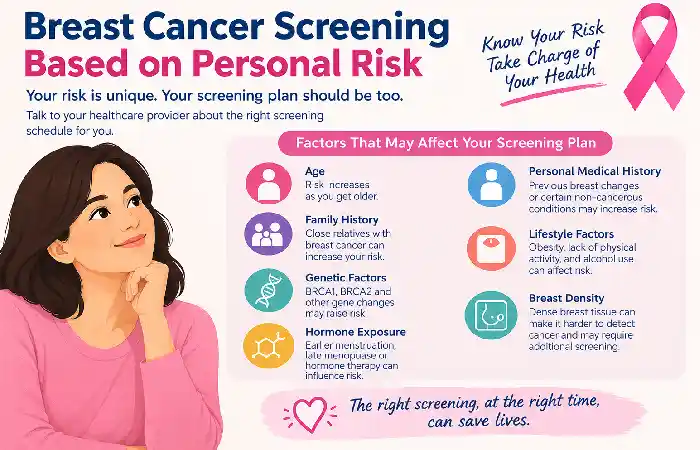
They do not necessarily have to given the same cancer screening programs for every individual.
Personal risk may influence by:
| Risk Factor | Why It May Matter |
| Age | Cancer risk generally changes as people get older. |
| Family history | Some cancers occur more frequently in certain families. |
| Genetic changes | Certain inherited variants can increase cancer risk. |
| Smoking history | Strongly associated with several cancers. |
| Previous cancer | May change future surveillance |
| Previous abnormal screening | May require additional follow-up |
| Certain medical conditions | Some conditions increase cancer risk. |
| Previous radiation exposure | Can increase the risk of certain cancers |
| Lifestyle and environmental exposures | May influence risk for some cancers |
Individuals at greater risk may require screening at an age, with a test or at a frequency different from the average-risk population.
Having relatives who have had cancer has not been proven as a factor that will cause you to become unhealthy; however, if a family history is present, it is vital to inform your doctor for additional advice.
Understanding Cancer Screening Results
A cancer screening test result is not the same as a cancer diagnosis.
A normal or negative result usually means that the screening test found nothing abnormal as it was looking for, at the particular screening at that time. It does not mean that there is no cancer present.
A positive or abnormal result means that something requiring further assessment was found. It does not definitively mean cancer has found. Other tests may request, such as repeat screening, imaging, lab tests, or a biopsy, depending on what kind of screening test has been done.
A false positive occurs when a screening test is abnormal when no cancer is present. A false negative occurs when a screening test is normal when cancer is present.
If the screening test result is abnormal, it is valuable to follow the recommended next step. If follow-up is delay, diagnosis may delay when further work-up is indicate.
Frequently Asked Questions About Cancer Screening
At what age should cancer screening begin?
No fixed age for all cancer screening. Cancer screening recommendations vary between cancers, and it is likely to be the case that the screening will be related to age, sex, and risk factors, and recommendations may vary between countries.
Does a positive screening test mean I have cancer?
Not necessarily. If your results show that you have a positive or abnormal screening result, it does not necessarily mean you have cancer. Screening tests by themselves do not usually give a definitive answer of “cancer.”
Can cancer screening be wrong?
Yes. False-positive and false-negative results can occur with screening tests. For this reason, screening recommendations are target to a defined population in which the potential benefits of screening believe to outweigh the potential harms.
Should people with no symptoms get cancer screening?
Screening is made for some – but not all – cancers to identify those who are healthy and showing no symptoms. But not all cancers have an effective routine screening test. Recommendations vary by type and individual risk.
What should I do if I have symptoms despite a normal screening result?
Do not assume that a normal screening test means there is no disease. New and ongoing symptoms need to discuss with a health care professional, as diagnostic testing may require.
Final Thoughts
Screening for some cancers or precancerous states design to detect the cancer or precancerous abnormality at an early stage before symptoms are evident. Breast, cervical, colorectal, and some lung cancer screening programs are recommend to uses in appropriate populations. The decision to screen for other cancers is more individual.
A screening program is determines by an individual’s age, history of personal or family cancer, genetic risk, previous screening results, and local guidelines. Screening should also regard as one element of cancer prevention and early detection rather than a strategy which guarantees a diagnosis of cancer or an opportunity to prevent a diagnosis of cancer.
Medical disclaimer: The information contain in this article is for general education purposes only and is not intend to medical advice, a diagnosis, or treatment. Cancer screening specifics may change and may also be different from country to country. Always speak with a qualified healthcare provider regarding your personal cancer screening choices.
Dr. Khizrana Begum is a qualified medical professional with MBBS and MD qualifications and 5+ years of experience in the medical field. She works as a General Physician and Dermatologist, with knowledge spanning general medicine, dermatology, preventive healthcare and skin health.
As a medical reviewer, Dr. Khizrana Begum reviews health and wellness content for medical accuracy, clarity and authenticity.
Sameena Begum reviews content for clarity, accuracy and reader usefulness. Her review process helps ensure that published information is clearly presented, relevant and easy for readers to understand.
Syeda Yasmeen is a Health & Wellness Writer at InHumanBeing.com. She creates clear and reader-focused content across health, nutrition, wellness, women’s health, men’s health and babies’ health.