 Syeda Yasmeen
Health & Wellness Writer Syeda Yasmeen creates clear and
reader-focused content covering health,
nutrition, wellness, women’s health,
men’s health and babies’ health.
Read Full Bio of Author →
Syeda Yasmeen
Health & Wellness Writer Syeda Yasmeen creates clear and
reader-focused content covering health,
nutrition, wellness, women’s health,
men’s health and babies’ health.
Read Full Bio of Author →
 Sameena Begum
Health, Technology & Digital Content Reviewer Sameena Begum reviews selected content
for clarity, factual presentation,
consistency and reader usefulness.
Read Full Bio of Reviewer →
Sameena Begum
Health, Technology & Digital Content Reviewer Sameena Begum reviews selected content
for clarity, factual presentation,
consistency and reader usefulness.
Read Full Bio of Reviewer →
 Dr. Khizrana Begum
General Physician and Dermatologist Dr. Khizrana Begum is a qualified medical
professional with MBBS and MD qualifications
and 5+ years of experience. She reviews health
and wellness content for medical accuracy,
clarity and responsible presentation.
Read Full Bio of Medical Reviewer →
Dr. Khizrana Begum
General Physician and Dermatologist Dr. Khizrana Begum is a qualified medical
professional with MBBS and MD qualifications
and 5+ years of experience. She reviews health
and wellness content for medical accuracy,
clarity and responsible presentation.
Read Full Bio of Medical Reviewer →
Beginner Dumbbell Workout for Women: Simple Full-Body Guide
The Beginner Dumbbell Workout for Women is an easy strength training workout at home or gym. Dumbbells are versatile, easy to use and can be used to train the legs, back, chest, shoulders, arms and core with a minimal amount of equipment.
No need to do extensive weight lifting to get started. The aim is to develop the correct technique, to start with a challenging resistance level and to slowly increase the difficulty of the exercise.
Whether you’re new to strength training or looking to take your bodyweight training next steps, this is the easy way to get started.
Dumbbell exercises can be a practical way for beginners to add resistance to their workouts and build a structured training routine. For a complete overview of beginner-friendly exercises, explore our beginner workout plan for women.
❝
This article is part of
Womens Fitness Hub
Choosing the Right Dumbbells
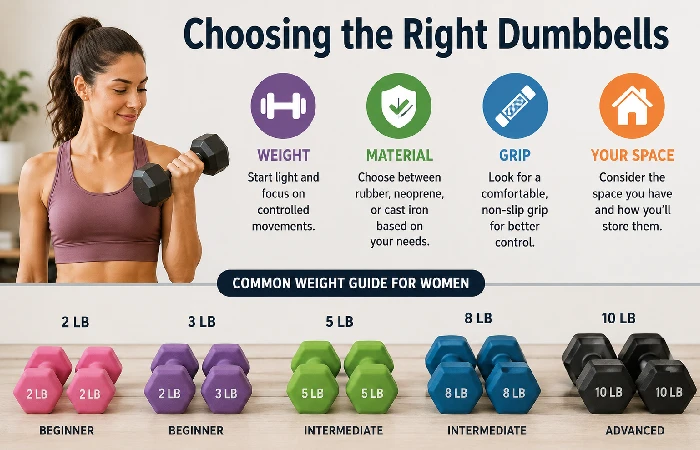
Starting dumbbell training is a lot like choosing a friend: one of the most critical steps is picking a size that’s right for you.
The “best” weight is not necessarily the heaviest that one can perform. Rather, select a resistance that will allow you to perform your desired number of repetitions with proper form.
Beginner Dumbbell Guide
| Exercise Type | Suggested Starting Range |
| Lateral raises | 2–5 lb each |
| Biceps curls | 5–10 lb each |
| Shoulder press | 5–15 lb each |
| Dumbbell rows | 8–20 lb each |
| Goblet squats | 10–25 lb |
| Romanian deadlifts | 10–25 lb each |
The following are general examples only and not requirements. Your starting weight may be less or more appropriate.
How to Know if the Weight Is Right
The following are signs that the weight may not be right:
- Repetitions 1-5 should be controlled.
- Repetitions 6-8 need to be increased in difficulty.
- Repeat 9–10 should be difficult.
- Still a high level of form should be maintained.
- If unable to work out safely, decrease the weight.
Adjustable vs Fixed Dumbbells
| Type | Advantages | Best For |
| Fixed dumbbells | Simple and easy to use | Beginners with limited exercises |
| Adjustable dumbbells | Multiple weights in one set | Home workouts and progression |
| Neoprene dumbbells | Comfortable grip | Light workouts and beginners |
| Hex dumbbells | Stable on the floor | Strength training |
Adjustable dumbbells can be more compact, as they can offer multiple resistance levels with just a single pair if you’re constructing a house gym.
If you do not have access to a gym, many dumbbell exercises can be performed at home with a small amount of equipment. Explore our beginner home workout plan for women for additional ideas.
Full-Body Dumbbell Exercises
A whole-body training session will balance the training of the major movement patterns and will not be based on any individual muscle group.
Beginner Exercise Guide
| Exercise | Main Muscles | Sets | Reps |
| Goblet Squat | Legs, glutes | 2 | 8–12 |
| Dumbbell Romanian Deadlift | Hamstrings, glutes | 2 | 8–12 |
| One-Arm Row | Back, arms | 2 | 8–12/side |
| Dumbbell Chest Press | Chest, shoulders, arms | 2 | 8–12 |
| Shoulder Press | Shoulders, arms | 2 | 8–12 |
| Biceps Curl | Biceps | 2 | 10–12 |
| Overhead Triceps Extension | Triceps | 2 | 10–12 |
Goblet Squat
- Hold one dumbbell vertically close to your chest.
- Sit back, bend your knees and make your chest comfortable.
- Push with your feet back to standing.
- Use a light dumbbell until the exercise is comfortable.
Romanian Deadlift
- Grab dumbbells in front of thighs.
- Lift and tuck your hips back, keeping your back in a neutral position.
- Simply push weights down from your legs and push your hips forward back into a standing position.
- The motion should be through the hips and not too far from the knees.
One-Arm Dumbbell Row
- Rest one hand on any stable bench or surface.
- Grab the dumbbell with the other hand and move it towards your body.
- Don’t drop it down, but lower it slowly.
Dumbbell Chest Press
- Lay on a firm bench or exercise surface.
- Keep dumbbells above chest and slowly bring them down.
- Push them upwards but not aggressively on elbows.
Shoulder Press
- Hold the dumbbells around shoulder height.
- Push them up overhead, maintaining control of the torso.
- If overhead pressing is difficult, use a lighter weight or other exercise or activity.
Upper Body Routine
A top-line dumbbell workout can target the upper-body muscles, including the chest, back, shoulder and arm muscles.
Dumbbells are also commonly available in gyms and can be used for a variety of beginner resistance exercises. Our beginner gym workout plan for women provides another way to structure your training.
Beginner Upper-Body Workout
| Exercise | Sets | Reps |
| Dumbbell Chest Press | 2 | 8–12 |
| One-Arm Dumbbell Row | 2 | 8–12/side |
| Shoulder Press | 2 | 8–12 |
| Lateral Raise | 2 | 10–15 |
| Biceps Curl | 2 | 10–12 |
| Triceps Extension | 2 | 10–12 |
Rest around 60–120 seconds between sets.
Focus on Control
Don’t swing dumbbells to complete repetitions.
For instance, in a bicep curl, refrain from letting the elbow angle drop too much and lower the weight at a slow pace.
The purpose is not just to change direction of the dumbbell. You are targeting the desired muscle(s) with a controlled range of motion.
How Often?
If training full-body, there is no need for a daily upper-body workout.
For many beginners 2-3 strength sessions a week is sufficient.
Lower Body Routine
Training your lower body is one of the best ways to contribute to your overall strength, since the body’s largest muscle groups are in the lower body.
Before adding weights, beginners can practice fundamental movement patterns using bodyweight exercises. Explore our beginner bodyweight workout plan for women for simple movements to learn first.
Beginner Lower-Body Workout
| Exercise | Sets | Reps |
| Goblet Squat | 2–3 | 8–12 |
| Romanian Deadlift | 2–3 | 8–12 |
| Reverse Lunge | 2 | 6–10/side |
| Glute Bridge | 2 | 10–15 |
| Calf Raise | 2 | 12–15 |
Reverse Lunges
- If you’re feeling comfortable with the movement, hold dumbbells at your sides.
- Step back, sink into a controlled position, and push through front foot back to original position.
- Practice bodyweight reverse lunges first if you are still learning how to balance.
Glute Bridges
- When the glute bridges are easy, you can place a light dumbbell across your hips for resistance.
- Contract gluts at the top; slowly lower hips.
Calf Raises
- Facing forward with feet shoulder width apart.
- Lift up heels, hold, and lower heels slowly.
- If needed, hold onto a wall or firm surface for support.
Don’t Ignore Balance
- One leg training can also provide some movement coordination and control.
- But you don’t have to do a handful of unilateral exercises. The beginner program requires only a few judicious moves.
Workout Progression
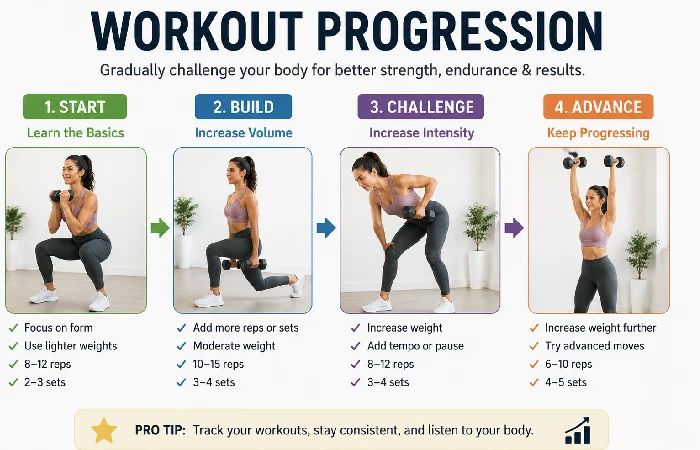
A Beginner Dumbbell Workout for Women is not meant to be a workout that you continue at the same level, and neither are the dumbbells!
As your fitness level increases, your exercise should become more difficult.
This is called progressive overload.
Dumbbell workouts are one way to introduce resistance training into a beginner fitness routine. For more guidance on building a resistance-based program, explore our beginner strength training plan for women.
Ways to Progress
Progress can be made by:
- Increasing repetitions.
- Adding a small amount of weight.
- Adding another set.
- Improving your technique.
- Increasing your range of motion.
- Selecting a more difficult level of the challenge.
You don’t need to make all the changes immediately.
Example Progression
| Week | Exercise | Weight | Reps |
| 1 | Goblet squat | 10 lb | 8 |
| 2 | Goblet squat | 10 lb | 10 |
| 3 | Goblet squat | 10 lb | 12 |
| 4 | Goblet squat | 12 lb | 10 |
These numbers are simply an example. Your progression should be based on your own fitness level.
Simple Weekly Schedule
| Day | Workout |
| Monday | Full-body dumbbell workout |
| Tuesday | Walking or light cardio |
| Wednesday | Rest |
| Thursday | Full-body dumbbell workout |
| Friday | Light activity |
| Saturday | Optional cardio/mobility |
| Sunday | Rest |
These numbers are just an example. Be sure to progress at your own level.
Adding flexibility and mobility work around your resistance workouts can help create a more balanced routine. Explore our stretching exercises for women for simple movements to include alongside your training.
Track Your Progress
Record a simple account of:
- Exercise
- Weight used
- Repetitions
- Sets
- How the exercise was performed
That way it’s easier to notice improvements that may not be evident in the mirror.
Safety First
Strive to warm up before lifting and move slowly.
Don’t overload weight if not able to keep techniques relatively good. If you feel pain during exercise, sharp or dizziness, chest pain or unusual symptoms, stop and seek appropriate medical advice.
Please seek medical advice before beginning a new training program if you have an injury, medical condition or special training restrictions.
Final Takeaway
An effective and convenient Beginner Dumbbell Workout for Women can be a great strength building exercise without the need of a complicated gym program. Begin with manageable loads, familiarize yourself with the basic movements and take your time to properly develop your technique.
You do not have to lift as much as another person or change up the exercises each week. Pay attention to making little changes, getting enough rest and training regularly.
There can be meaningful progress made over time, with a few extra pounds, an additional rep or exercise done with increased control.
Dr. Khizrana Begum is a qualified medical professional with MBBS and MD qualifications and 5+ years of experience in the medical field. She works as a General Physician and Dermatologist, with knowledge spanning general medicine, dermatology, preventive healthcare and skin health.
As a medical reviewer, Dr. Khizrana Begum reviews health and wellness content for medical accuracy, clarity and authenticity.
Sameena Begum reviews content for clarity, accuracy and reader usefulness. Her review process helps ensure that published information is clearly presented, relevant and easy for readers to understand.
Syeda Yasmeen is a Health & Wellness Writer at InHumanBeing.com. She creates clear and reader-focused content across health, nutrition, wellness, women’s health, men’s health and babies’ health.