
Last Updated: September 15, 2026
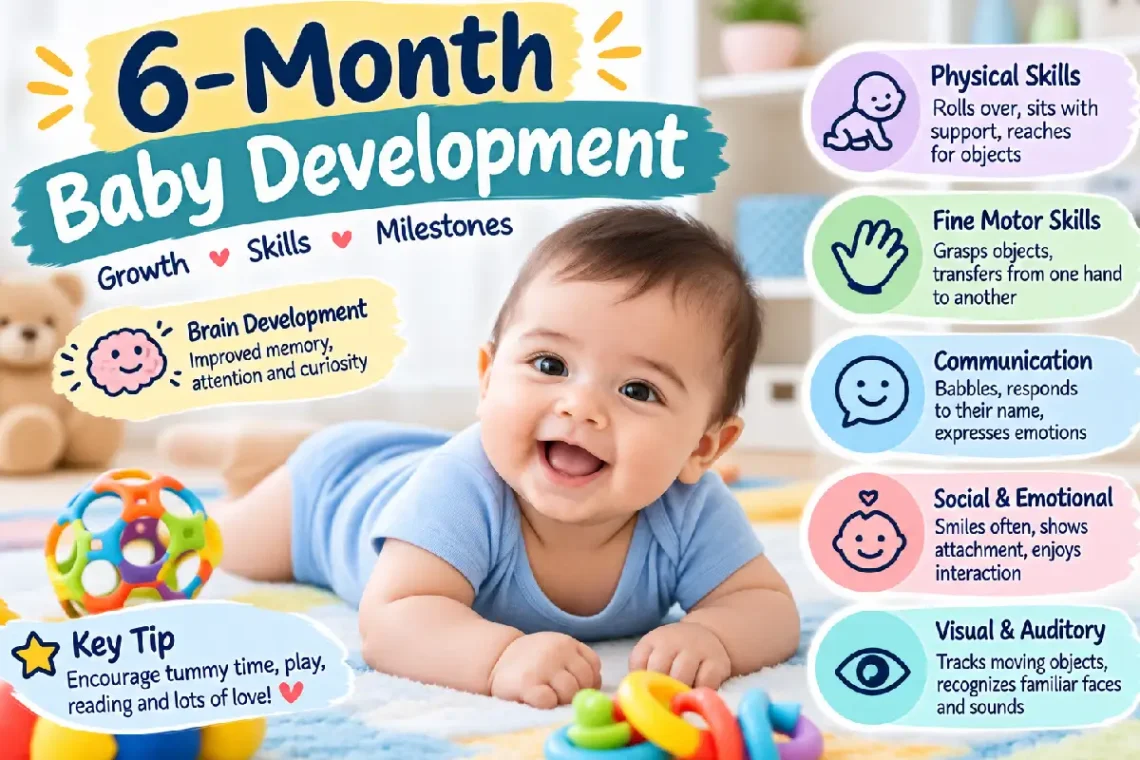
Your baby may look very different from the early months to the 6 months. They can sit on their own, touch toys, roll about, laugh, make more noises and are now very interested in the people and things around them. Changes in movement, communication, thinking and social skills are part of 6-Month Baby Development.
Each child is different.All babies grow at their own rate. Milestones can be helpful guides but not a deadline. You and your baby’s pediatrician will be able to get a good idea of your baby’s progress during regular well-child visits.
Physical Milestones at 6 Months
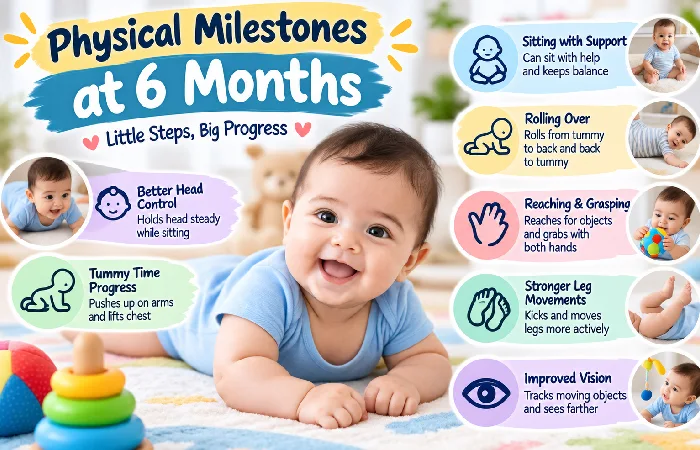
By 6 months, your baby’s head and body control are improved. They might be more active when tummy time and more interested in moving around.
Your baby might:
- Begins rolling from tummy to back and may start rolling in other directions
- Uses straight or almost straight arms to push up during tummy time
- Extends hands to grab nearby toys
- Approaches to feed his/her mouth
- Holds toys with their hands
- When supported is able to carry some weight on legs
- Sits with support or starts to sit unaided
Physical growth is another vital aspect of physical development. Your baby’s pediatrician will chart your baby’s weight, length, and head circumference as he grows, not by comparing the one measurement to another.
Babies are also being more active at this age, so ensure their play area is safe and hazard free of small objects or other choking hazards.
Cognitive Milestones at 6 Months
Your baby’s brain is hard at work forming connections! They are learning by observing, touching, listening and repeating.
A 6-month-old may:
- Be interested in the surroundings
- Watch objects closely
- Grab items they desire
- Use hands and mouth to explore toys
- Find an object that goes away from view
- Notice familiar people
- Enjoy cause-and-effect games
Your child might be learning to pick up toys again and again as he watches you doing it. It seems like a game made for tough babies and patience—but it’s just a straightforward method your baby can use to see that activities have consequences.
Provide safe objects for your baby to explore and lots of time to investigate.
Social and Emotional Milestones
Social development can begin to be seen by this age.
Your baby may laugh, smile, make noises to call your attention, and play with familiar people. They may also become more interested in mirrors and facial expressions.
You may notice:
- Increased smiling and laughing
- Having fun in social games.
- Charges of relating to familiar people more strongly.
- Interest in looking at faces:
- Reactions to various emotions
- Attempts to get your attention
Many games like peekaboo are particularly enjoyable since the baby is able to communicate with you as he or she learns that people and things can go out of sight and back in again.
React to your baby’s smiles, sounds and facial expressions. Easy back and forth exchanges promote early social communication.
Language and Communication
Babies are testing out their voice at 6 months.
Your baby may make various sounds, squeal, laugh, or react when you speak to your baby. They can also alternate with you in making sounds.
Communication can include:
- Laughing
- Squealing
- Repeatedly babbling or saying words over and over, or making repeated sounds.
- Responding to sounds
- To make sound effect to attract attention
- Facing familiar faces
Expressing excitement with body movements and sounds
Talk to your baby throughout the day. Explain actions and identify objects, and sing songs, and say something when they make sounds.
You can mimic some of your baby’s noises then stop. This helps teach the concept of taking turns when communicating.
Fine and Gross Motor Skills
Your baby is practicing fine motor skills and gross motor skills at 6 months.
Fine motor skills are smaller skills, particularly of the hands and fingers. Gross motor skills are the larger, arm, leg, neck and body movements.
| Skill Type | Examples at Around 6 Months |
| Fine motor | Reaching for toys and holding objects |
| Hand control | Moving objects from one hand toward the other |
| Gross motor | Rolling and pushing up during tummy time |
| Sitting | Sitting with support and developing better balance |
| Leg strength | Bearing some weight when held upright |
| Body control | Better control of the head and upper body |
Some skills may be learned later than 6 months than your baby’s ability. Some babies may be more interested in sitting and others may be determined to roll all over the room.
Provide them safe chances to practice instead of pushing them to achieve some milestone.
Activities for a 6-Month-Old Baby
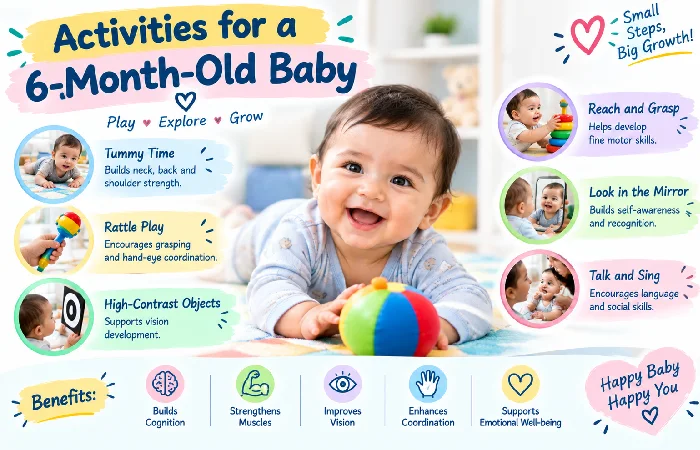
Toys and activities do not have to be costly to foster development.
Tummy Time
Now more, supervised tummy time while your baby is awake. Encourage reaching and movement by offering an interesting toy in front of them.
Read Together
Use bright coloured board books or books with basic illustrations. Point and say the names of pictures.
Even though your baby may not be able to get the meaning of the words at this stage, the repetition of hearing words is an important step in early communication.
Play Peekaboo
Place your hands over your face and then show your face smiling. Your baby might laugh and over time come to expect the next.
Encourage Reaching
Put a safe toy within your baby’s reach. Don’t give it to them right away; let them attempt to take it.
Sing and Talk
Sing songs, make funny sounds and talk about everyday activities.
Try saying things such as, “Here is your cup,” or “Let’s put on your socks.”
Safe Floor Play
Let your baby move about on a clean safe floor. Play on the floor offers practice opportunities for rolling, reaching, pushing and sitting.
Be sure to watch your baby while he/she is playing and keep small objects, cords, plastic bags, and other hazards away from him/her.
Signs of Healthy Development
Healthy development isn’t a checklist of items that need to be accomplished on a specific day.
Rather, seek a progressive change.
Your baby may be:
- Learning new movements
- Becoming more interactive
- Responding to sounds
- Being caring and interested in others
- Exploring objects
- Becoming more expressive
- Development of head and body control
- Learning new means of communication
A first step for parents is to be attuned to change over time.
For instance, your baby might require support when sitting and over time become more stable. They might begin with some sounds and gradually begin to use their voice more.
Development happens through many small steps.
The CDC’s guidelines are valuable resources for parents interested in knowing what many kids can do at various ages. It’s also important to talk about your baby’s growth at frequent pediatric checkups.
When to seek professional advice
Contact your child’s doctor if you are concerned about your baby’s development. If there is a concern, it is not necessary to wait for the next scheduled appointment.
Be especially aware of whether your baby is developing new skills over time or if he or she is losing a skill that he or she once had. It’s important to talk to a healthcare provider if any skills have been lost.
If you have any concerns about your baby’s: You might also want to talk to your baby’s doctor about:
- Movement
- Muscle strength
- Hearing
- Vision
- Communication
- Social interaction
- Feeding
- Overall development
Your pediatrician will also be able to check your baby’s development and determine if further screening or professional assistance is required.
Some parents compare their baby with other babies and videos on the internet. Don’t fall into the trap of worrying over those comparisons. Also two healthy babies can reach the same milestone at different times.
When to Seek Professional Advice
If you don’t feel comfortable, raise it.
The following may help to prepare for the appointment:
What you’ve seen:
- When you first noticed it
- What skills your baby has acquired
- Any skills that your baby has lost or forgotten
- Issues related to eating, sleeping, activity or communication
A short list will help you to communicate your concerns during the visit.
For reliable guidance on infant development and health, parents can visit HealthyChildren.org from the American Academy of Pediatrics.
Final Takeaway
The 6-Month Baby Development can be quite a great deal of exciting changes. Your baby will be stronger, more mobile, more social and more vocal. May roll, reach for toys, laugh, begin to make new sounds, and develop improved sitting and body control.
The best support is simple: talk to your baby, read to your baby, play with your baby, respond to their sounds, allow safe floor time and give your baby opportunities to explore.
First and foremost, keep the following in mind: development is not a race. Track your baby’s growth, make regular well-child visits and consult your pediatrician if there’s any concern.