
Last Updated: September 14, 2026
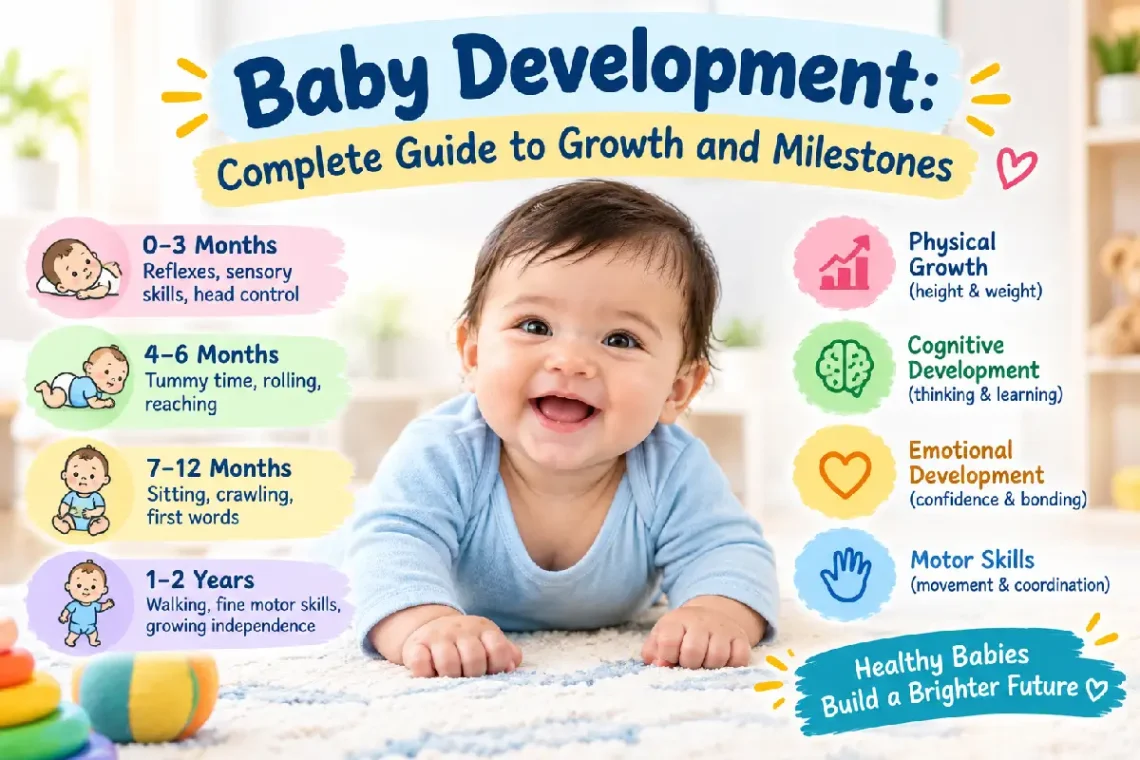
Everything you need to know about baby development during their first year Baby development happens so fast! Babies will have so many new skills and will reach all kinds of milestones throughout their first year of life. They will change a lot in those first 12 months – controlling their bodies, recognizing familiar faces and communicating, discovering their world, and becoming more and more social.
Parents ask us all the time questions like… When will a baby smile? When will a baby roll over, sit up and crawl? When will my baby say their first words? How many skills will my baby develop?
Babies all learn at different rates and some will sit earlier and some won’t roll until a little later but this is just normal.
Development by Age:
Baby development at 1 year old. Here’s what you need to know: What to expect baby development in the first year. Baby development milestones by age.
How to promote your baby’s development. When to seek advice.
What Is Baby Development?
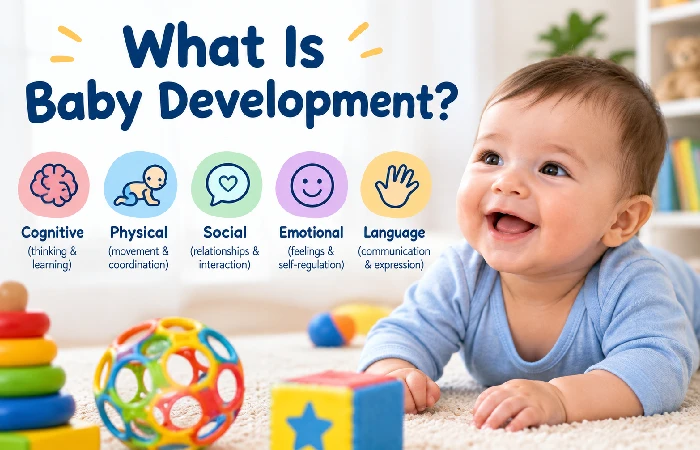
Understanding the development of a baby development is the physical, mental, emotional, social and communication development of a baby as they grow. Development occurs before a baby is born and happens throughout childhood but in the first year, baby’s development is very rapid.
Baby development includes several major areas:
- Physical development
- Cognitive development
- Social development
- Emotional development
- Language development
- Communication skills
- Gross motor skills
- Fine motor skills
These areas often develop together.
For instance, as their head control becomes more robust, they might sit up to get a better view of what’s around them. They will become more interested in the world around them as their eyesight and their attention span improve. They will be able to reach for toys, move around independently and interact with the world around them as their gross motor skills develop.
Development is a ‘steady process’.
Your baby doesn’t just suddenly become good at something at a single point in time. Most skills develop gradually by playing, exploring and practicing the skill repeatedly.
Baby Development Milestones by Age
Developmental milestones are skills that many babies develop during particular stages.
Milestones may involve:
- Movement
- Communication
- Social interaction
- Problem-solving
- Emotional responses
Common milestones during the first year include:
- Smiling
- Making sounds
- Holding up the head
- Rolling over
- Reaching for objects
- Sitting
- Babbling
- Crawling
- Responding to familiar people
- Using gestures
- Standing with support
- Saying simple words
However, babies do not all reach milestones at exactly the same age.
Why Milestone Timing Varies
Development can be influenced by many factors, including:
- Individual development
- Temperament
- Opportunities for movement and play
- Premature birth
- Health factors
- Family environment
All babies develop differently. One of your babies might have been an early crawler and then later delayed in talking, compared to other children, while one of your others might have had the opposite experience and learned to talk before he learned to crawl. It’s best to focus on your overall child’s pattern of development rather than searching for some fixed date.
Physical Development in Babies
Physical development refers to changes in a baby’s body as they grow.
During the first year, babies experience rapid increases in:
- Length or height
- Weight
- Head size
- Muscle strength
- Body control
Regular pediatric visits help monitor physical growth.
Head and Neck Control
Newborn babies have limited head control.
During the first months, muscles gradually become stronger.
Babies may begin to:
- Lift their heads briefly
- Turn their heads
- Hold their heads more steadily
Improved head and neck control supports later milestones such as sitting and moving.
Growth in Strength
As babies grow, their muscles become stronger.
They gradually gain better control of:
- Their head
- Neck
- Arms
- Hands
- Legs
- Core muscles
This increasing strength supports movement and exploration.
Body Awareness
Babies learn about their bodies gradually.
Baby steps. – Many young babies start out watching their hands. At some point, they’ll start to deliberately move their arms and legs, reach for things and wiggle their toes.
These things are just a normal part of physical and sensory development.
Cognitive Development in Babies
Cognitive development is when babies learn, think, remember, explore and understand.
1st Year It is a babies’ sensory and experiential learning.
Eventually babies start to notice patterns and routines.
They explore through:
- Looking
- Listening
- Touching
- Moving
- Tasting
- Repeating actions
Learning Through Observation
Babies spend a great deal of time watching the people and objects around them.
They may:
- Study faces
- Follow moving objects
- Watch caregivers
- Observe toys
- Notice changes in their environment
Over time, babies become more aware of patterns and routines.
Cause and Effect
As babies grow, they begin to understand that their actions can produce results.
For example, a baby may discover that:
- Shaking a toy creates a sound.
- Pressing something causes movement.
- Dropping an object makes it fall.
- Crying brings a caregiver closer.
Repeated experiences help babies understand cause and effect.
Object Permanence
Between the ages of 8-12 months – some babies start to make sense of what objects and people still exist even when they cannot be seen.
Social and Emotional Development
This is a significant milestone in a baby’s cognitive development.
Between the ages of 4-6 months – babies develop strong emotional attachments and attachments to the people they know.
Recognizing Familiar People
Young babies gradually become familiar with:
- Parents
- Caregivers
- Voices
- Faces
They may show greater comfort around familiar people.
Smiling and Social Interaction
One of the most exciting early milestones is the social smile.
Babies may begin smiling in response to:
- Familiar faces
- Voices
- Play
- Interaction
Smiling can encourage further communication between babies and caregivers.
Emotional Expression
Babies gradually communicate emotions through:
- Facial expressions
- Sounds
- Crying
- Smiling
- Body movements
As babies grow, their emotional responses may become more varied.
Separation Anxiety
When this occurs; Some babies develop anxieties when they are away from their parents or care providers. This often occurs later in their first year. This change in behavior might be mild or quite severe, which can be part of the normal development of social and emotional skills.
Language and Communication Development
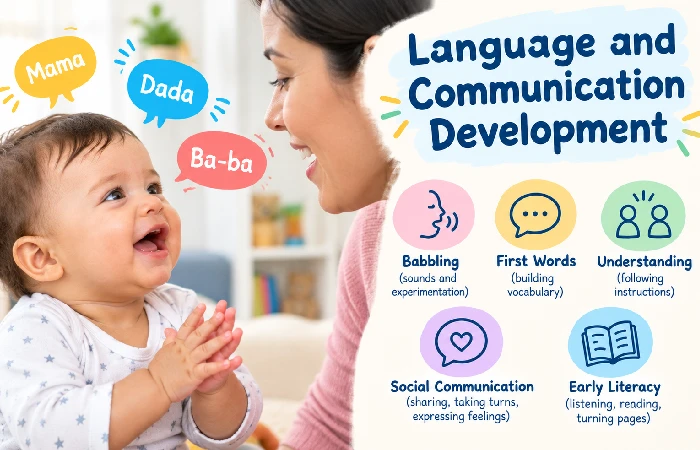
Babies begin communicating long before they say their first words.
Communication during infancy includes:
- Crying
- Facial expressions
- Eye contact
- Body movements
- Cooing
- Babbling
- Gestures
Early Communication
Newborn babies communicate many needs through crying.
Over time, caregivers may begin recognizing different patterns associated with:
- Hunger
- Tiredness
- Discomfort
- The need for attention
Cooing
During the first months, many babies begin making soft vowel-like sounds.
These sounds may be part of early communication.
Babbling
As babies grow, their sounds become more complex.
Babbling may include repeated sounds such as:
- Ba-ba
- Ma-ma
- Da-da
At first, these sounds may not have specific meanings.
However, babbling helps babies practice communication skills.
Responding to Sounds
Babies may gradually become more responsive to familiar voices and sounds.
They may:
- Turn toward sounds.
- Watch the speaker.
- Respond to their name.
- Attempt to imitate sounds.
Talking, singing, and reading to babies can provide valuable communication experiences.
Motor Skills Development
Motor development refers to a baby’s ability to control movement.
Motor skills are often divided into two categories:
- Gross motor skills
- Fine motor skills
Gross Motor Skills
Gross motor skills involve large body movements.
Examples include:
- Holding up the head
- Rolling
- Sitting
- Crawling
- Pulling up
- Standing
These skills develop gradually as babies gain strength and coordination.
Fine Motor Skills
Fine motor skills involve smaller movements, especially those involving the hands and fingers.
Examples include:
- Opening and closing the hands
- Reaching
- Grasping objects
- Transferring objects between hands
- Picking up small objects
Fine motor skills help babies explore their environment.
Baby Development From 0 to 3 Months
The first three months involve significant adjustment and rapid development.
| Development Area | Common Development |
| Physical & Motor Development | Begins to hold head up, pushes up on arms when prone, and lifts the head to 45 degrees when prone. |
| Cognitive Development | Begins to actively use arms and legs. Listens to sounds and tracks objects moving in the visual field. |
| Social & Emotional Development | Watches faces, follows moving objects with eyes, notices objects of interest, may turn toward familiar sounds. |
| Language & Communication | Begins to smile socially. |
Baby Development From 4 to 6 Months
Between four and six months, many babies become more active and interactive.
They often show increased curiosity about their surroundings.
| Development Area | Common Development |
| Physical & Motor Development | Supports head well, may start to roll over, push up in tummy position, sits with support and reaches for objects. |
| Cognitive Development | Looks for objects with hands and mouth, responds to clapping and familiar routines. |
| Social & Emotional Development | Smiles and laughs frequently, interacts with others and recognises familiar faces. |
| Language & Communication | Babbling expands and imitates sounds and gestures, responds when his name is called, sounds out new sounds. |
Baby Development From 7 to 9 Months
During this stage, many babies become increasingly mobile.
They may explore their environment more actively.
| Development Area | Common Development |
| Physical & Motor Development | May sit alone, crawl or scoot, transfer objects from hand to hand, and pull to move into new positions. |
| Cognitive Development | Will search for objects that are partially hidden, discover how objects work, and have a stronger understanding of cause and effect. |
| Social & Emotional Development | May want to cling to loved ones and become timid around strangers. |
| Language & Communication | Will imitate others’ sounds and gestures, respond when called by their name, and babble constantly. |
Baby Development From 10 to 12 Months
During the final months of the first year, many babies become increasingly independent.
They may move, communicate, and interact in more complex ways.
| Development Area | Common Development |
| Physical & Motor Development | Can pull to stand, may start crawling, cruise around furniture, stand supported, and even take first steps. |
| Cognitive Development | Finds hidden objects, imitates, can follow simple routines and commands, and starts to explore containers and objects. |
| Social & Emotional Development | Has preferences for some people, may become anxious when separated from primary caregivers and enjoys active interaction. |
| Language & Communication | Points or waves, responds to simple requests, and says a few words. |
How to Support Healthy Baby Development
Parents and caregivers play an important role in creating an environment that supports learning and development.
You do not need complicated activities or expensive toys.
Simple, everyday interactions can be highly valuable.
- Talk to Your Baby
Talk throughout the day.
Describe what you are doing.
For example:
- “We are putting on your socks.”
- “Let’s look at the book.”
- “Here is your toy.”
Hearing language can support communication development.
- Read Together
Reading introduces babies to:
- Sounds
- Words
- Pictures
- Communication
Choose age-appropriate books and allow your baby to explore them.
- Provide Supervised Tummy Time
Tummy time can help babies develop strength in their:
- Neck
- Shoulders
- Upper body
Always supervise your baby during tummy time.
- Encourage Safe Exploration
Babies learn through exploration.
Provide safe opportunities to:
- Reach
- Touch
- Move
- Observe
- Explore
As babies become mobile, make sure their environment is appropriately baby-proofed.
- Respond to Communication
Respond when your baby:
- Makes sounds.
- Smiles.
- Gestures.
- Looks at you.
This back-and-forth interaction helps support communication and social development.
- Play Together
Simple games can support development.
Examples include:
- Peekaboo
- Singing
- Clapping games
- Looking at pictures
- Rolling a soft ball
Play also provides opportunities for bonding.
- Support Healthy Sleep and Nutrition
Adequate sleep and appropriate nutrition are important for overall health and development.
Follow age-appropriate guidance regarding:
- Feeding
- Sleep
- Physical activity
- Avoid Comparing Babies
Every baby develops differently.
Comparing your baby to another child can create unnecessary worry.
Focus on your baby’s individual progress.
When to Talk to a Pediatrician About Development
Early guidance can help determine whether additional evaluation or support is needed.
Consider Talking to a Pediatrician If Your Baby:
- Does not seem to respond to sounds.
- Has difficulty making eye contact.
- Loses skills they previously had.
- Has significant difficulty moving.
- Appears unusually floppy or stiff.
- Does not seem interested in interaction.
- Has difficulty feeding or swallowing.
- Shows significant delays in movement.
- Does not respond to familiar people or voices.
- Has other developmental changes that concern you.
This does not mean that every concern indicates a developmental problem.
However, discussing concerns early can provide reassurance and, when necessary, appropriate support.
Trust Your Observations
Parents and caregivers spend a great deal of time with their babies.
If something feels unusual or you are concerned about your baby’s progress, speak with a healthcare professional.
It is better to ask questions than to ignore ongoing concerns.
The Importance of Regular Pediatric Visits
Regular health visits provide opportunities to monitor:
- Growth
- Weight
- Physical health
- Development
- Feeding
- Sleep
Healthcare professionals may ask questions about your baby’s milestones and observe their movement and interaction.
These visits are also a good opportunity to discuss any concerns.
Consider keeping notes about:
- New skills
- Changes in behavior
- Communication
- Movement
- Feeding
- Sleep
This information can help you discuss your baby’s development more clearly.
Understanding Developmental Differences
Development does not follow exactly the same pattern for every baby.
Some babies develop certain skills earlier.
Others may take more time.
For example:
- One baby may roll early.
- Another may sit early.
- One may crawl early.
- Another may focus more on communication.
The order and timing of milestones can vary.
A single missed milestone does not necessarily indicate a problem.
Healthcare professionals consider the baby’s overall development, medical history, growth, and individual circumstances.
Creating a Healthy Developmental Environment
A healthy environment does not need to be complicated.
Babies benefit from:
- Loving relationships
- Responsive caregiving
- Safe exploration
- Conversation
- Play
- Reading
- Appropriate nutrition
- Adequate sleep
- Regular healthcare
Everyday simple interactions can be opportunities to learn with your baby. For instance, bathing, dressing, feeding and playing can all be opportunities for communicating and exploring.
Final Thoughts
10 things to do for healthy 1st year of baby do development 1st year of baby do development: you will be amazed at the changes What an extraordinary experience for you and your family. Your new family member will grow from an almost immobile and voiceless of a tiny 10 things to do for healthy 1st year of baby development
Above all, celebrate any progress you see, be happy for your baby’s newest achievements, ensure your baby is safe and secure and do not rush to any decision regarding your baby. If you have any questions related to your baby’s communication, physical development, hearing, vision or any other progress, speak with your doctor. Get more information about your baby’s growth so that you can relax knowing that your baby is in safe hands.