
Last Updated: September 15, 2026
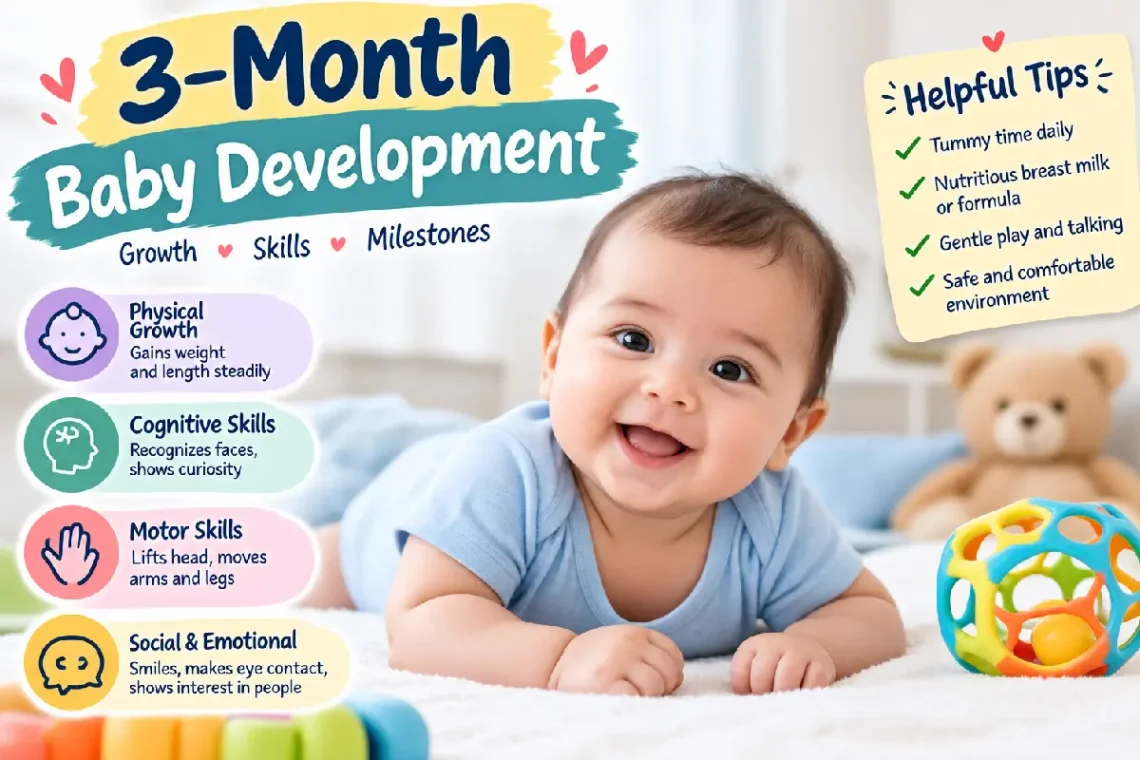
Your baby may be more alert, active and interested in everything they see at 3 months. Better head control, more movement, smiling, making sounds, and attention to people and objects may be involved in 3-Month Baby Development.
All babies grow at their own rate. For some babies, a milestone may occur sooner or later than for other babies. The most important thing is to observe your baby’s growth and learning over time.
Many babies are able to do certain things at a specific age and age milestones can guide parents, but age milestones should not replace routine medical care.
Physical Development at 3 Months
Babies are developing their body awareness and are stronger around 3 months.
Your baby might be able to hold their head up better when you’re holding them up, or when you do tummy time. They may also be more active with their arms and legs.
Some babies may:
- Hold their head more firmly
- Hold up their head and chest while doing tummy time
- Extend and bend their legs
- Use both arms and legs to move.
- Move his/her hands toward his/her mouth.
- Open and close their hands
- Look at their hands
- Become more interested in their surroundings
Tummy time is particularly beneficial for strengthening muscles. Never put your baby on their tummy to sleep, and only do tummy time when your baby is awake and supervised.
Cognitive Development at 3 Months
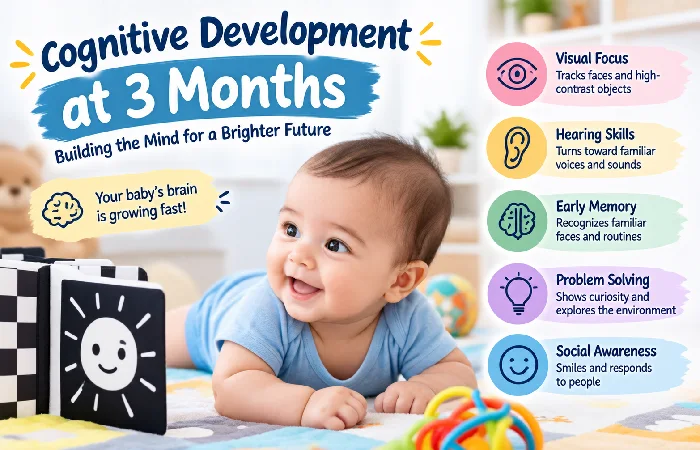
Your baby is learning so much in the first few months.
When your baby is about 3 months old, he may be able to look longer at faces, watch objects longer and respond more to sounds. May follow a moving person or toy with the eyes.
Your baby will be seen:
- Watch moving objects
- Look closely at faces
- Recognize familiar people
- Focus on colourful toys
- Explore their hands
- React to sounds
- Become interested in new sights
Discussions, singing, reading and pointing to various items can support early learning through simple activities.
You need not buy costly toys for teaching your child. You already have a great tool that you can use for learning – it’s your voice, face, and everyday interaction with others.
Social and Emotional Development
An increased level of socialization is one of the most fascinating alterations that occur at this age.
Your baby may smile more when you talk or interact with him. They may get excited if they see their familiar caregiver.
Some babies may:
- Smile at people
- Enjoy face-to-face interaction
- Calm when comforted
- Become excited when they see a familiar person
- Demonstrate varying responses to various situations
- Make sounds to call attention to what you are saying.
When your baby looks, smiles, cries or makes sounds, respond helps to create a sense of security.
If your baby makes a sound, try talking back to her. Although your baby can’t talk, these conversations are a precursor to communication.
Communication Milestones
Your 3-month-old is learning that some sounds can get him or her attention.
There may be increased cooing, gurgling or other soft noises heard. Your baby may drowse when you talk to him.
At this age, the child may begin to communicate in the following ways:
- Cooing
- Making soft sounds
- Crying for different purposes
- Responding to familiar voices
- Turning toward sounds
- Smiling during interaction
- Practising/sounding out words during play time
Talk to your baby throughout the day. Tell them what you are doing, sing some simple songs or read a short book.
There is no need to use ‘difficult’ vocabulary. Back and forth interaction and hearing your voice is beneficial for your baby.
Motor Skills at 3 Months
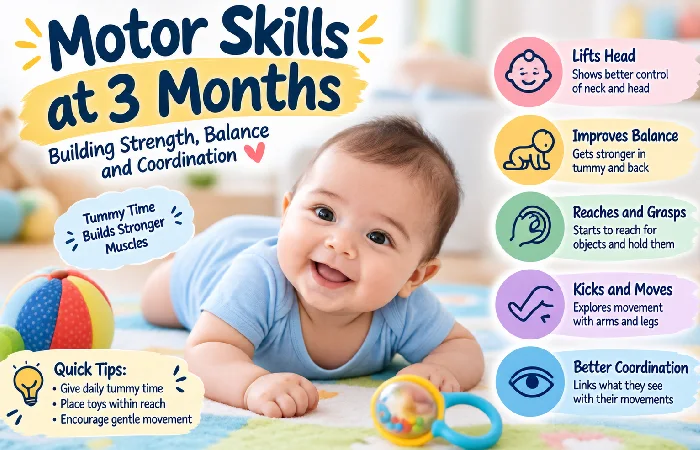
Motor development is closely related to physical development.
Your baby may be more able to hold his or her head and upper body at 3 months. They might push up with their arms or lift head and chest during supervised tummy time.
You may also notice more purposeful movements.
| Motor Skill | What You May Notice |
| Head control | Holds head steadier when supported |
| Tummy time | Lifts head and chest |
| Arm movement | Moves arms actively |
| Leg movement | Kicks and stretches legs |
| Hands | Opens hands and brings them toward mouth |
If your baby’s movements are not the same as another baby’s, don’t worry. Growth occurs at various rates.
Let your child’s doctor know if you are concerned about any movement, strength, or head control issues.
3-Month Baby Activities
There are simple activities you can do at home to facilitate development.
- Use Supervised Tummy Time.
Feed your baby on their tummy when awake and supervised. Be at their level and speak to them.
While encouraging them to lift and turn their head, you can put a safe toy in front of them.
- Talk Face-to-Face
Keep your baby close and talk to him/her. Take a break after speaking as if waiting for an answer.
When your baby makes a noise, do respond!
This produces a straightforward bounce-back with the person.
- Read a Short Book
Your baby doesn’t need to understand the story, but he can listen to your voice and look at pictures.
Select books featuring simple illustrations, images of faces and/or high-contrast patterns.
- Sing Together
Sing nursery rhymes or simple songs. Your infant can hear the beat and your voice.
Don’t be concerned with having a great voice. Your baby is not judging you!
- Place Baby Watch Safe Objects
Hold your baby securely and give him a chance to observe various objects in the room.
What Can a 3-Month-Old Baby Do?
Many babies are now more active and socially involved around 3 months.
Your baby could be able to:
- Smile during interactions
- Make cooing sounds
- Watch faces closely
- Follow moving objects
- Hold head more firmly
- When children are doing tummy time, lift their head up.
- Actively move arms and legs
- Recognize familiar voices
- Demonstrate curiosity about toys and environment
- Keep in mind: “Milestones are not a competition.
Some babies might be very vocal, while others might be more interested in moving. A baby might be especially fascinated with faces.
Speak with your pediatrician if your baby was born early if developmental milestones should be evaluated with corrected age.
When to Talk to a Pediatrician
Often parents ask themselves if their baby is developing as expected. Feel free to ask your pediatrician questions.
If you notice something that is worrisome, like your child losing a skill they once had, or a major concern with their ability to move, hear, see, communicate or interact socially, talk to your child’s health care provider.
Developmental issues should also be discussed at routine well-child checks.
Developmental Surveillance is part of pediatric care throughout a child’s life, and formal developmental screening is recommended at certain ages; (AAP 2002).
Avoid waiting for a milestone list to determine if there is a problem. Remember, you know your baby best, so say anything that seems unusual or of concern.
A Simple Parent Check-In
- Rather than asking “Is my baby on time?,” ask:
- Am I helping my baby to learn new skills?
- Is my baby more interactive?
- Does my baby listen? Does my baby react to voices and sounds?
- Are there changes in movement that happen over time?
- Have they lost any skills they previously had?
- Are there any issues I need to discuss with the pediatrician?
These questions will help you get a clearer picture of your baby’s development.
For trusted information on developmental milestones, parents can refer to the CDC’s Developmental Milestones.
Final Takeaway
The 3-Month Baby Development stage is exciting, and can be three months. Your baby might smile more, make new sounds, watch things, move more and develop head control.
Talk, read, sing, play, respond—and provide lots of safe space for your baby to move and explore are the very simple ways to support development.
All babies grow at their own rate. Make sure to visit your baby’s doctor regularly, monitor your baby’s development and share your concerns with your baby’s healthcare provider.