
Last Updated: September 14, 2026
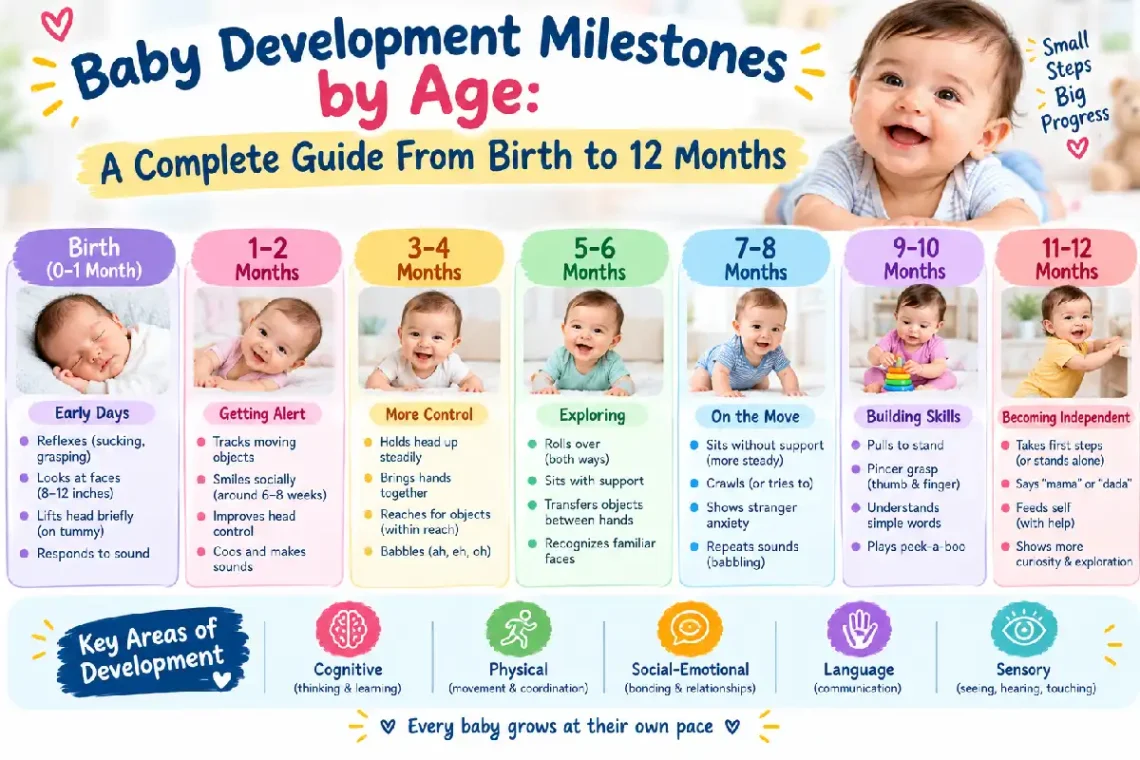
Celebrating baby’s progress – what to look out for in baby development Baby’s first year is such an exciting time and you can look forward to baby gradually learning how to move, communicate, interact with people and the world around them and express their needs. Baby development milestones are what this can look like.
Possible questions from mums: When do baby smile?
When do babies roll, sit?
When do babies crawl?
When do babies babble or say a first word?
However, babies are individual and may be a little ahead or behind of milestone stages, or may achieve milestones in different order than others.
What Are Baby Development Milestones?
Developmental milestones for babies are skills and abilities that most babies develop as they grow. These milestones can occur in several areas, including:
- Physical development
- Motor skills
- Cognitive development
- Language and communication
- Social development
- Emotional development
Milestones may not be achieved all at once.
For instance, a baby first needs to gain head and trunk control and strength before they can sit. They might cry and coo and listen and babble before they are able to use real words.
Milestones are a general guide of how a child’s development progresses. This information is a useful tool for parents and clinicians to see where babies are in terms of their development. But, babies aren’t all exactly on the same schedule!
Why Do Babies Develop at Different Rates?
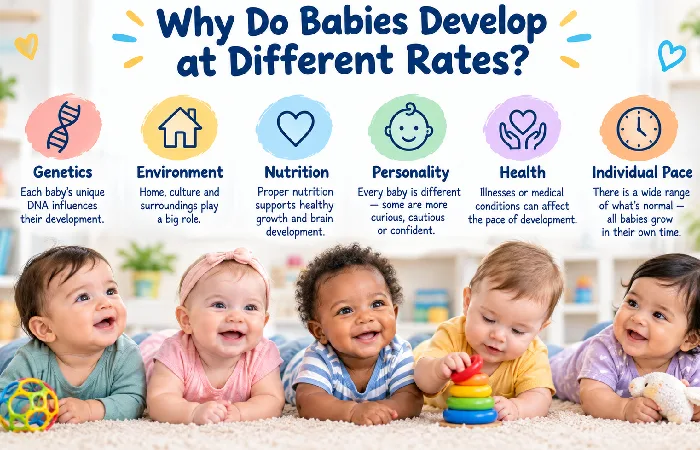
Development can vary because of several factors, including:
- Individual differences
- Temperament
- Opportunities for play and movement
- Premature birth
- Health factors
- Family environment
Age milestones can vary: Your baby may reach some milestones before or later than another baby. The overall direction of development is usually more significant than comparing your infant with another baby.
Physical Milestones
This refers to your baby’s growing size, strength, coordination and movement. Your baby will develop physical control of his or her body over the first year, including:
- Improved head control
- Rolling over
- Sitting
- Crawling or other forms of movement
- Pulling to stand
- Standing with support
- Taking early steps
Head Control
Newborns can only lift their head for a few seconds at a time. Baby’s neck and upper-body muscles slowly strengthen over the first months of life. Your baby might be able to lift his head up briefly at first, but will then progress to holding his head more steady.
Rolling Over
Rolling is an important motor milestone.
Many babies first learn to roll in one direction before developing the ability to roll in both directions.
The exact timing varies.
Sitting
Babies usually develop sitting skills gradually.
They may first:
- Sit with support
- Lean forward while sitting
- Use their hands for balance
Crawling and Movement
Not every baby crawls in the same way.
Some babies may:
- Crawl on hands and knees
- Scoot
- Roll
- Move backward
- Use other methods to move
Some babies may not crawl before beginning to stand and walk.
Cognitive Milestones
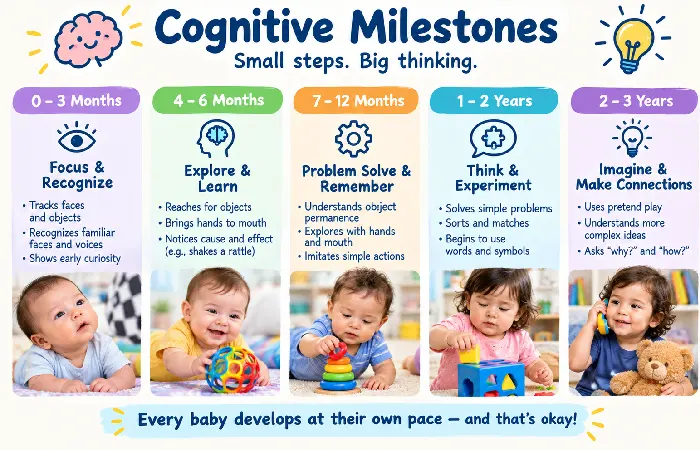
Cognitive development is how babies learn, think, remember, explore and understand their world. In the first-year babies learn mainly through touch and experience. Young babies are usually more and more interested in the faces of people.
Recognizing Faces and Objects
They may:
- Watch caregivers
- Study facial expressions
- Follow moving objects
- Recognize familiar people
Exploring Through the Senses
Babies learn by:
- Looking
- Listening
- Touching
- Moving
- Tasting
As babies grow, they actively explore objects.
They may shake toys, bang objects together, or put safe objects into their mouths.
Understanding Cause and Effect
Over time, babies begin to notice that their actions can produce results.
For example, they may learn that:
- Shaking a toy creates a sound.
- Dropping an object makes it fall.
- Pressing something causes a reaction.
This is an important part of early learning.
Searching for Hidden Objects
Later in infancy, babies may begin looking for objects that disappear from view.
This reflects a growing understanding that objects can continue to exist even when they cannot be seen.
Language Milestones
Babies begin developing communication skills long before they speak.
Language development includes:
- Listening
- Responding to sounds
- Making sounds
- Babbling
- Understanding familiar words
- Using gestures
- Saying early words
Crying as Communication
During the newborn stage, crying is one of the main ways babies communicate.
Babies may cry because of:
- Hunger
- Tiredness
- Discomfort
- The need for attention
Caregivers often become familiar with their baby’s communication patterns over time.
Cooing
During the first months, many babies begin making soft vowel-like sounds.
These sounds are often called cooing.
Babbling
As babies grow, their sounds become more varied.
Babbling may include repeated sounds such as:
- Ba-ba
- Ma-ma
- Da-da
Initially, these sounds may not have a specific meaning.
However, babbling helps babies practice communication.
Gestures and Early Words
Toward the end of the first year, some babies may use gestures.
Examples include:
- Pointing
- Waving
- Reaching
Some babies may also begin saying simple meaningful words.
Social and Emotional Milestones
During the first year, babies gradually become more socially aware.
Recognizing Familiar People
Babies may become increasingly familiar with:
- Parents
- Caregivers
- Voices
- Faces
They may show greater comfort around familiar people.
Smiling
One of the early social milestones is the social smile.
Babies may smile in response to:
- Familiar faces
- Voices
- Playful interaction
Enjoying Interaction
As babies grow, they may become more interested in playing and interacting with others.
They may:
- Laugh
- Smile
- Respond to playful games
- Enjoy attention
Stranger Awareness and Separation Anxiety
Caution around new people. During the 2nd half of the first year, some babies show a more wary approach to people they do not know. They may also become distressed when apart from a familiar carer.
Baby Development Milestones by Age
| Physical and Motor Skills | Communication and Social Skills | Cognitive Skills | Age Range |
| Rocks or rolls over, lifts up on arms and legs, lifts head a few seconds. Unsupported sit, may roll over from tummy to back. Achieves stable head control, moves arms and legs | Cries to communicate, coos, makes eye contact and may smile 2-4 months | Watches face and watches movement | Birth to 3 Months |
| May roll, reaches for toys, sits with support. | Laughs, babbles, responds to voices, interacts in play 4-6 months | Reaches for objects and starts to understand cause and effect | 4 to 6 Months |
| Provides assisted sitting, attempst to crawl and scoot, transfers objects from hand to hand | Responds to name, babbles a lot, recognizes some people 6-12 months | Looks for partially hidden objects and explores toys | 7 to 9 Months |
| Unsupported sit, may crawl, pull to stand, cruise, supported walking | Uses gestures, may be saying some words, looks for toys from across the room, explores new objects and situations. | Looks for hidden objects and copies actions | 10 to 12 Months |
Common Developmental Areas During the First Year
| Development Area | Examples of Baby Milestones |
| Physical Development | Better head and body control, body size, and strength |
| Gross Motor Skills | Rolling, sitting, crawling, pulling to stand, walking a little ways |
| Fine Motor Skills | Reaching and grasping, passing objects from hand to hand, starting to pick up objects with fingers |
| Cognitive Development | Exploring and recognising familiar faces, cause and effect |
| Language Development | Cooing and babbling, responding to sounds, gestures and early words |
| Social Development | Smiling and recognising familiar people, responding happily to being spoken to and played with, developing strong attachments, sucking and swallowing |
| Emotional Development | Smiling and engaging with people, using signs and words, experiencing feelings |
When a Baby May Need Developmental Support
Different babies develop at different times so the fact that one is slower in a particular milestone doesn’t necessarily indicate a problem.
Consider Talking to a Pediatrician If Your Baby:
- Does not seem to respond to sounds.
- Does not appear to notice people or surroundings.
- Has difficulty making eye contact.
- Has significant difficulty moving.
- Appears unusually floppy or stiff.
- Does not seem interested in interaction.
- Has difficulty feeding or swallowing.
- Is not making progress in important developmental areas.
- Loses skills they previously developed.
Loss of Skills Should Be Discussed Promptly
If your baby loses a skill they previously had, for instance if they were babbling, socializing, or using a movement skill and then suddenly lose it, you should consult your health care provider.
Early Support Can Be Helpful
Depending on the situation, support may involve professionals such as:
- Pediatricians
- Developmental specialists
- Physical therapists
- Occupational therapists
- Speech and language specialists
Early evaluation can help families understand their baby’s individual needs.
Final Thoughts
Baby development milestones help you understand the huge changes that take place in the first year. Babies learn to be physically strong and motorically skillful, think, learn to speak and form relationships with you and others.
From the time your baby is able to hold their head up, sit, babble, crawl, gesture and say those very first words; Baby’s got something new to do at each and every step.
Don’t forget that these milestones are guidelines – babies all learn at different rates. They may appear to miss them, that’s normal. The key is to look at your whole baby and provide opportunities for movement and communication, lots of safe opportunities to explore, and love and nurture and see how your baby goes.
If you’re concerned about your baby’s learning, trust the judgment of your instincts, and discuss your concerns with your health professional. They are there to help you – early intervention can make a big difference.
Supporting your baby’s growth through the first year with love, care, routine and lots of movement and communication is what makes the biggest difference.