

Last Updated: September 14, 2026
Baby Years 1-6 Month: This is a time of such growth and discovery for your baby. From the first smiles and coos to sit, crawl, point, and maybe take a first step or two, your baby is discovering new skills at every stage of their babyhood.
What should my baby be doing? Your baby may hit one milestone earlier in the month and another one later. Monthly milestone guides are a helpful general rule but your baby’s development can differ from others.
Development includes several important areas:
- Physical and motor development
- Cognitive development
- Language and communication
- Social and emotional development
1-Month Baby Milestones

First Babies are busy getting used to life in the world outside the womb. During this month your new baby will spend a lot of time sleeping and being fed, but already she will also be beginning to respond to some of the things around her.
Common 1-Month Milestones
A 1-month-old baby may:
- Move arms and legs.
- Turn their head.
- Briefly lift their head while lying on their stomach.
- Look at nearby faces.
- Respond to familiar sounds.
- Focus on objects at close range.
- Communicate primarily through crying.
Babies at this age have limited head control and need proper support for the head and neck.
Development at 1 Month
| Development Area | Common Milestones |
| Physical | Moves arms and legs and may briefly lift the head |
| Cognitive | Begins noticing faces, lights, and nearby objects |
| Communication | Cries to communicate needs |
| Social | May briefly focus on familiar faces and voices |
2-Month Baby Milestones
Babies will be more awake and engaged. They are likely to be watching what is going on around them and engaging more with you.
Common 2-Month Milestones
A 2-month-old may:
- Begin smiling socially.
- Make simple cooing sounds.
- Look at faces.
- Follow moving objects with their eyes.
- Hold their head up briefly.
- Move arms and legs more actively.
- Become calmer when comforted.
Interaction is still key and chatting and smiling at your baby can be a way of continuing to create communication and interaction.
3-Month Baby Milestones
Three months – you’ll notice more movement and interaction. A lot of babies are starting to move more and take more of an interest in the world around them by three months.
Common 3-Month Milestones
A 3-month-old may:
- Hold their head up for longer.
- Push up slightly during tummy time.
- Follow moving objects.
- Open and close their hands.
- Bring hands toward the mouth.
- Smile and respond to interaction.
- Make cooing sounds.
- Recognize familiar voices.
Babies may also begin showing excitement when they see familiar people.
Development at 2 to 3 Months
| Development Area | Common Milestones |
| Physical & Motor | Improved head control and stronger movements |
| Fine Motor | Opens and closes hands and brings hands toward the mouth |
| Cognitive | Watches movement and recognizes familiar faces |
| Communication | Begins cooing and responding to voices |
| Social | Smiles and enjoys interaction |
4-Month Baby Milestones
Your baby might be curious about objects and start reaching for the things around them. Babies may become more curious about objects and begin reaching for things around them.
Common 4-Month Milestones
A 4-month-old may:
- Hold their head steadily.
- Push up on their arms during tummy time.
- Reach toward objects.
- Bring objects toward their mouth.
- Smile and laugh.
- Make more sounds.
- Respond to familiar voices.
Some babies may begin rolling over during this period.
Babies also become more interested in toys and may actively try to touch or grasp them.
5-Month Baby Milestones
At five months, many babies continue developing strength, coordination, and social skills.
They may become more active during play and show increased interest in their surroundings.
Common 5-Month Milestones
A 5-month-old may:
- Reach for and grasp objects.
- Bring toys to their mouth.
- Roll over.
- Push up during tummy time.
- Sit with support.
- Laugh and smile.
- Babble and experiment with sounds.
- Recognize familiar people.
Babies may also begin showing stronger preferences for favorite toys or people.
6-Month Baby Milestones
By six months, many babies have developed greater body control and may become increasingly interested in exploring.
Common 6-Month Milestones
A 6-month-old may:
- Roll over in one or both directions.
- Sit with support.
- Reach for objects.
- Transfer objects between hands.
- Explore objects with the mouth.
- Babble.
- Respond to sounds.
- Recognize familiar people.
Development at 4 to 6 Months
| Development Area | Common Milestones |
| Physical & Motor | Better head control, Rolls, pushes up, and sits with support |
| Fine Motor | Reaches for, grabs, and manipulates toys and transfers objects between hands |
| Cognitive | Explores toys and understands cause and effect |
| Communication | Laughs, babbles, and listens to sounds |
| Social | Looks for familiar people and interacts with others |
7-Month Baby Milestones
They may spend more time exploring objects and moving around.
Common 7-Month Milestones
A 7-month-old may:
- Sit with little support.
- Reach for objects.
- Transfer objects between hands.
- Explore objects.
- Babble frequently.
- Respond to familiar voices.
- Recognize caregivers.
Some babies may begin attempting to move across the floor.
8-Month Baby Milestones
By eight months, many babies are developing greater independence.
Movement and exploration often become more important.
Common 8-Month Milestones
An 8-month-old may:
- Sit independently.
- Move around on the floor.
- Begin crawling or scooting.
- Reach for desired objects.
- Search for partially hidden objects.
- Respond to their name.
- Babble using different sounds.
Some babies may become more cautious around unfamiliar people.
This can be a normal part of social and emotional development.
9-Month Baby Milestones
At nine months, babies often become highly active and increasingly aware of their surroundings.
Common 9-Month Milestones
A 9-month-old may:
- Sit independently.
- Crawl or use another method of movement.
- Pull toward standing.
- Transfer objects between hands.
- Look for objects that disappear.
- Respond to their name.
- Babble frequently.
- Show preferences for familiar caregivers.
Babies may also enjoy games such as peekaboo.
Development at 7 to 9 Months
| Development Area | Common Milestones |
| Physical & Motor | Sits independently, crawls or scoots, and may begin pulling up |
| Fine Motor | Transfers objects and uses hands to explore |
| Cognitive | Searches for partially hidden objects and understands simple cause and effect |
| Communication | Responds to name and babbles frequently |
| Social | Shows attachment to caregivers and may become cautious around strangers |
10-Month Baby Milestones
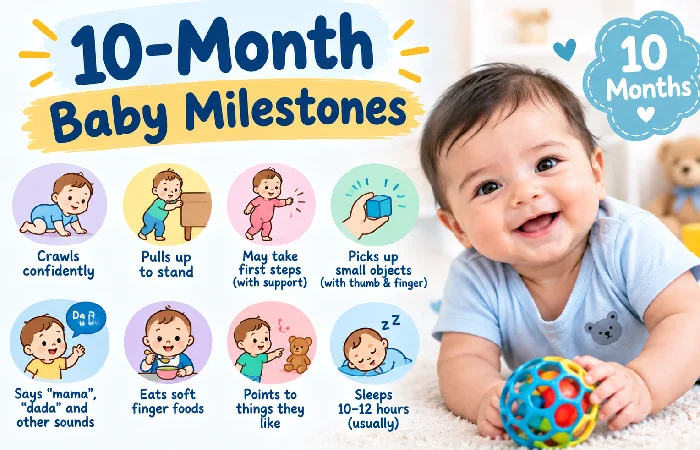
At ten months, many babies become increasingly mobile.
They may also show stronger problem-solving abilities.
Common 10-Month Milestones
A 10-month-old may:
- Crawl.
- Pull to stand.
- Move along furniture.
- Sit independently.
- Pick up smaller objects.
- Place objects into containers.
- Search for hidden objects.
- Imitate simple actions.
- Use gestures.
Communication may also become more intentional.
11-Month Baby Milestones
At eleven months, babies may become increasingly independent.
They may spend more time exploring their environment and interacting with people.
Common 11-Month Milestones
An 11-month-old may:
- Crawl or move independently.
- Pull to stand.
- Cruise along furniture.
- Stand briefly with support.
- Use fingers more precisely.
- Understand familiar routines.
- Respond to simple requests.
- Use gestures such as waving.
- Imitate actions.
Some babies may begin attempting to say simple words.
12-Month Baby Milestones
The first birthday marks an important developmental stage.
By 12 months, many babies have developed a wide range of physical, cognitive, social, and communication skills.
Common 12-Month Milestones
A 12-month-old may:
- Crawl or move independently.
- Pull to stand.
- Cruise along furniture.
- Stand with support.
- Take supported steps.
- Possibly take independent steps.
- Pick up small objects.
- Put objects into containers.
- Look for hidden objects.
- Imitate actions.
- Use gestures.
- Understand simple words.
- Say one or more meaningful words.
Not every baby will walk independently at 12 months.
Some babies take longer to develop walking skills.
Development at 10 to 12 Months
| Development Area | Common Milestones |
| Physical & Motor | Crawls, pulls to stand, cruises, and may take early steps |
| Fine Motor | Picks up small objects and places items into containers |
| Cognitive | Searches for hidden objects and imitates actions |
| Communication | Uses gestures, understands familiar words, and may say simple words |
| Social & Emotional | Shows preferences for caregivers and enjoys interactive play |
When Should You Talk to a Pediatrician?
Developmental timelines vary, but parents should discuss concerns with a pediatrician.
Consider seeking professional advice if your baby:
- Loses skills they previously had.
- Does not seem to respond to sounds.
- Has significant difficulty moving.
- Appears unusually floppy or stiff.
- Has difficulty interacting with others.
- Does not make progress in important developmental areas.
- Has significant feeding or swallowing difficulties.
A developmental difference does not automatically mean there is a serious problem.
However, early discussion with a healthcare professional can provide reassurance and support.
Final Thoughts
These baby milestones by month can assist you in tracking the various milestones for your baby. From head control and social smiles to rolling, sitting, crawling, gestures and speech, babies will develop skills in many different areas. Please bear in mind that these milestones are only a guide and each baby develops at their own pace, there is no “deadline” for a particular milestone so rather than comparing your child to another always remember your baby will develop at his/her own unique pace.
Show Love, be responsive, be in a safe and stimulating environment, talk, smile, meet in the eye and visit your doctor regularly.
If you feel worried, believe yourself and talk to the doctor.