
Last Updated: September 14, 2026
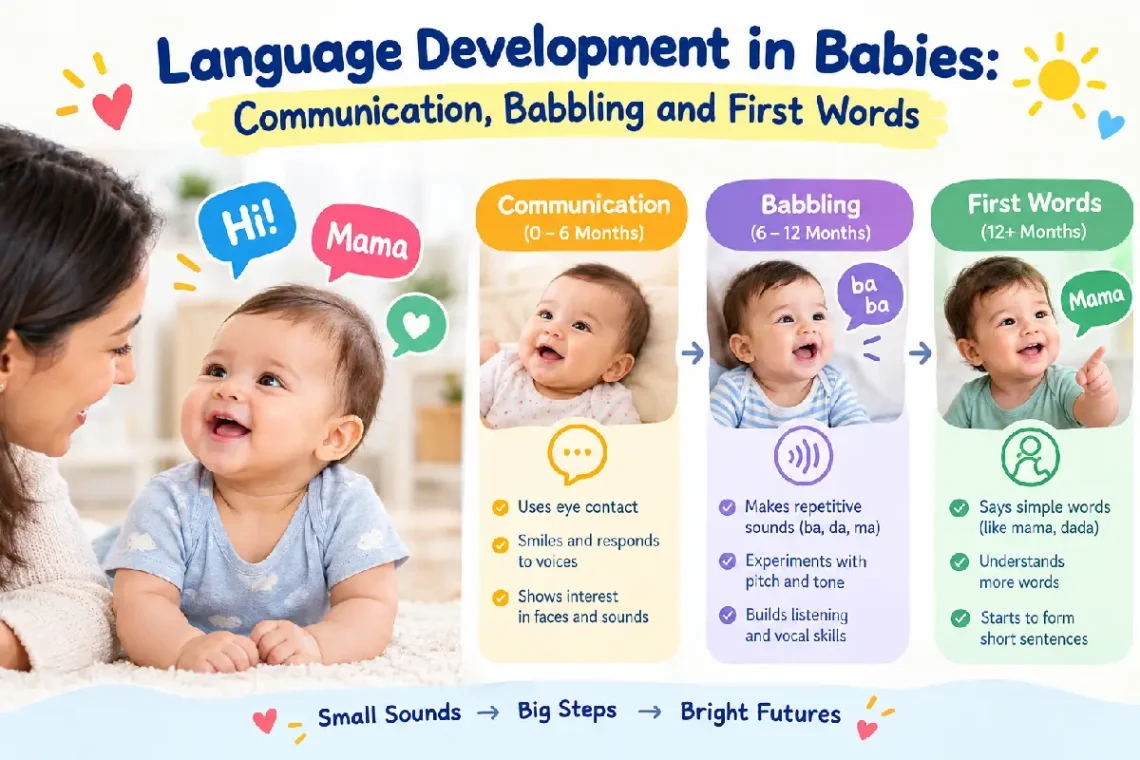
The stages of language acquisition in infants begin long before an infant learns their first word. Infants listen to people speaking, react to sounds, observe people around them, and cry and gesture as a means of communication.
In the first year of a baby’s life, they become capable of developing communication to a higher level than simply crying. From crying, infants learn how to coo and babble, how to respond to voices and words that are familiar to them, and communicate by gestures or words.
The queries about when babies will start babbling, what babies are expected to do at six months old, and when babies will speak their first words are really normal and understandable questions.
What is important to bear in mind is that all children develop independently. Some kids become capable of babbling and making many different sounds, but some kids like just listening and watching.
Attention: These milestones of language acquisition are only recommendations. All kids develop independently. If you are concerned about possible hearing or language development problems, you should visit your pediatrician.
How Babies Develop Language
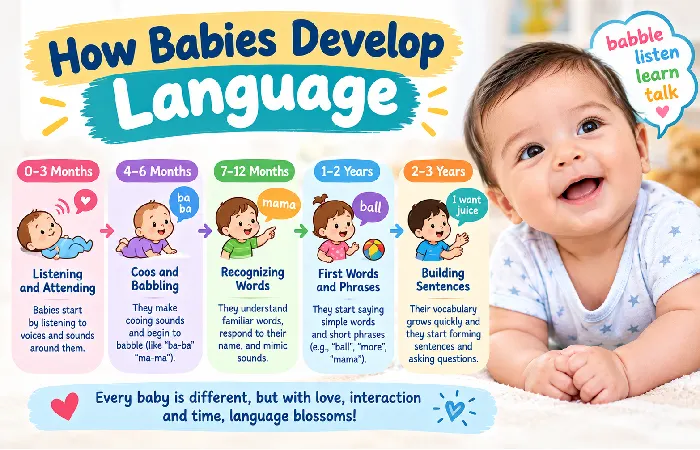
Language development is a gradual process. Babies learn about communication through listening to those around them as well as being part of communication interactions.
Prior to babies learning how to use words, there are other important communication skills that they will learn.
These include:
- Being able to listen to the voice
- Being able to recognize familiar sounds
- Being able to watch the face
- Eye contact
- Taking turns
- Making sound
- Responding to sounds and voices
- Gestures
Language development includes both receptive communication and expressive communication.
Receptive Communication
Receptive communication means the ability to understand language.
Prior to using words, babies might already start recognizing:
- Familiar voice
- Their names
- Recognizing common sounds
- Commonly used words
- Recognizing everyday routines
Expressive Communication
Expressive communication includes the way babies communicate with others.
This includes:
- Crying
- Facial expressions
- Cooing
- Babbling
- Gestures
- Early words
Language development is a gradual process as babies gain more experience interacting.
Early Communication Skills
Children Communicate From Birth
Although children cannot talk from birth, they can communicate their needs and responses to their caregivers.
Crying
Crying can be considered to be one of the first ways through which communication takes place.
The reasons why babies cry can include:
- Being hungry
- Being tired
- Being uncomfortable
- Being over-stimulated
- Seeking comfort
Over time, the caregiver learns what the baby’s needs are.
Eye Contact
As children grow older, they develop an increasing interest in faces.
Eye contact can be a very important way of communicating for babies.
Babies might:
- Maintain eye contact
- Gaze at faces
- React to smiles
- Become interested in face-to-face communication
Facial Expressions
Children might also use facial expressions to communicate their emotions.
They can express the following emotions:
- Happiness
- Excitement
- Discomfort
- Frustration
- Interest
Turn Taking
It is a two-way process when communicating.
If a baby makes some noise and receives a response, the baby will react to that response.
These types of interactions help children learn communication.
Baby Sounds and Babbling
Infants learn to go from crying to producing different types of sounds.
These sounds are extremely important for the development of language.
Cooing
In the first few months of their lives, babies begin producing certain vocal sounds.
Some of these sounds might include:
- “Ahh”
- “Oo”
- “Eeh”
It is called cooing.
Such sounds might be produced by the babies when they are:
- Happy
- Conscious
- Communicating with their carers
Sound Experimentation
As the babies get older, they begin experimenting with their sounds.
They will:
- Cry
- Laughs
- Make loud sounds
- Experiment with pitch
Through sound experimentation, babies learn how to control their sounds.
Babbling
Older babies often start babbling.
The repetitive sounds that they produce might be:
- Ba-ba-ba
- Ma-ma-ma
- Da-da-da
Initially, these sounds do not have any specific meanings.
However, babbling helps develop speaking skills.
Why Is Babbling Important?
Through babbling, babies practice:
- Movement of lips
- Movement of tongue
- Voice control
- Sound production
Furthermore, babies listen to the sounds and languages around them.
First Words
There is a lot of excitement on the part of the parents when expecting the baby’s first word.
However, language acquisition takes place even before this.
Before speaking their first word, the baby would have:
- Listened to language.
- Distinguished sounds.
- Cooed.
- Babbled.
- Gestures made.
- Words understood.
When do Babies speak their First Words?
Some babies utter first words at the end of the first year.
Nonetheless, this period differs from one baby to another.
The first words could be names for familiar objects or people.
In order to qualify as a word, there is consistency in the use of the word by the baby to communicate something.
Consistent use of a particular sound to communicate a familiar object indicates intentional communication.
Words Are Not the Only Way of Communicating
Gestures play a great part too.
The baby could communicate through:
- Pointing.
- Waving.
- Reaching out.
- Lifting objects.
- Fixing gaze on the object.
Understanding Language
However, infants may start understanding language even if they cannot yet talk.
Such a process is known as receptive language development.
Responding to Familiar Voices
In their first months of life, infants may become familiar with the voices they hear often.
Their response could be:
- Turning toward the speaker
- Becoming silent
- Getting excited
Responding to Their Name
Infants become more developed later in infancy and may start responding to their names.
They could turn their heads toward the speaker or even look at the speaker.
Understanding Words
Infants may start understanding commonly used words when they have accumulated some language experience.
Examples of such words could be those related to:
- People
- Eating
- Playing with toys
- Daily activities
Understanding Routines
Infants also get used to language through routine activities.
It means that infants hear similar words before:
- Eating
- Taking a bath
- Sleeping
- Going out
Language Milestones by Age
Language development changes rapidly during the first year.
The following table provides a general overview of common communication milestones.
| Age Range | Common Language and Communication Skills |
| Birth to 3 Months | Cries to communicate needs, listens to voices, may respond to sounds, makes eye contact, and begins cooing. |
| 4 to 6 Months | Laughs, makes a wider range of sounds, experiments with pitch and volume, and may begin babbling. |
| 7 to 9 Months | Babbles repeatedly, responds to familiar voices, may respond to their name, and uses sounds to gain attention. |
| 10 to 12 Months | Uses gestures, understands some familiar words, imitates sounds, and may begin using simple meaningful words |
Milestones should be viewed as general patterns rather than strict rules.
How to Encourage Baby Language Development

Parents or caregivers are essential in fostering communication in infants.
You don’t need any specific equipment or elaborate sessions.
Some basic ways are sufficient.
Talk to Your Infant Often
Talk all through the day.
Describe what you’re doing.
For instance:
- “It’s time to wear your socks.”
- “You are having your bottle now.”
- “Now look at that dog.”
Exposure to speech aids in building familiarity with sounds and words.
Answer Back to Your Infant’s Noises
Answer to your infant’s cooing or babbling.
You can:
- Smile at them.
- Mimic their noise.
- Have a conversation.
- And wait for another one.
It enables them to understand conversations.
Read Books to Your Child
Reading provides exposure to:
- Words
- Sounds
- Illustrations
- Linguistic rhythms
Use simple age-appropriate books.
You don’t have to follow the text literally.
Name things in the illustrations and point at them.
Sing Songs
Songs enable babies to enjoy:
- Rhythms
- Repetition
- Variety of sounds
Singing simple songs and rhymes may be fun activities that may include communication.
Have Eye Contact with Babies
Eye contact will help babies to learn how to:
- Use facial expressions
- Move their mouths
- Express emotions
Eye contact will help in communication and socialization.
Teach Babies Names of Everyday Objects
Names should be simple and relate to objects around your baby every day.
Examples of names which you can teach to babies are:
- Ball
- Cup
- Dog
- Book
Repetition will assist babies in learning new words.
Help Babies in Making Gestures
Gestures are an important aspect of communication.
Simple gestures that you can teach babies are:
- Wave
- Clap Hands
- Pointing
Express gratitude to your babies when they communicate.
Eliminate Background Noises
Background noises can hinder babies’ listening when they communicate.
Focus on Babies’ Interests
If babies show interest in anything, then talk about it with babies.
Example:
- “You have a ball.”
- “What a nice ball!”
Everyday Activities That Support Language Development
Language learning does not require structured lessons.
Daily activities can provide many opportunities.
| Daily Activity | How It Can Support Language Development |
| Feeding | Talk about food, describe actions, and respond to your baby’s sounds |
| Bath Time | Name body parts, toys, and actions |
| Getting Dressed | Describe clothing and simple actions. |
| Playtime | Name toys, imitate sounds, and encourage interaction. |
| Reading | Introduces words, sounds, pictures, and conversation |
| Outdoor Walks | Provides opportunities to name objects, animals, and sounds |
| Bedtime | Encourages calm conversation, songs, and reading |
Final Thoughts
Language acquisition in infants is a process that starts right after babies’ birth. While infants begin to speak only after some time has passed since their birth, language acquisition takes place much earlier – long before babies utter their first words.
The typical sequence includes crying, eye contact, cooing, babbling, gestures, recognition of some words, and uttering their first words.
All babies grow and develop in different ways, and some babies vocalize at an earlier age than others. Some babies vocalize a lot from their birth, and some babies tend to listen and watch longer before becoming vocal.
There are easy ways of how to help infants develop their language skills. The list of such activities includes talking, singing, reading books to babies, responding to their vocalizations, naming objects, and gesturing encouragement.
The key point is that every activity with a baby should bring joy to you. Every play and every reading session with a baby can be a great learning opportunity for them.
In case you have any concerns regarding hearing, communication, and language development of a baby, do not hesitate to consult a doctor.